Stainless Steel Animal Jewelry Manufacturer
Develop production-ready animal jewelry collections for OEM, ODM, private-label, wholesale, and multi-channel retail programs with Chicolink.
Chicolink Jewelry develops stainless steel animal jewelry for global B2B buyers from our factory in Dongguan, China.
- Translate animal artwork, silhouettes, reliefs, engraving, stones, and color details into manufacturable jewelry specifications.
- Develop pendants, necklaces, charms, earrings, rings, bracelets, sets, memorial jewelry, and approved pet-related products.
- Coordinate engineering, sampling, in-house PVD plating, bulk production, quality control, branded packaging, and shipment preparation.
- Control every approved SKU through drawings, BOMs, physical samples, color references, inspection requirements, and packaging versions.

Coordinate an Animal Jewelry Program Across Teams
We coordinate product planning, engineering, quotation, quality, packaging, and reorder data through one approved project specification. Each function receives defined inputs, approval points, and records before sampling and bulk production. This keeps artwork, commercial terms, quality criteria, and retail data aligned throughout the project.
Collection Planning
- Define animal themes, product formats, price levels, finishes, and launch phases.
- Separate core designs from seasonal or channel-specific variants.
- Count products, motifs, colors, sizes, stones, and packages as distinct SKU variables before development begins.
- Set approval gates for assortment, samples, packaging data, and launch readiness before adding further variants.
Engineering Review
- Check thin legs, tails, horns, wings, cutouts, recessed details, and attachment points.
- Review polishing, cleaning, plating, assembly, and inspection access.
- Record unresolved design assumptions before they become tooling or bulk-production risks.
- Return specific design alternatives when the original geometry conflicts with production, function, or inspection needs.
Commercial Control
- Quote from an identified material, size, weight, process, quantity split, finish, and package.
- Show how added motifs, colors, molds, stones, or labels affect cost and scheduling.
- Update the quotation basis when the approved scope changes.
- Separate one-time development charges from recurring unit, testing, packaging, and shipment cost elements where applicable.
Quality Alignment
- Define critical appearance, dimension, connection, function, and packaging checks by product type.
- Link inspection to approved drawings, physical samples, and written acceptance criteria.
- Coordinate customer-appointed inspection plans when arranged before shipment.
- Record nonconformity, disposition, rework, and reinspection against the affected SKU and production batch.
Retail Readiness
- Coordinate logos, jewelry cards, pouches, boxes, care cards, barcodes, SKU labels, and set assembly.
- Confirm product orientation and protection for ears, claws, antlers, stones, and polished surfaces.
- Match packing data to the approved product version.
- Use trial packing where product fit, barcode scanning, orientation, transit protection, or set completeness needs validation.
Reorder Management
- Retain approved specifications, samples, color references, packaging files, and production records.
- Identify a reorder by order, SKU, drawing, material, finish, and package version.
- Review changes in materials, processes, tests, quantities, or timing before repeating production.
- Flag discontinued components, revised requirements, or unavailable materials before confirming the next production baseline.
Build a Commercial Animal Jewelry Collection Architecture
We convert an animal theme into a defined product range before sampling. Each motif is linked to its product structure, process route, sales channel, and SKU rule. We also separate human-worn animal jewelry, memorial jewelry, and pet-use products because they require different specifications.
| Collection Direction | Suitable Product Formats | Development Focus | Commercial Control |
|---|---|---|---|
| Pet-inspired motifs | Pendants, necklaces, charms, earrings, rings, bracelets | Portrait simplification, paw or silhouette recognition, names, dates, engraving area | Separate standard motifs from customer-specific personalization data |
| Wildlife motifs | Pendants, signet rings, earrings, cuffs, statement charms | Horns, tails, claws, relief depth, weight, balance, edge treatment | Confirm which designs share size, finish, chain, and packaging |
| Marine collections | Charms, pendants, earrings, bracelets, sets | Thin fins, tentacles, shells, openwork, texture, stones, color filling | Plan a core capsule before adding multiple colors or sizes |
| Birds and insects | Studs, drop earrings, pendants, brooches if approved, charms | Wing detail, antennae, symmetry, left/right direction, lightweight structures | Define mirrored pairs and packaging orientation by SKU |
| Equestrian and farm themes | Pendants, tags, bracelets, rings, gift sets | Line-art readability, equipment details, engraving, attachment strength | Align motifs with gift, lifestyle, event, or licensed programs |
| Memorial and identification | Necklaces, ID pendants, keepsake charms, pet tags | Legible data, controlled personalization, polished edges, secure connection | Keep variable data, proof approval, and final inspection traceable |
| Zodiac or symbolic animals | Pendants, charms, earrings, rings, sets | Symbol consistency, cultural context, multi-SKU structure | Develop detailed zodiac systems on their dedicated project specification |
Define Customization and Its Commercial Impact
A new outline, relief, attachment, stone map, color area, or package can require a separate drawing, tool, sample, production lot, inspection method, or SKU. We document each option before confirming feasibility, price, quantity conditions, and timing.
| Custom Variable | Chicolink Can Review | Information Required | Possible Project Impact |
|---|---|---|---|
| Animal artwork | Silhouette, line art, relief, cutout, texture, or approved reference | Authorized artwork, intended size, front/back treatment, fixed details | Drawing time, detail revision, process route, tooling, sample |
| Product structure | Pendant, stud, drop, ring, bracelet, charm, set, or approved accessory | Dimensions, weight target, wearing direction, attachment, chain or finding | Components, assembly, comfort, inspection, MOQ |
| Personalization | Name, date, message, coordinates, portrait line art, ID data | Font, character set, data file, position, proof process | Data control, proof approval, engraving, final inspection |
| Surface design | Polish, brush, sandblast, texture, engraving, etching, or filling | Reference sample, artwork zones, viewing surface, acceptance criteria | Process sequence, masking, appearance standard, sample |
| Finish color | Bare steel, PVD gold, rose gold, black, or project-approved finish | Physical reference, substrate, quantity by finish, market, test request | Finish samples, separate processing lots, cost, timing, evidence scope |
| Stones or color details | Zircon, approved stones, resin, paint, or cold-enamel route | Type, size, color map, fixing method, quantity per motif | Stone seat, sourcing, assembly, adhesion check, packaging |
| Exclusive tooling | New mold, fixture, stamp, or dedicated structure | Drawings, forecast, ownership request, exclusivity terms | Engineering, tooling charge, sample rounds, volume requirement |
| Branding and packaging | Product logo, tag, card, pouch, box, barcode, or set | Brand files, dielines, SKU data, quantity, channel requirements | Separate sample, print MOQ, packing time, inspection points |
Select Materials for Structure, Use, and Market
We specify materials by component. The animal body, ear post, chain, jump ring, clasp, stone seat, spring, solder, and decorative material may differ. We select them from the product use, structure, process route, target market, finish, test request, cost target, and confirmed supply conditions.
| Material or Component | Typical Project Consideration | Animal Jewelry Application | Confirmation Required |
|---|---|---|---|
| 304 stainless steel | Broad supply and flexible processing for many fashion-jewelry structures | Cut, stamped, formed, machined, assembled, or plated animal designs | Grade, form, thickness, hardness, finish, use, market, tests |
| 316L stainless steel | Contains molybdenum and generally offers stronger pitting-corrosion resistance; harder processing may affect complex designs | Skin-contact or project-specified products after structure and process review | Grade evidence, machinability, component scope, finish, market, tests |
| Chains and findings | Chain profile, wire size, weld closure, clasp, jump ring, and pendant opening must work together | Animal pendants, charms, bracelets, layered products, memorial necklaces | Material, dimensions, finish, direction, strength, total length |
| Ear posts and backs | Post material, diameter, length, angle, weld, and back fit affect function and comfort | Animal studs, drops, hoops, and mirrored pairs | Material, post specification, alignment, pull requirement, packing protection |
| Stones and decorative parts | Size, cut, color, coating, fixing method, and tolerance affect assembly and inspection | Eyes, spots, wings, scales, floral-animal combinations, gift details | Stone map, seat, adhesive or setting route, inspection method |
| Resin, paint, or cold enamel | Color boundaries, fill depth, curing, adhesion, polishing, and plating compatibility must be reviewed | Colored feathers, insects, fish, paws, faces, or logo details | Color code, sample, process sequence, acceptance, care statement |
Engineer Animal Details for Stable Production
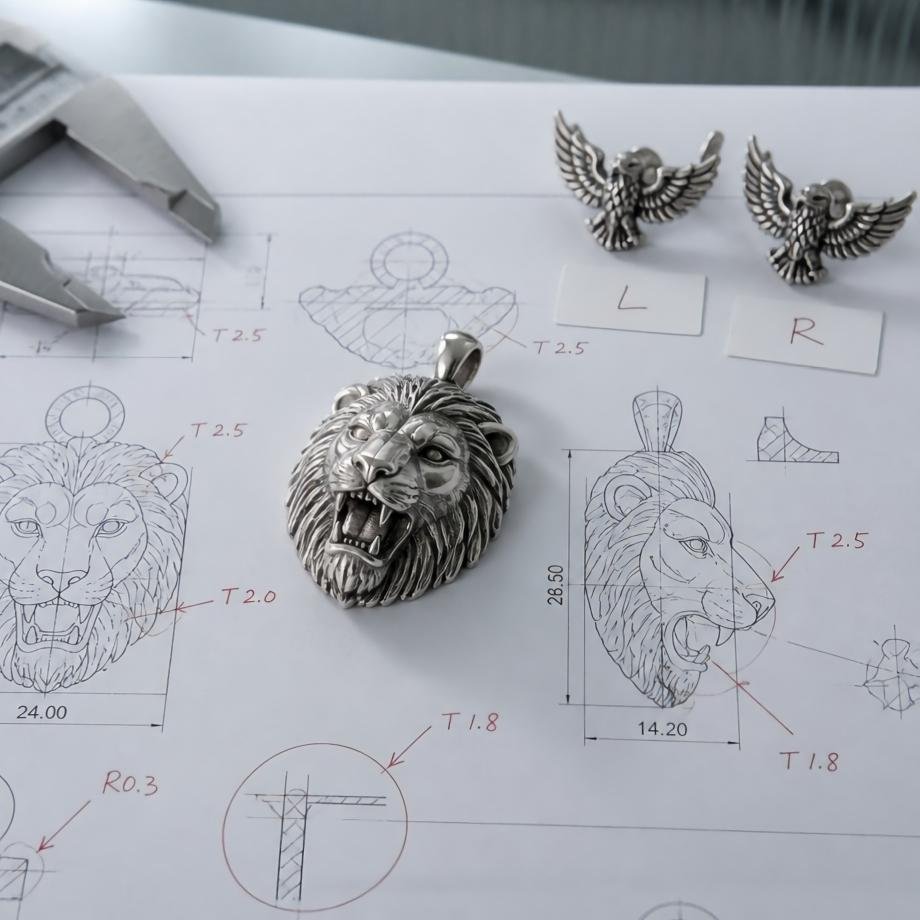
Animal artwork can lose detail at wearable size. Thin tails, legs, antlers, antennae, wings, claws, and cutouts may deform, trap polishing compound, or create sharp edges. Before tooling, we identify required revisions, measurable features, process risks, and sample checks.
Convert Recognizable Artwork Into a Manufacturable Product
- Recognition at final size: We evaluate the silhouette, eye, ear, wing, paw, face, and internal line details at the intended millimeter dimensions. Fine lines, holes, and narrow bridges are reviewed after expected polishing and plating effects, not only in an enlarged rendering.
- Thin and projecting features: Tails, legs, antlers, horns, beaks, and antennae require sufficient support. For casting, our initial wall-thickness review may start around 0.8–1.2 mm; every local feature still requires engineering approval.
- Cutouts and narrow bridges: For sheet cutting or stamping, holes and narrow bridges normally should not be smaller than the material thickness without specific evaluation. We check burr removal, edge loss, warping, hole position, and attachment strength.
- Edges and skin contact: Pointed ears, claws, wings, and cut profiles are assigned chamfers, radii, deburring, and surface criteria. Skin-contact, pierced, or high-friction areas receive separate attention for burrs, welds, and raised points.
- Balance and attachment: We review bail position, jump-ring direction, chain clearance, pendant flipping, center of gravity, and drop orientation. Heavy or asymmetric earrings also require post, connection, and wearing-balance review.
- Direction and paired products: Mirrored earrings and directional animals are identified as left and right parts in drawings, fixtures, inspection, and packing instructions to prevent reversed assembly or mismatched pairs.
- Recessed and three-dimensional areas: Deep grooves, undercuts, blind recesses, and enclosed spaces are reviewed for tool access, polishing, cleaning, drainage, plating coverage, stone setting, and inspection visibility.
Match Animal Geometry to the Production Route
We select the production route from geometry, quantity, material, surface, tolerance, weight, and reorder needs. A flat charm, relief pendant, and stone-set ring may use different routes even when they share one animal motif. Engineering approval defines the sequence, tooling, sample, control points, and cost basis.
| Design Characteristic | Production Route | Main Risks We Check | Required Approval |
|---|---|---|---|
| Flat silhouette or openwork | Laser cutting, wire cutting, stamping, or forming | Burrs, narrow bridges, warping, hole position, edge loss after polishing | Dimensioned outline, metal sample, edge and flatness check |
| Repeated flat motif at volume | Stamping or hydraulic forming with approved tooling | Tool marks, cracking, springback, feature consistency | Tool trial, first article, critical-dimension record |
| Three-dimensional animal relief | Casting, wax route, CNC, or combined processing | Wall thickness, shrinkage, porosity, undercuts, weight, polishing access | 3D file, prototype, metal sample, approved surface |
| Precise recess or machined detail | CNC, drilling, engraving, or combined route | Tool access, internal radius, vibration, time, repeatability | Machining drawing, first article, measurement record |
| Fine line art, name, date, or texture | Laser engraving, etching, embossing, or stamping | Line loss, merging, depth variation, readability after finish | Artwork proof, approved font and line sample |
| Colored animal zones | Resin, paint, cold enamel, or another approved fill route | Boundary control, bubbles, curing, adhesion, surface level | Color map, process sample, adhesion criteria |
| Stone-set eyes or accents | Setting, adhesive fixing, or approved combination | Seat size, stone direction, looseness, overflow, plating sequence | Stone map, setting sample, firmness method |
| Chain, bail, or moving attachment | Welding, jump-ring assembly, hinge, pin, or approved finding | Opening, misalignment, flipping, wear, load path | Assembly sample, functional check, pull requirement |
Approve PVD Color and Surface Specifications
A color name is not a plating specification. We define the substrate, preparation, surface texture, coating route, layer structure, physical reference, quantity by color, protected areas, and evaluation conditions. Bare steel is recorded as an unplated finish; PVD colors are specified separately.
Control the Finish Before Bulk Plating
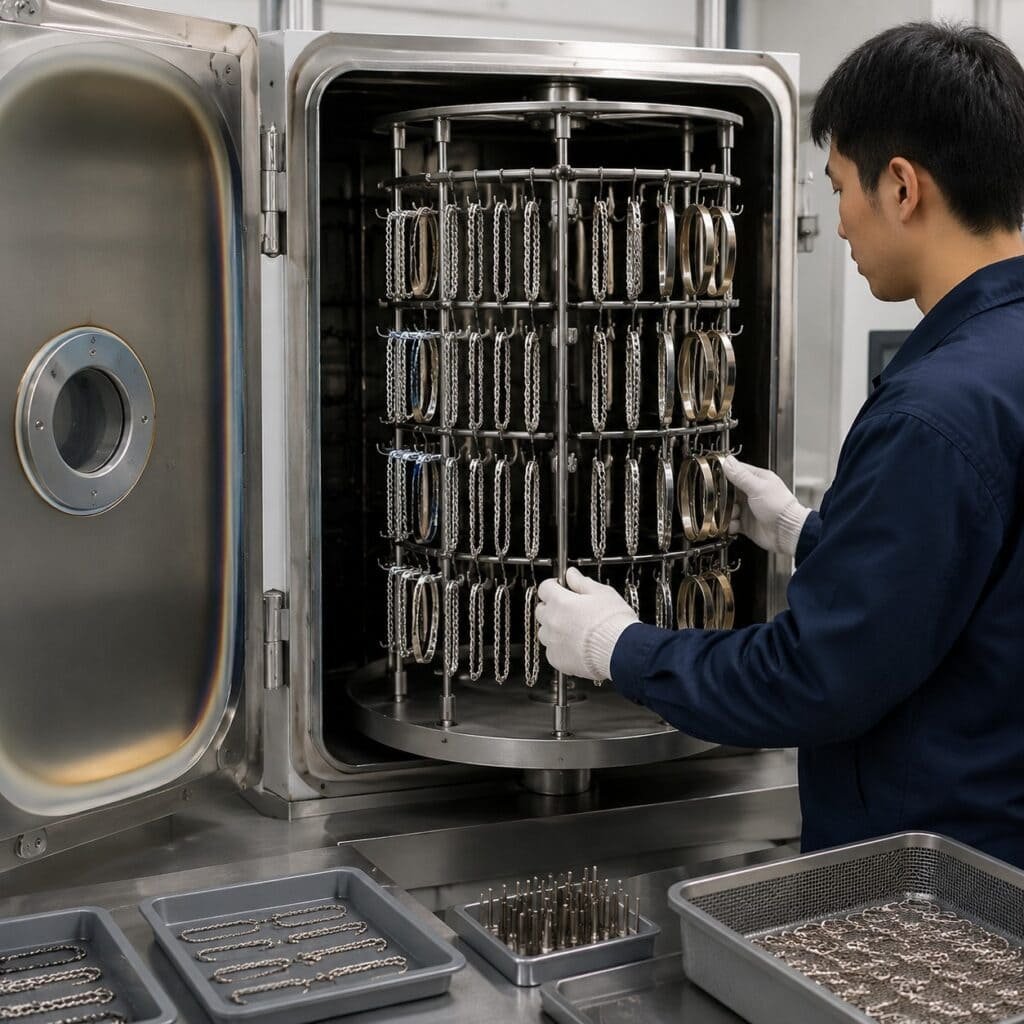
Chicolink operates an in-house plating workshop. We coordinate the approved animal jewelry specification from metal preparation through coating, inspection, and batch recording.
- Surface preparation: Record polish, brushing, sandblasting, satin, texture, or an approved combination by visible area.
- Color reference: Approve a physical sample or standard plate under agreed viewing conditions; digital color alone cannot control a metallic finish.
- Coating structure: Record PVD/IP, water plating, or another approved in-house route, including base and top layers where applicable.
- Product review: Check hanging points, recesses, engraving, stones, resin, moving areas, and assembly dimensions before coating.
- Variant control: State quantity per animal, product, size, and color. Added colors may require separate samples, plating lots, inspections, and packaging SKUs.
- Claim control: Performance depends on the approved coating system, wear, chemicals, care, environment, and test method. We do not make unconditional waterproof or never-fade claims.
The approved sample, specification, and test request become the basis for bulk plating. Any change to material, polish, color, layer, or use condition is reviewed before production.
Move From Project Brief to Golden Sample
We convert your brief into an approved manufacturing baseline. OEM projects start with drawings, samples, or specifications. ODM projects can start with a market, theme, channel, price position, or partial concept. We list unresolved items and link every approved change to the active version.
Close Decisions Before Bulk Production
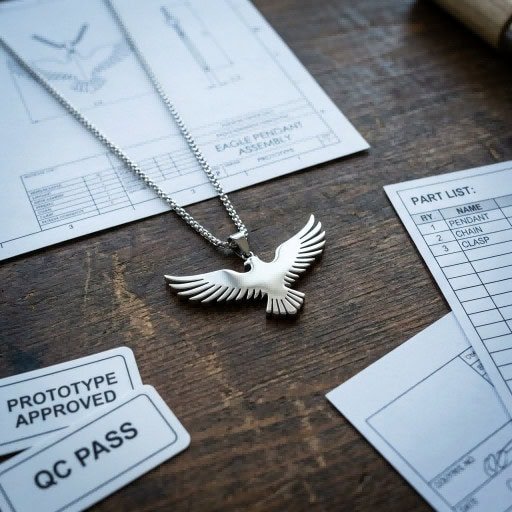
1. Collect the brief: Confirm the animal theme, product, dimensions, material, quantity split, finish, components, stones or fill, logo, target market, testing, packaging, price target, and deadline.
2. Review feasibility: Engineering checks geometry, process access, structure, weight, comfort, attachment, surface, tooling, inspection, and bulk-production risks. Missing decisions are returned as confirmation items.
3. Define the quotation basis: Identify the SKU, version, quantity by variant, material, process, tooling, samples, finish, testing, packaging, freight basis, and quotation conditions.
4. Prepare controlled files: Create or review the 2D drawing, 3D model, BOM, stone or color map, engraving proof, logo file, packaging file, and critical quality points required for the project.
5. Build the required samples: Depending on risk, the project may use a concept model, metal sample, color sample, functional sample, packaging sample, pre-production sample, or a combination.
6. Record feedback: Link every revision to the active drawing, BOM, sample, color, and package version. Unapproved old files are removed from purchasing, production, inspection, and packing use.
7. Approve the golden sample: Record what the sample controls, who approved it, the approval date, photographs, open issues, storage location, and whether it is authorized as the bulk standard.
Confirm MOQ, SKU Mix, Cost, and Timing
We confirm quantities by style, motif, color, size, material, plating lot, personalization method, and packaging version. Total project quantity alone does not define each production variant. The figures below are planning references; our written quotation states the terms for the reviewed project and current schedule.
| Item | Common Planning Reference | Conditions That Require Confirmation |
|---|---|---|
| Regular stock MOQ | 120 pieces per style | Actual SKU, stock, color, size, packaging, and shipment plan |
| Common OEM/ODM MOQ | 500 pieces per style | Motif, tooling, material, size, process, color split, stones, packaging, and tests |
| Existing-style sample | 3–7 working days | Availability, finish, changes, packaging, sample quantity, and payment |
| Custom animal jewelry sample | 25–30 working days | Artwork, engineering, tooling, sourcing, revisions, finish, and required validation |
| Existing-style bulk production | 20–30 working days | Quantity, stock status, color, packaging, inspection, and factory schedule |
| Custom bulk production | 25–45 working days | Begins after specifications, approvals, materials, and production conditions are ready |
| Mixed animal motifs | Reviewed by project | Quantity per motif, shared tooling or parts, process route, plating, labels, and packing |
| Added personalization | Reviewed by project | Data format, proof approval, variable engraving, inspection, and order sequence |
Schedule Multi-SKU Animal Jewelry Production Capacity
We schedule multi-SKU animal collections across design, engineering, PMC, manufacturing, plating, quality, and packing. Before confirming delivery, we review the SKU mix, process routes, approvals, materials, plating lots, tests, packaging, and current factory load.
Connect Factory Resources to the Approved SKU Plan
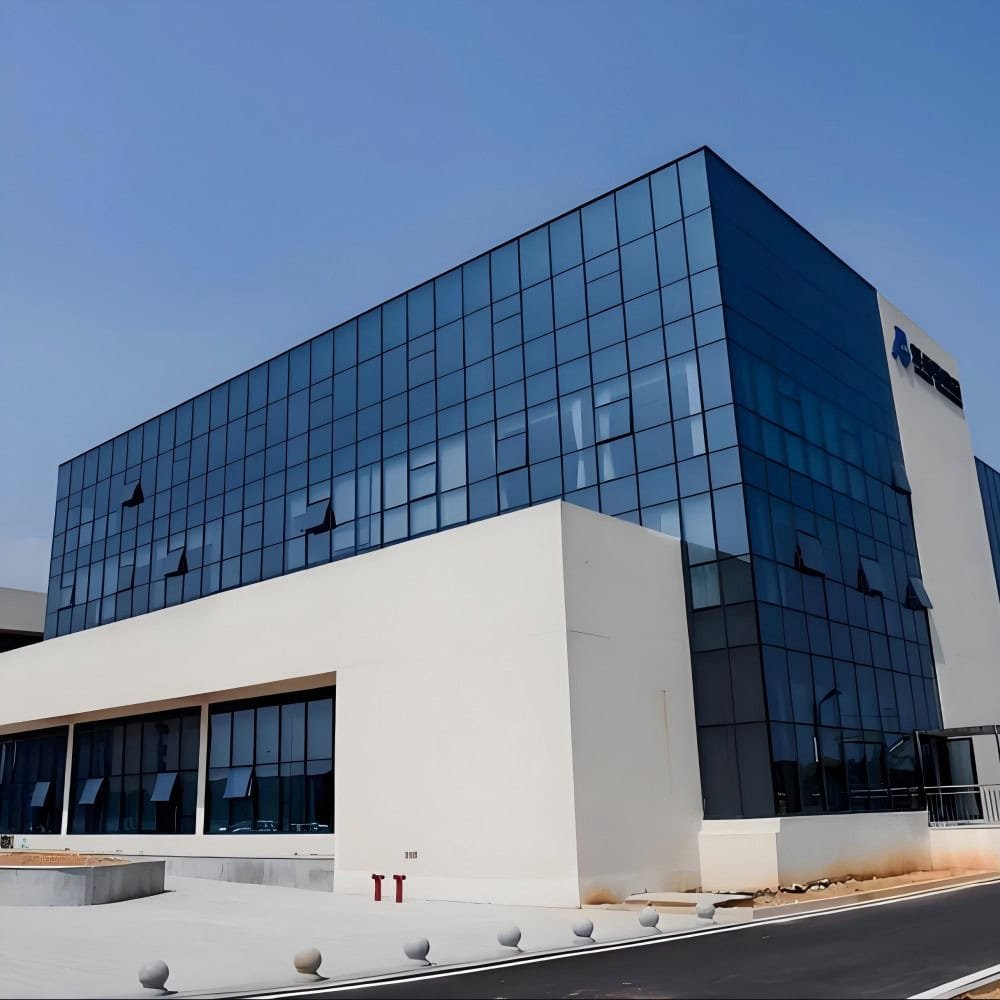
- Manufacturing base: Chicolink was founded in June 2012 and operates a factory of more than 5,500 square meters in Dongguan, China.
- Production organization: 400+ employees support manufacturing and related operations. PMC coordinates materials, processes, schedules, work orders, and delivery follow-up.
- Development team: 6 jewelry designers and 3 jewelry engineers support artwork review, drawings, structure, process selection, sampling, and manufacturability decisions.
- Monthly capacity: Factory output exceeds 200,000 pieces per month. Actual capacity for an animal jewelry program depends on design complexity, quantity per SKU, tooling, process route, finish, packaging, inspection, and timing.
- Equipment base: Our 58 major machines include five CNC machines, four casting machines, three laser-cutting machines, five laser-welding machines, three laser-logo machines, six stamping machines, eight polishing machines, and six PVD units, with additional bending, drilling, wax-injection, and lathe equipment.
- Integrated plating: Our in-house plating workshop links metal preparation, approved color, coating, inspection, exception handling, and batch records under the same project specification.
- Audit and inspection access: We support factory audits and third-party quality inspections when scope, timing, responsibilities, and access requirements are arranged in advance.
Control Critical Animal Jewelry Quality Points
We define quality controls from the product risk. Incoming, in-process, first-article, plating, final, and packing checks are selected by structure. Customer contracts, quality agreements, drawings, samples, and test standards take priority over our internal defaults when supplied in writing.
| Quality Point | Animal Jewelry Risk | Chicolink Control | Record or Approval Basis |
|---|---|---|---|
| Motif and detail | Lost facial features, merged lines, blocked cutouts, excessive polishing | Compare outline, relief, engraving, texture, and key dimensions | Active drawing, artwork proof, golden sample |
| Edge and surface | Sharp ears, claws, wings, burrs, pits, scratches, rough welds | Deburring, radius or chamfer check, surface classification, visual inspection | Surface sample, defect criteria, inspection photos |
| Direction and pairing | Reversed animals, mismatched mirrored earrings, incorrect assembly | Left/right identification, orientation check, pair weight and color review | Drawing direction, assembly guide, packing reference |
| Attachment and function | Open jump ring, failed weld, pendant flipping, loose clasp or ear post | Connection, alignment, opening/closing, wearing direction, and pull checks | Approved structure and applicable test plan |
| Stones and color filling | Loose stones, overflow, bubbles, wrong color map, poor adhesion | Position, count, firmness, curing, surface, and method-specific adhesion checks | Stone map, color map, approved sample, SOP |
| PVD appearance | Shade difference, incomplete coverage, pinholes, burning, peeling | Physical color comparison, coverage and defect review, thickness check as specified | Approved color sample, plating specification, batch record |
| Dimensions and weight | Wrong pendant size, hole clearance, chain length, ring size, or pair balance | Calibrated measurement at specified locations and product state | Drawing, measurement method, actual values |
| Packaging and SKU | Wrong animal, color, engraving, barcode, card, or set component | Product-to-label match, orientation, protection, quantity, carton review | Packing file, SKU list, approved trial pack |
Protect Reorder Consistency With Batch Traceability
We identify every reorder by its approved baseline, not only an item name. Each production lot is linked to its order, SKU, drawing, sample, material, finish, inspection, packaging, and shipment records. A changed motif, color, chain, engraving file, label, or package is reviewed as a new version or SKU.

Trace Each Reorder to Its Approved Baseline
- Product identity: Customer, order number, SKU, style, animal motif, drawing version, BOM version, and approved sample reference.
- Material identity: Material name, grade, supplier, incoming lot, component materials, and approved substitutions where applicable.
- Production identity: Work order, production date, workshop, tooling, forming, machining, welding, polishing, setting, filling, and assembly records required by the route.
- Plating identity: In-house plating workshop, equipment number, color, plating lot, input and output quantities, coating requirement, and approved color reference.
- Quality identity: IQC, IPQC, first-article, final, AQL or 100% inspection, nonconformity, rework, and reinspection records.
- Packaging identity: Product orientation, personalization data, card, label, barcode, package version, carton number, packing list, and shipment date.
- Issue response: Complaint quantity, affected SKU and batch, photographs, use conditions, retained samples, investigation, disposition, corrective action, and preventive action.
We review current material availability, process condition, color reference, packaging data, and required testing before confirming a repeat order. A retained record supports comparison, but a previous report or sample is not automatically evidence for every future material, color, or batch.
Plan Testing for the Destination Market
We plan testing by destination market, product use, material, component, plating color, production batch, and written requirements. We can prepare samples, review available documents, and coordinate with SGS, HKPC, or another approved laboratory. Each report applies only to its stated samples, methods, dates, and scope.
| Requirement | When It May Apply | Information We Confirm | Chicolink Support |
|---|---|---|---|
| Nickel release | Skin-contact products where destination-market limits apply | Contact parts, material, color, wear treatment, method such as EN 1811/EN 12472, samples, laboratory | Sample preparation, document review, third-party coordination |
| Lead and cadmium | Products or components subject to customer or market substance limits | Product scope, components, coating, sample selection, current requirement | Testing coordination and report-scope review |
| REACH review | EU-bound projects with relevant restricted-substance requirements | Current requirement, product, material, color, coating, batch, evidence | Existing-document check or project-specific testing support |
| RoHS if required | Special channels or products with an identified applicable requirement | Product use, channel, applicable scope, standard, laboratory | Applicability review and testing coordination; not treated as a universal jewelry requirement |
| Salt spray | Bare or plated products with agreed corrosion-screening requirements | Method, solution, pH, temperature, sample position, duration, acceptance | Internal planning or third-party testing as agreed |
| Artificial perspiration | Skin-contact products with agreed finish evaluation | Formula, pH, temperature, duration, cleaning, color evaluation | Internal planning or third-party testing as agreed |
| Third-party inspection | Bulk orders requiring independent pre-shipment review | Agency, booking date, sampling, scope, criteria, report recipient, reinspection rule | Factory access and inspection coordination by prior arrangement |
Prepare Animal Jewelry for Retail Delivery
Animal collections can contain many similar-looking SKUs. We link each motif, product, color, size, engraving, and set to its approved branding and packaging record. Packing also protects thin features, stones, ear posts, chains, and polished surfaces during handling and shipment. Product identity, package version, barcode data, set contents, orientation, and carton information are checked against the approved SKU.
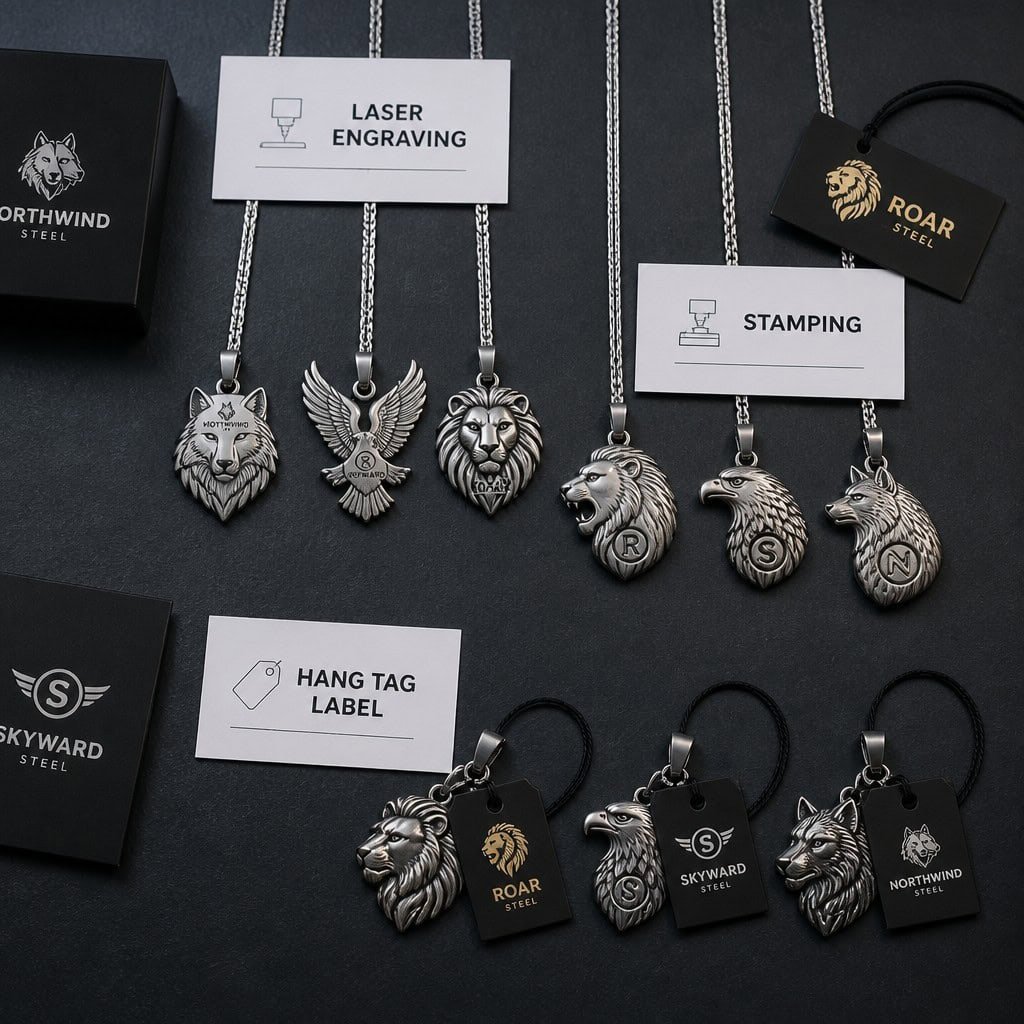
Product Branding
- Apply an approved logo by laser engraving, etching, stamping, embossing, product tag, or another reviewed route.
- Confirm content, direction, dimensions, safe margins, depth, and visible surface before sampling.
- Keep product, tag, card, pouch, and box logo files under separate version control when their artwork differs.
- Check logo readability after polishing and finishing on the actual production surface, not only in enlarged artwork.
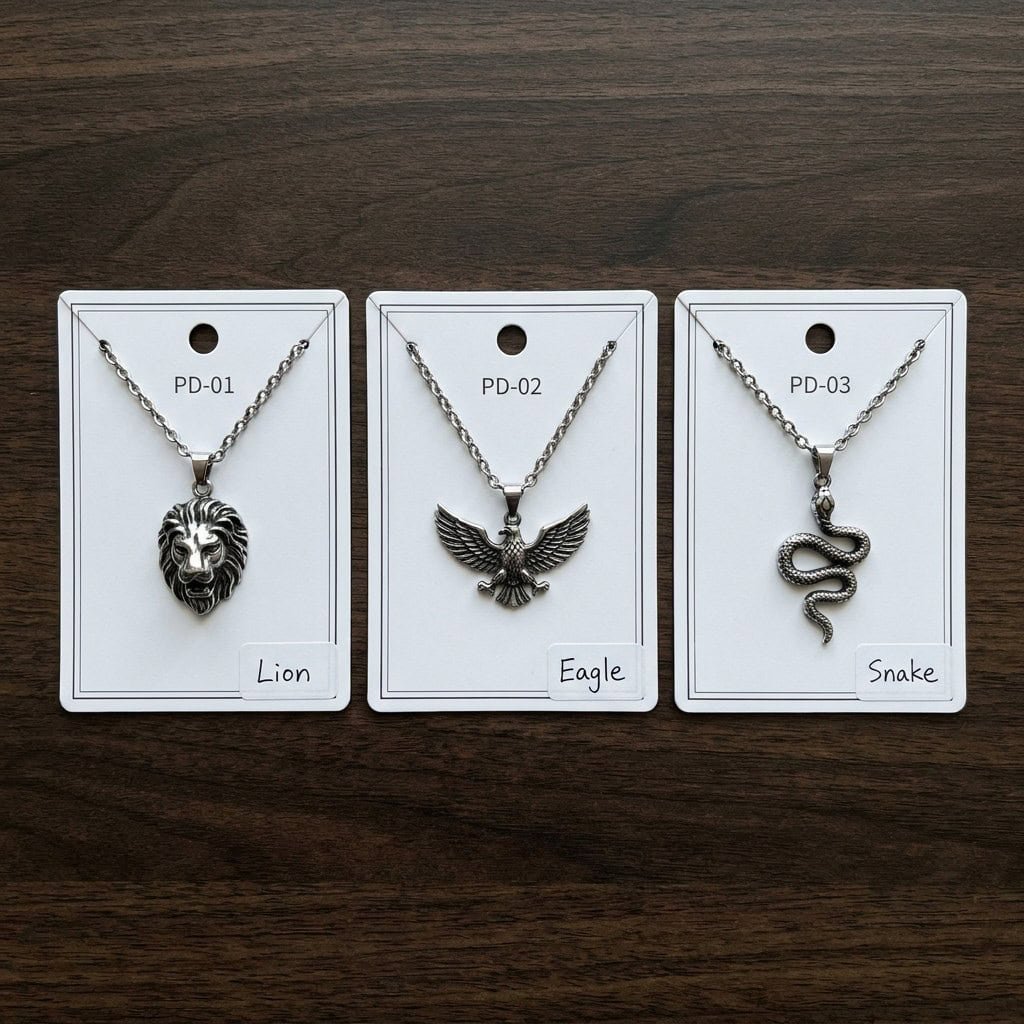
Jewelry Cards
- Match card size, hole or slot position, product orientation, logo, color, finish, and required legal or care text.
- Review whether thin animal features, chains, ear posts, or mirrored pairs need an additional tie, backing, or protective layer.
- Approve a trial card with the actual product before bulk packing when fit is critical.
- Record front, back, and hanging direction so visually similar animal SKUs are packed consistently.
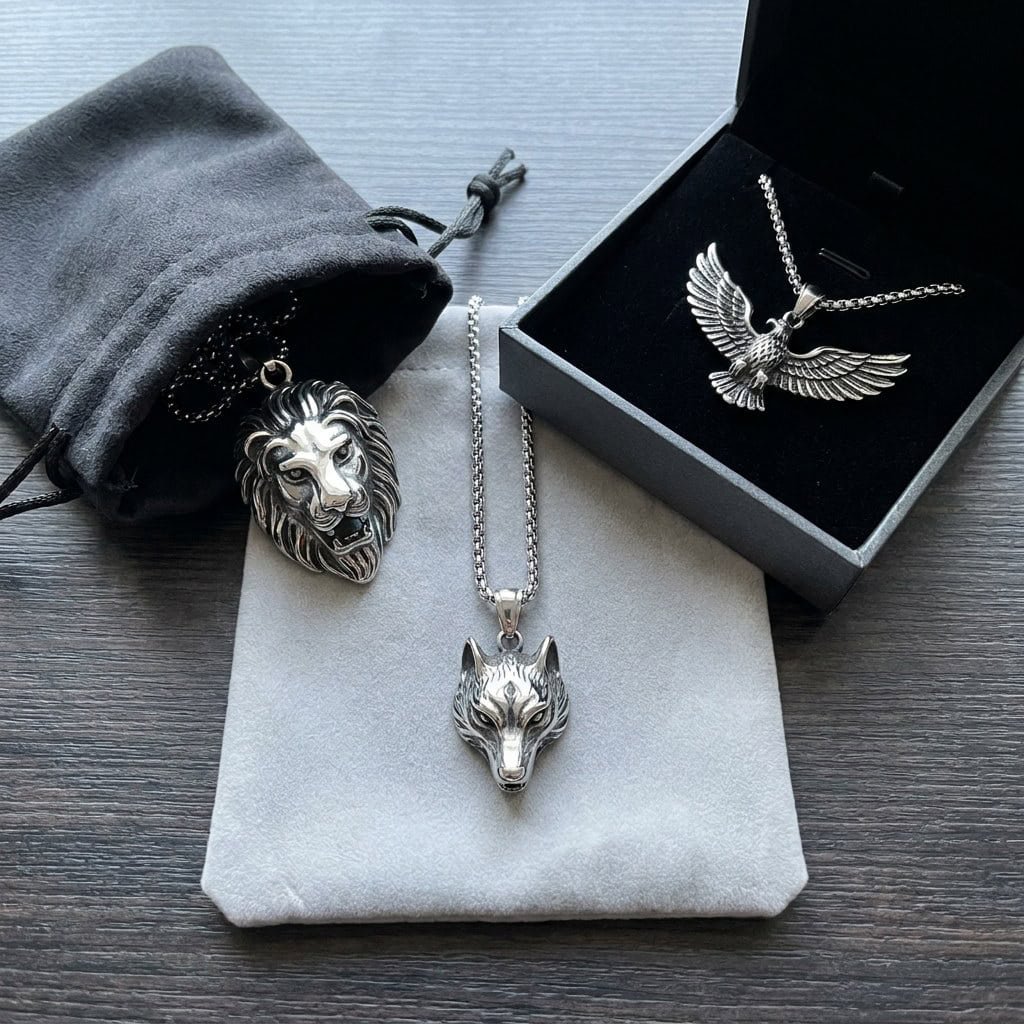
Pouches and Boxes
- Specify material, dimensions, color, finish, insert, product placement, and set arrangement.
- Separate protruding animal details, stones, and high-polish surfaces from hard contact points that may scratch, bend, or press the product.
- Confirm whether one package is shared or assigned to a specific collection, product, or market.
- Review insert clearance and closure pressure with the approved jewelry sample before releasing bulk packaging.
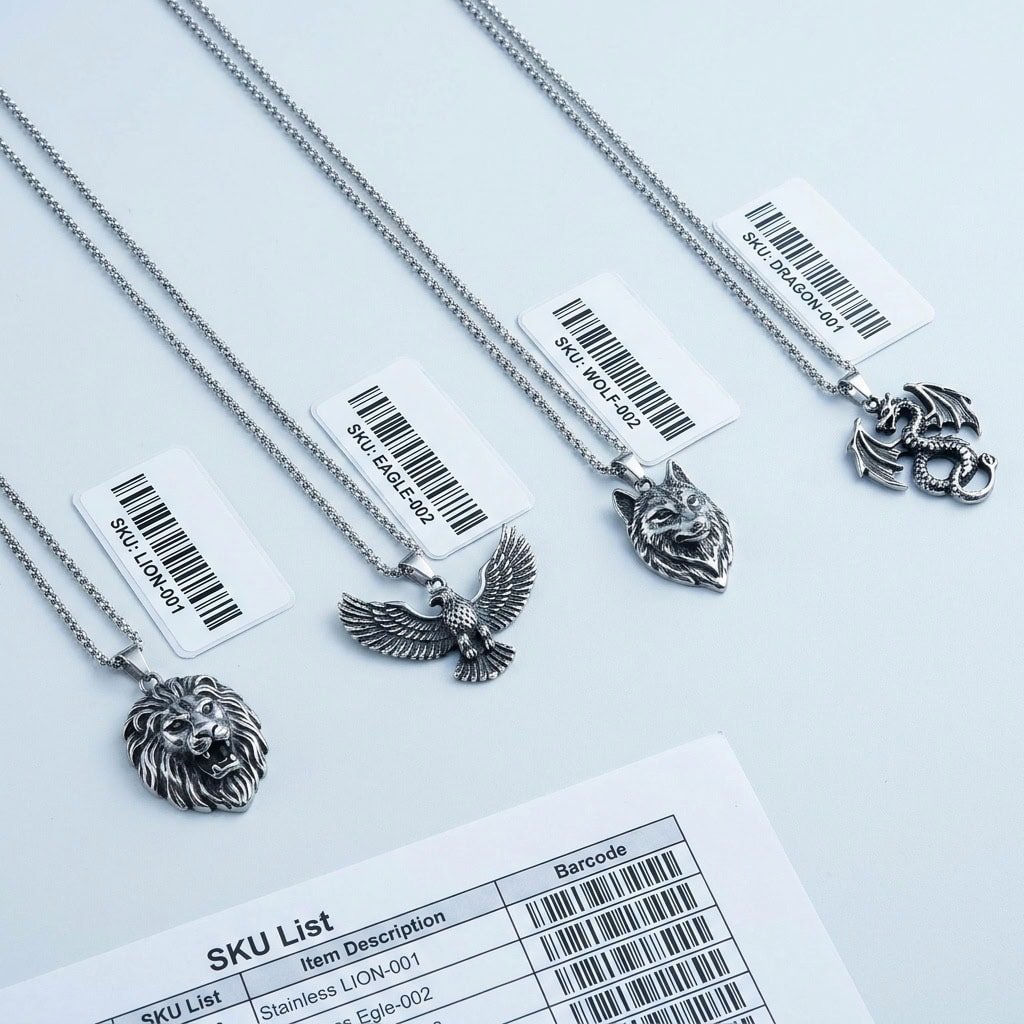
SKU and Barcodes
- Link the animal motif, product, finish, size, personalization, and package to the correct SKU, barcode, FNSKU, or retailer label.
- Define label content, format, position, scan requirement, and data source.
- Use the approved SKU list during product matching, packing inspection, inner-box packing, and carton preparation.
- Isolate unreadable, duplicated, missing, or mismatched labels before products enter the final shipping carton and retain correction traceability.
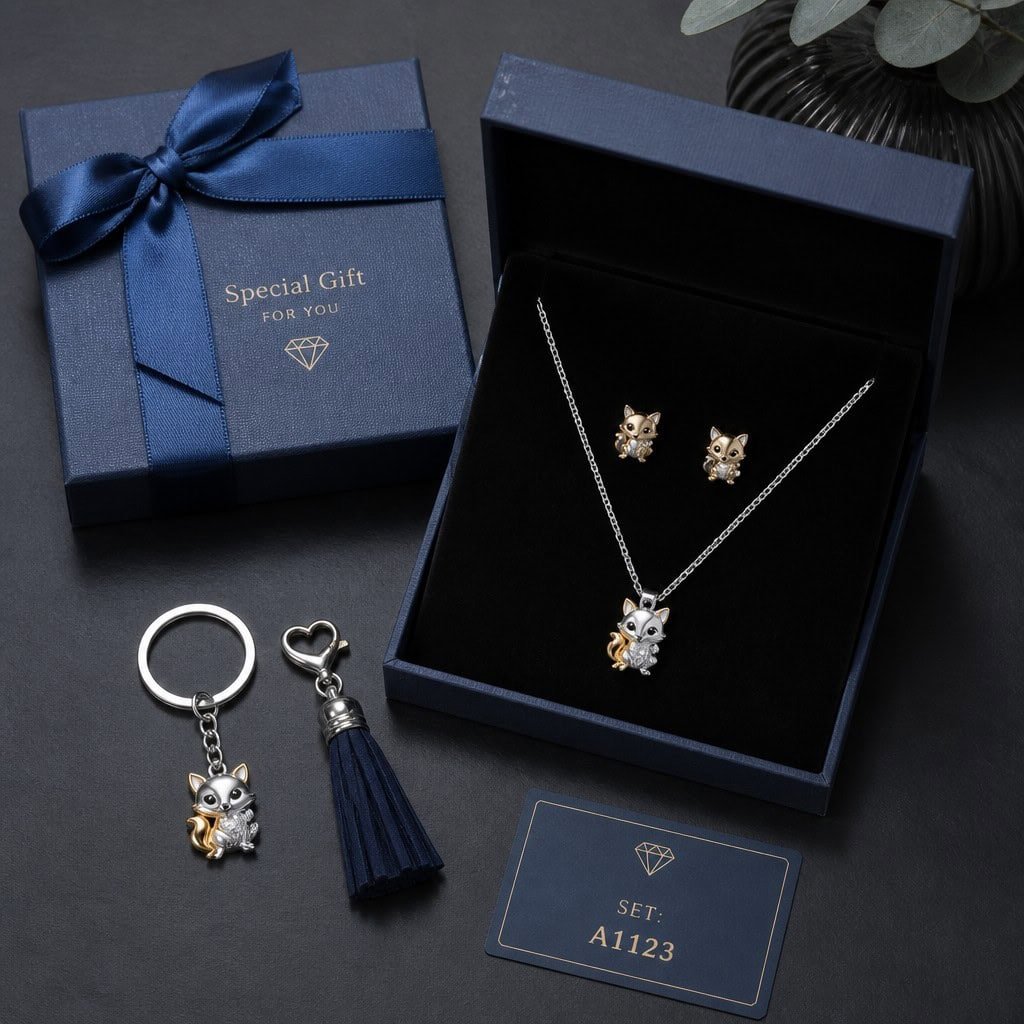
Sets and Assortments
- Control necklace-and-earring sets, charm assortments, themed gift sets, and mixed-animal packs by a written component list.
- Confirm quantity, direction, color, spare parts, care card, story card, and placement for every set.
- Inspect the complete set before closure to prevent missing or mismatched animal components.
- Define whether each set receives one shared SKU or separate component tracking for replenishment and claims.
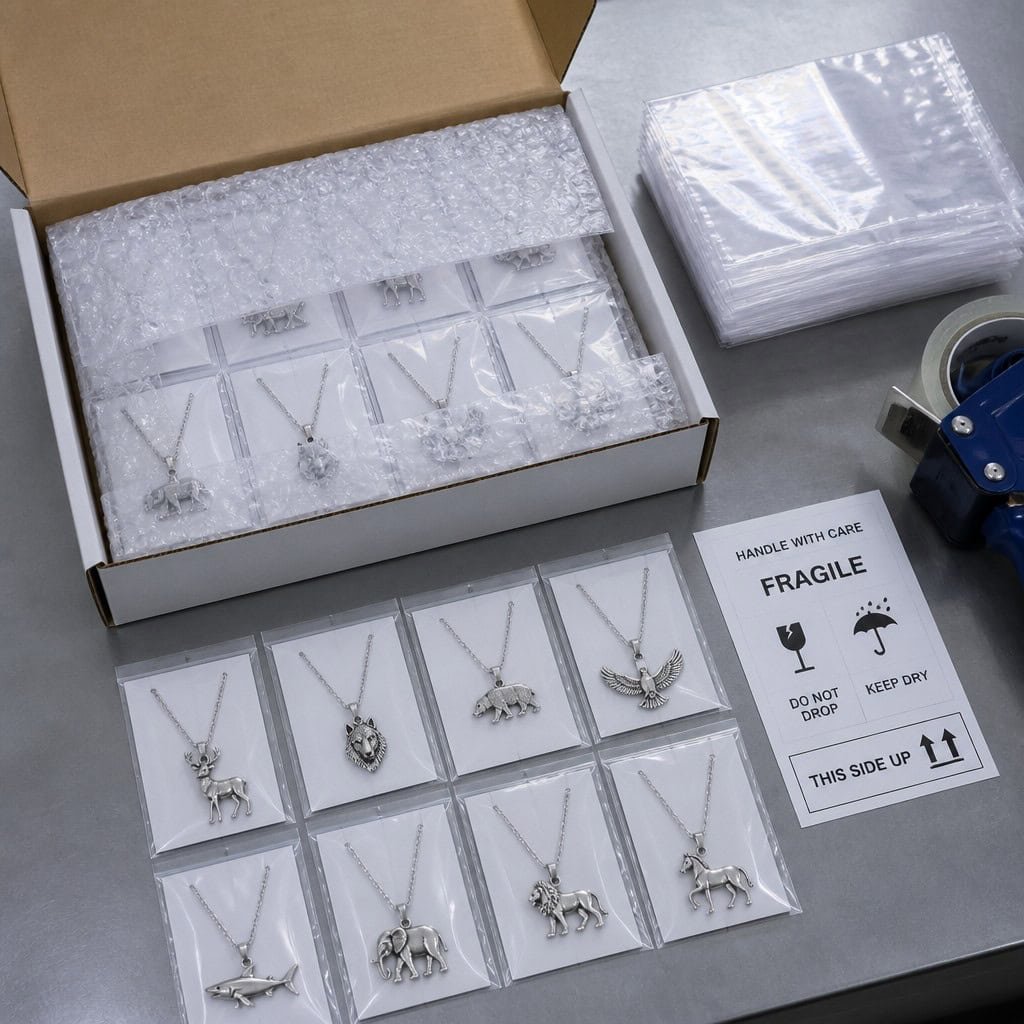
Transit Protection
- Plan anti-tangle, anti-scratch, moisture, ear-post, sharp-detail, and stone protection according to the product and shipping route.
- Confirm inner-box quantity, mixed-SKU rules, carton quantity, carton marks, destination labels, and handling symbols.
- Validate product movement and barcode visibility with a trial pack when the structure or channel requires it.
- Photograph the approved packing sequence when orientation or layered protection must be repeated during bulk packing.
Structure a Multi-Motif Animal Pendant Project
The planning example below shows how we configure a six-motif pendant project before quotation and sampling. It contains no customer identity, order result, or sales claim. We use the same decision sequence for a live project after reviewing its actual artwork, quantities, finishes, packaging, tests, and schedule.
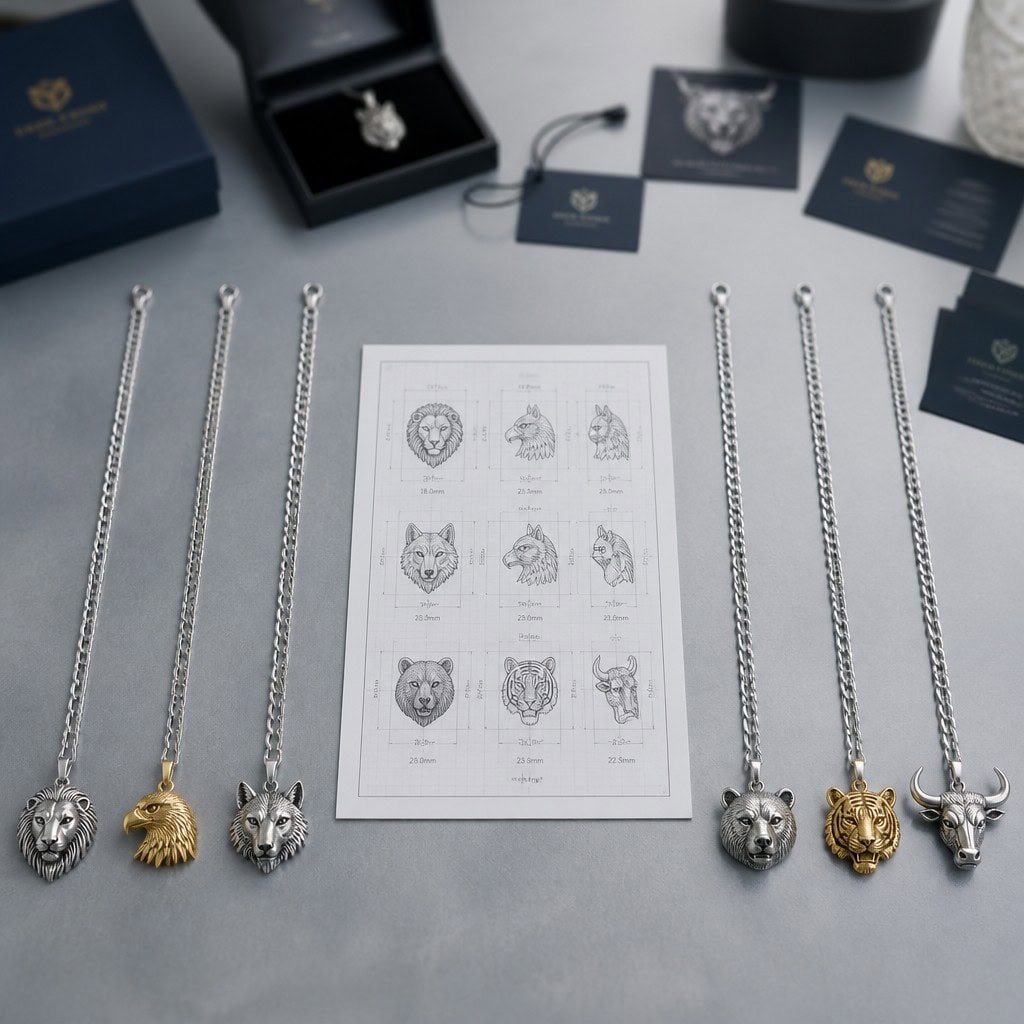
Six-Motif Pendant Project Planning Example
Use Scenario
A brand brief requests six animal pendants for online and wholesale channels, using one chain family, two finishes, individual SKU cards, and one gift-box format.
Key Challenge
Each motif has different thin features, cutouts, hanging points, and visual weight. Two finishes create twelve finished variants before packaging changes. Artwork scale, attachment, finish approval, and SKU mapping must be resolved before production planning.
Chicolink Solution
We review authorized artwork at final size, define the process route for each motif, correct weak or inaccessible details, standardize compatible chains and findings, and prepare controlled drawings. We separate quantities by motif and finish, approve physical finish references, link samples to active BOM and packaging files, and define motif, edge, connection, finish, label, and packing checks.
Result
The output identifies shared components, separate approvals, development charges, production variants, inspection points, and packaging records. Project-specific price, timing, and production results are confirmed only after review, sample approval, and order execution.
Project Data
Planning example: 6 animal motifs; 1 pendant size system; 1 chain family; 2 finishes; 12 finished product variants before packaging or market variations; branded jewelry cards; 1 gift-box structure; customer-defined testing and inspection requirements.
Animal Jewelry Procurement FAQ
These answers cover common conditions before animal jewelry development, including artwork, thin features, mixed motifs, portraits, pet tags, licensed characters, colored details, mirrored earrings, and inspections. We confirm feasibility, specification, quantity, price, timing, testing, and packaging from your submitted design and written requirements.
What animal jewelry products can Chicolink develop?
We review pendants, necklaces, charms, earrings, rings, bracelets, sets, memorial jewelry, and approved pet-related products. The final scope depends on geometry, material, process, components, use, market, tests, packaging, and completed engineering or sample validation.
Can you develop jewelry from animal artwork?
Yes. Send authorized vector artwork, drawings, 3D files, photographs, sketches, or a physical reference. We assess final-size recognition, dimensions, thin features, cutouts, attachment, surface, process route, tooling, and inspection before confirming development.
How are thin tails, legs, or antlers handled?
We review their thickness, length, support, orientation, manufacturing route, polishing loss, packing exposure, and normal-use load. Engineering may recommend widening, shortening, connecting, rounding, thickening, or changing the process. The sample confirms the approved solution.
Can different animal designs share one order?
Yes, subject to project review. Send the quantity for every product, motif, color, size, stone, and package. Shared materials or components do not automatically make all variants one production lot. We state accepted combinations in the quotation.
Can you reproduce a pet portrait?
We can evaluate an authorized photograph or line drawing for engraving, silhouette, relief, or another suitable route. Image quality, final size, recognizable features, contrast, production method, proof approval, and personalization-data control determine feasibility.
Are pet tags the same as animal jewelry?
No. A pet tag is used by an animal and requires separate review of attachment, engraving area, edge condition, weight, strength, movement, environment, and packaging. We do not apply a human fashion-jewelry specification by changing only the product name.
Can you use licensed animal characters?
We can review production after the customer confirms the rights required for the artwork, character, logo, font, photograph, or brand element. Submission of a reference does not transfer ownership or provide manufacturing authorization.
Can animal jewelry use stones or colored details?
Yes, after structure and process review. Send the stone or fill type, dimensions, color map, location, fixing method, surface target, quantity, and acceptance criteria. We confirm seats, boundaries, sequence, curing, adhesion, inspection, and packing protection.
How do you control mirrored animal earrings?
We identify left and right parts in drawings, tooling or fixtures, assembly instructions, inspection, and packaging. We check direction, dimensions, color, post location, connection, weight balance, and pair matching against the approved standard.
Can you support customer or third-party inspection?
Yes. We support factory audits and third-party quality inspection. Send the agency, booking window, scope, sampling plan, acceptance criteria, report recipient, and reinspection rule. We confirm access, scheduling, cost, and responsibilities before the visit.