
British Tudor Rose Jewelry Manufacturer for Custom Collections
Develop Tudor Rose-inspired stainless steel jewelry with controlled details, finishes, private-label packaging, and repeatable bulk-production specifications.
Chicolink Jewelry is a stainless steel jewelry manufacturer in Dongguan, China. We turn approved Tudor Rose-inspired artwork into production-ready jewelry for global brands, cultural-gift buyers, wholesalers, and retail groups. Before quotation and sampling, we review the structure, material, process, color, quantity, packaging, test plan, and target market.
- OEM and ODM development for pendants, necklaces, earrings, rings, bracelets, brooches, charms, and coordinated sets
- In-house PVD/IP and approved electroplating processes with sample approval and batch control
- Private-label packaging, quality inspection, bulk production, and third-party inspection support
Established in 2012 | 5,500+ m2 factory | 400+ staff | 200,000+ pieces monthly capacity
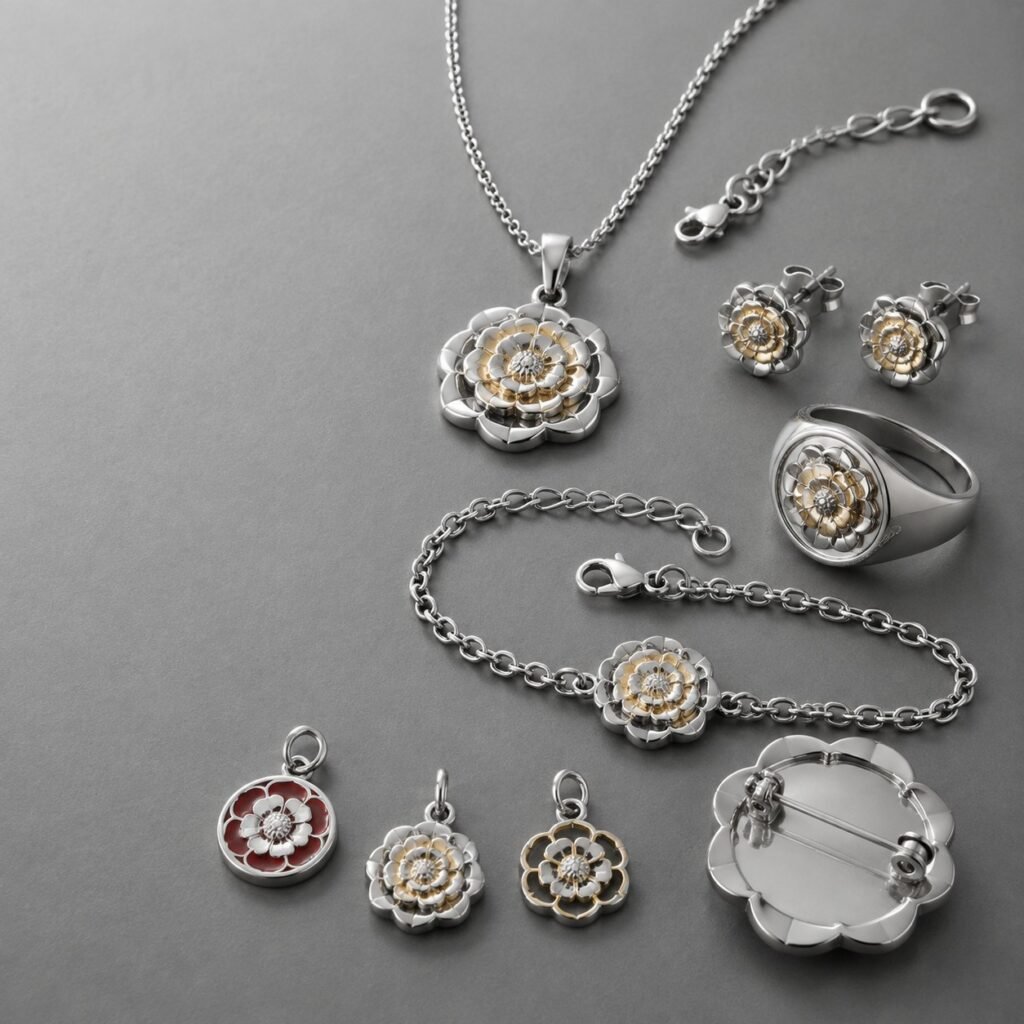
Tudor Rose Jewelry Programs Built Around Your Sales Channel
Chicolink plans each heritage-inspired collection around its sales channel and supply requirements. We align the product structure, finish, packaging, quantity, quality checkpoints, and replenishment method so the buyer can evaluate a complete manufacturing program rather than an isolated decorative sample. This approach connects design decisions with launch, replenishment, and retail execution.
International Jewelry Brands
For established brands, we convert buyer-approved artwork and technical requirements into controlled SKUs. Development can include coordinated product categories, approved color samples, private-label components, production records, pre-shipment inspection support, and specifications intended for repeat orders across multiple markets under one controlled approval path.
Museum Heritage Retail
For museums, heritage retailers, and cultural-gift programs, we develop jewelry around authorized artwork and an agreed interpretation of the Tudor Rose. Product, story card, gift box, barcode, and display requirements can be planned as one retail-ready program with traceable SKU and pack records.
Chain Store Programs
For chain and multi-site retailers, we focus on measurable specifications, assortment consistency, packaging execution, and replenishment. The approved sample, color reference, dimensions, attachment strength, labeling, and pack configuration become the control basis for bulk production and later repeat orders across stores and channels.
Boutique DTC Brands
For boutique and DTC brands, we can translate a focused Tudor Rose concept into a compact launch collection. The program may combine a hero pendant, matching earrings or rings, selected PVD colors, branded cards, and gift packaging within a defined price position.
Jewelry Wholesalers
For wholesalers, the priority is a commercially usable assortment with clear variants and repeatable supply. We can evaluate category mix, color options, chain lengths, pack quantities, and private-label requirements while separating regular styles from original custom-mold development with documented variant rules.
Commemorative Gift Programs
For commemorative, event, educational, or destination-gift programs, we can develop a controlled edition with project-specific artwork, date or text engraving, coordinated packaging, and quantity planning. Use rights, delivery date, labeling, and inspection requirements must be confirmed before sampling, with production-release responsibilities assigned.
Build A Recognizable Rose Without Copying Market Designs
A Tudor Rose-inspired brief may use layered petals, radial symmetry, red-and-white contrast, relief, openwork, or heraldic framing. Chicolink converts the approved direction into an original, manufacturable design instead of reproducing a third-party retail product. We separate authorized source material from general references and record the motif elements that must remain consistent across approved SKUs.
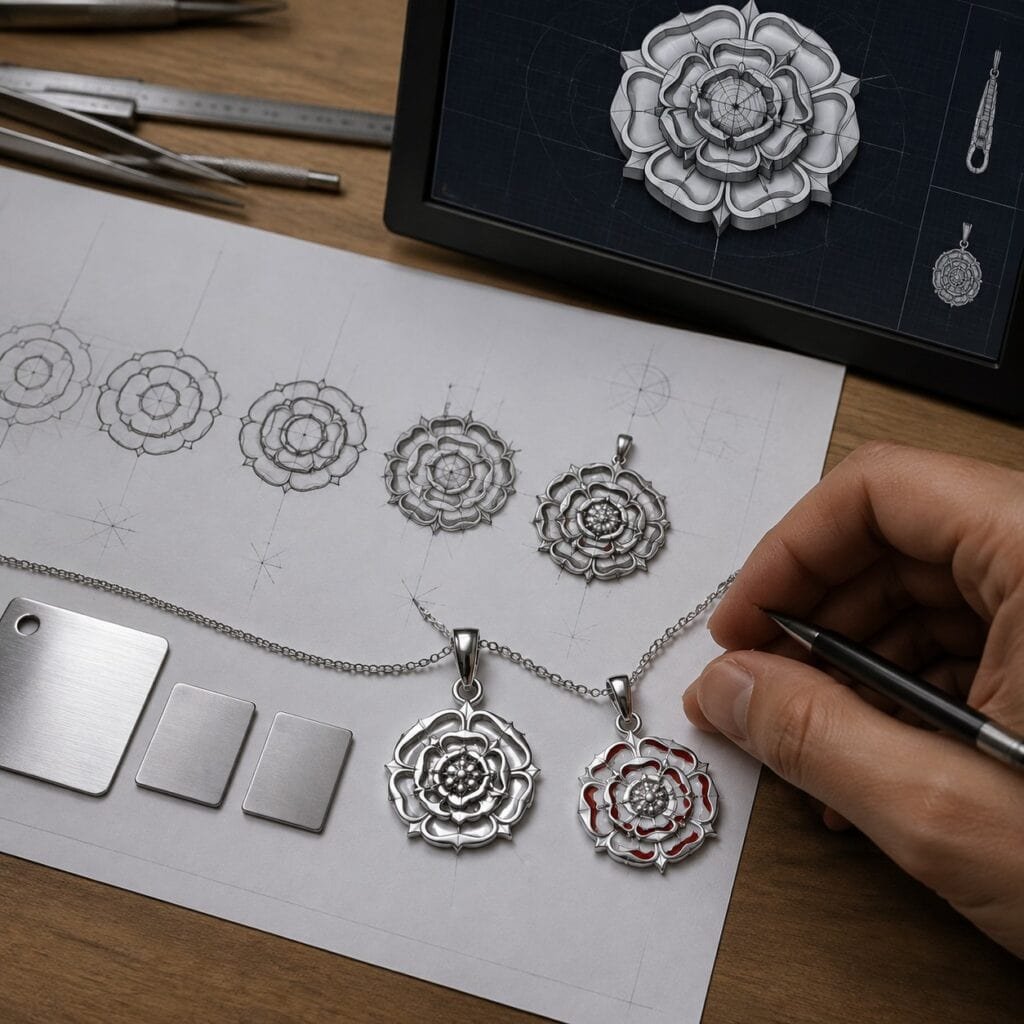
Define The Motif Before Engineering The Product
- Design source: Send original artwork, a licensed asset, a sketch, a style board, or a written creative brief. Reference products may clarify size or finish, but they should not be used as instructions to copy protected details.
- Visual hierarchy: Confirm which features must remain recognizable at jewelry scale: outer petals, inner petals, center detail, border, crown or shield framing, lettering, dates, and front-to-back orientation.
- Color interpretation: Specify whether red and white are essential to the concept or whether the collection will use polished steel, PVD gold, black, rose gold, recessed color filling, or a monochrome relief.
- Original development: Chicolink can adjust petal spacing, outline weight, negative space, relief, stone positions, and surrounding geometry to create a distinct production design aligned with the buyer's brand.
- Authorization: The buyer is responsible for confirming rights to supplied logos, museum assets, official emblems, fonts, branded packaging, and licensed cultural material. Chicolink does not present a project as royal, governmental, museum-approved, or officially licensed without written authorization.
- Approval record: The approved artwork version, dimensions, color references, logo files, and usage notes should be recorded before CAD, tooling, or sample production begins.
Extend One Tudor Rose Motif Across Eight Product Formats
Chicolink can engineer a collection around one approved motif while adapting scale, thickness, attachment, weight, finish, and packaging for each product type. A shared motif does not mean every SKU should use the same construction; each wearing position requires its own specification and quality controls. Before sampling, the buyer and Chicolink define the hero SKU, supporting items, color variants, set combinations, target price levels, packaging format, and planned replenishment structure.
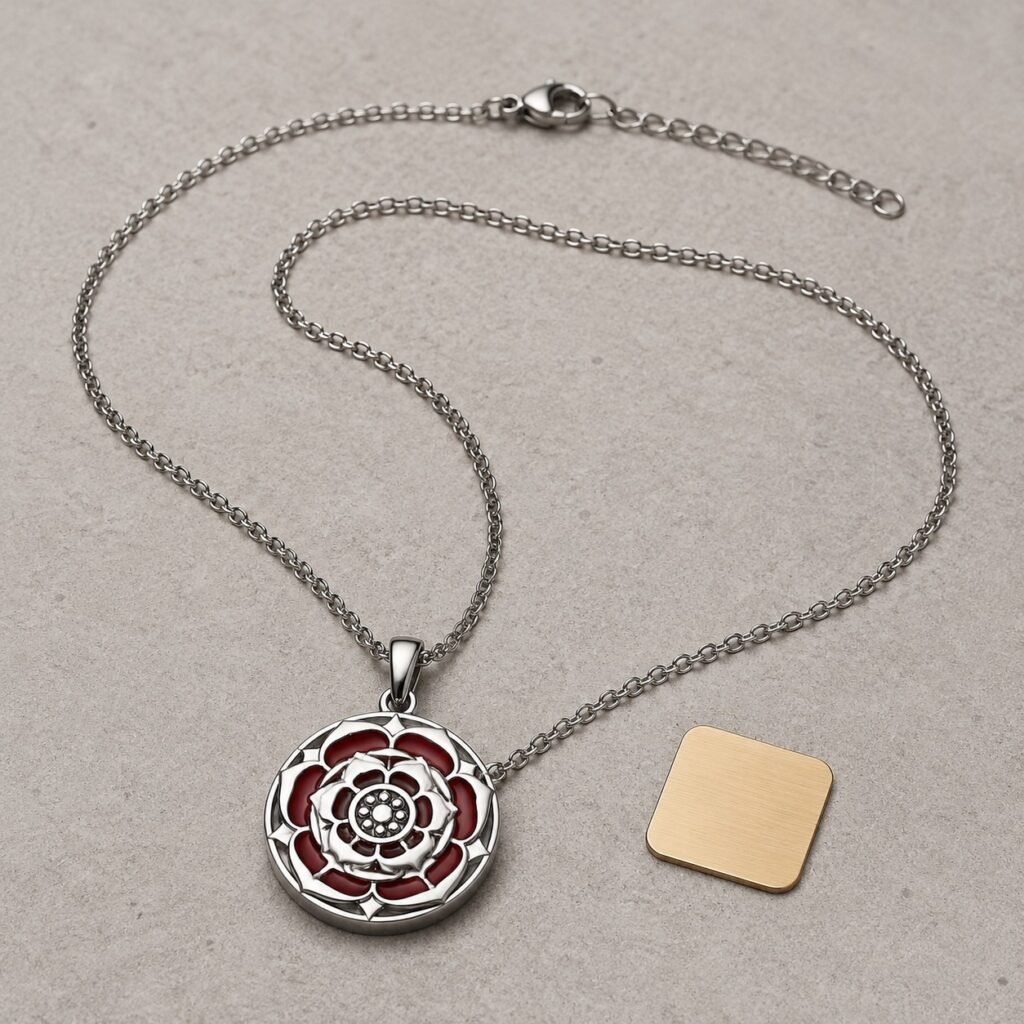
Pendant Necklaces
We develop the Tudor Rose as a central medallion, openwork pendant, colored emblem, or layered relief. We confirm pendant dimensions, thickness, weight, bail opening, front orientation, chain type, chain length, extension chain, clasp, and whether the pendant moves freely or remains fixed. We also approve the back profile and display position.
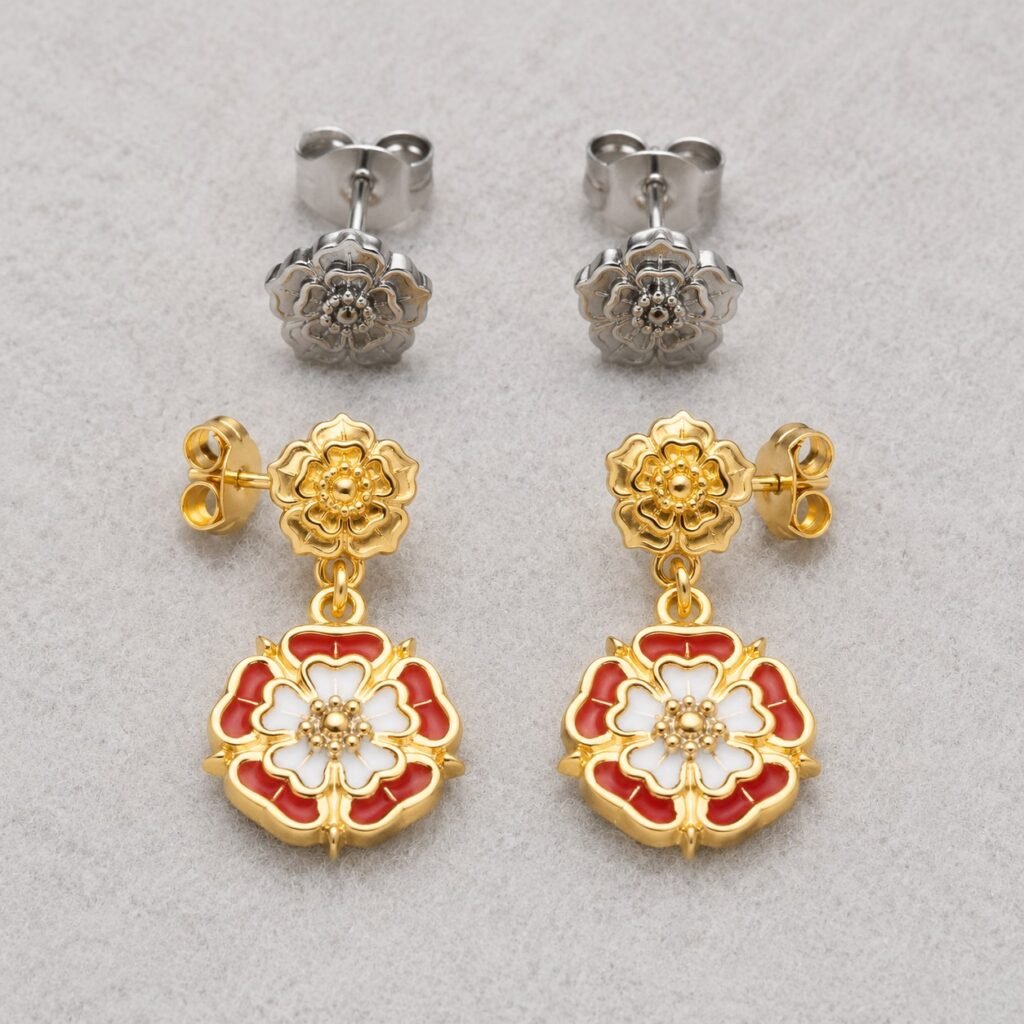
Stud Drop Earrings
We simplify the motif without losing petal recognition. We specify single-piece or articulated construction, left-right orientation, post material, post diameter and effective length, welding position, backing type, single-ear weight, pair weight difference, and pull-test requirement. We also confirm how both earrings align on the card, when worn, and in retail photography.
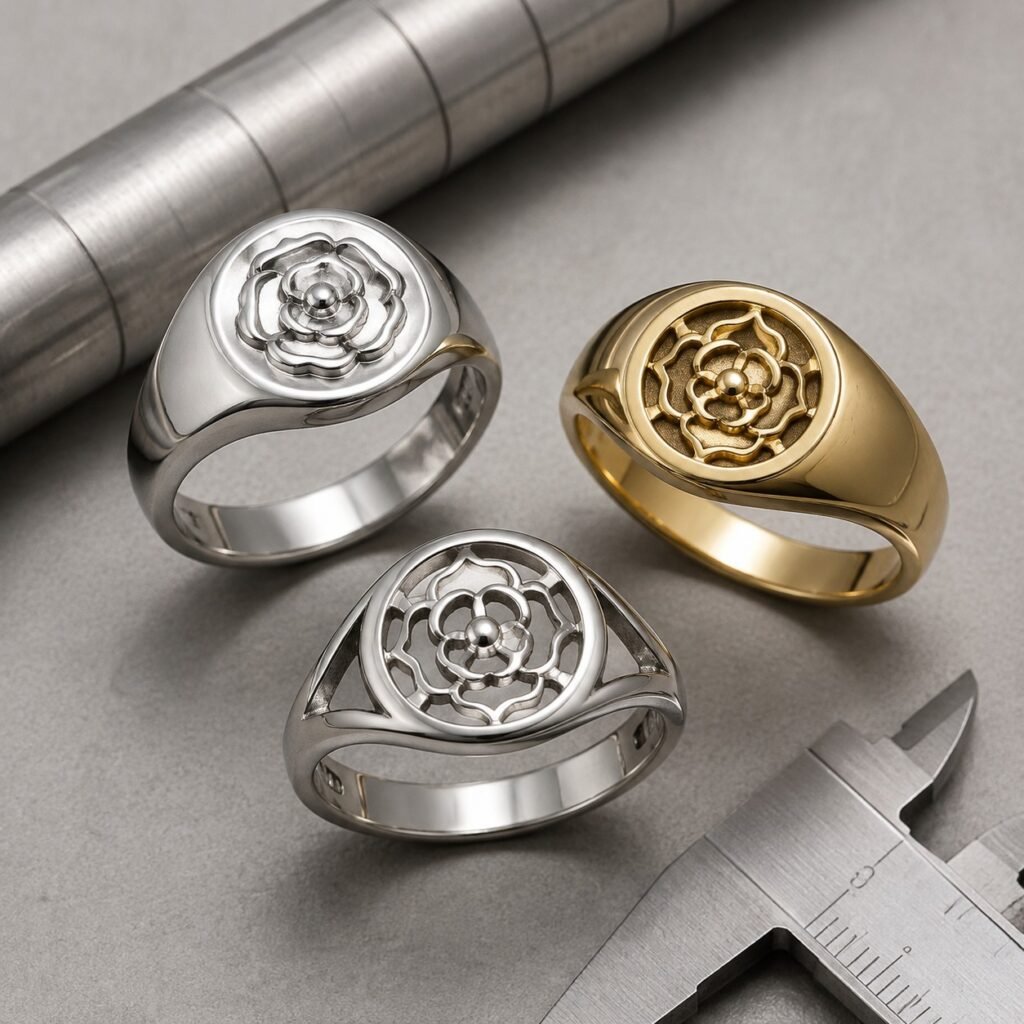
Rings And Signets
We apply the rose as a signet face, recessed pattern, openwork feature, enamel insert, or engraved detail. We confirm the ring-size system, inner diameter, face dimensions, band thickness, edge comfort, target weight, size range, and the effect of polishing or coating. The approved size-conversion basis is recorded for each production variant.
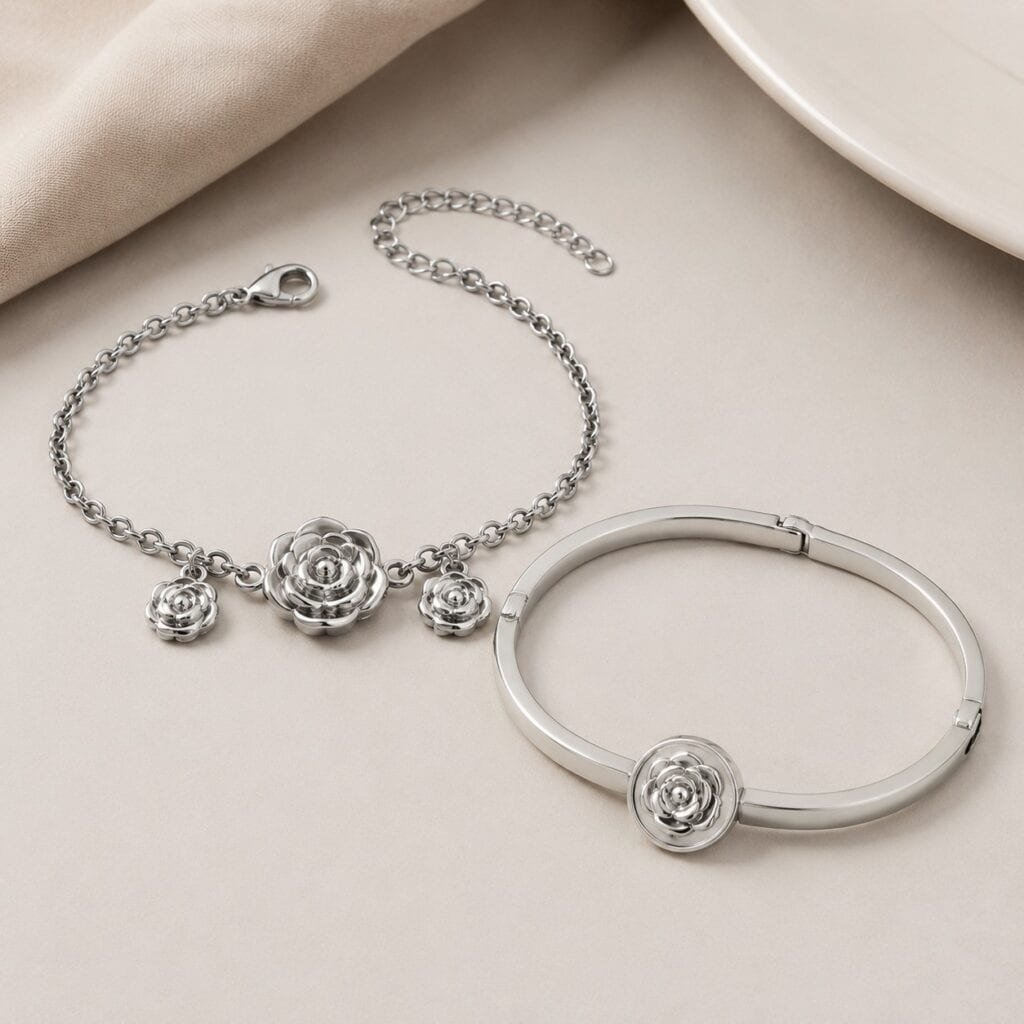
Bracelets And Bangles
We use a central charm, repeating rose links, engraved plate, or hinged emblem. We define finished length or internal dimensions, wrist fit, link direction, clasp, connecting-ring size, movement clearance, charm rotation, pull strength, and protection against tangling or surface contact. We check the assembled drape and comfort before size grading.
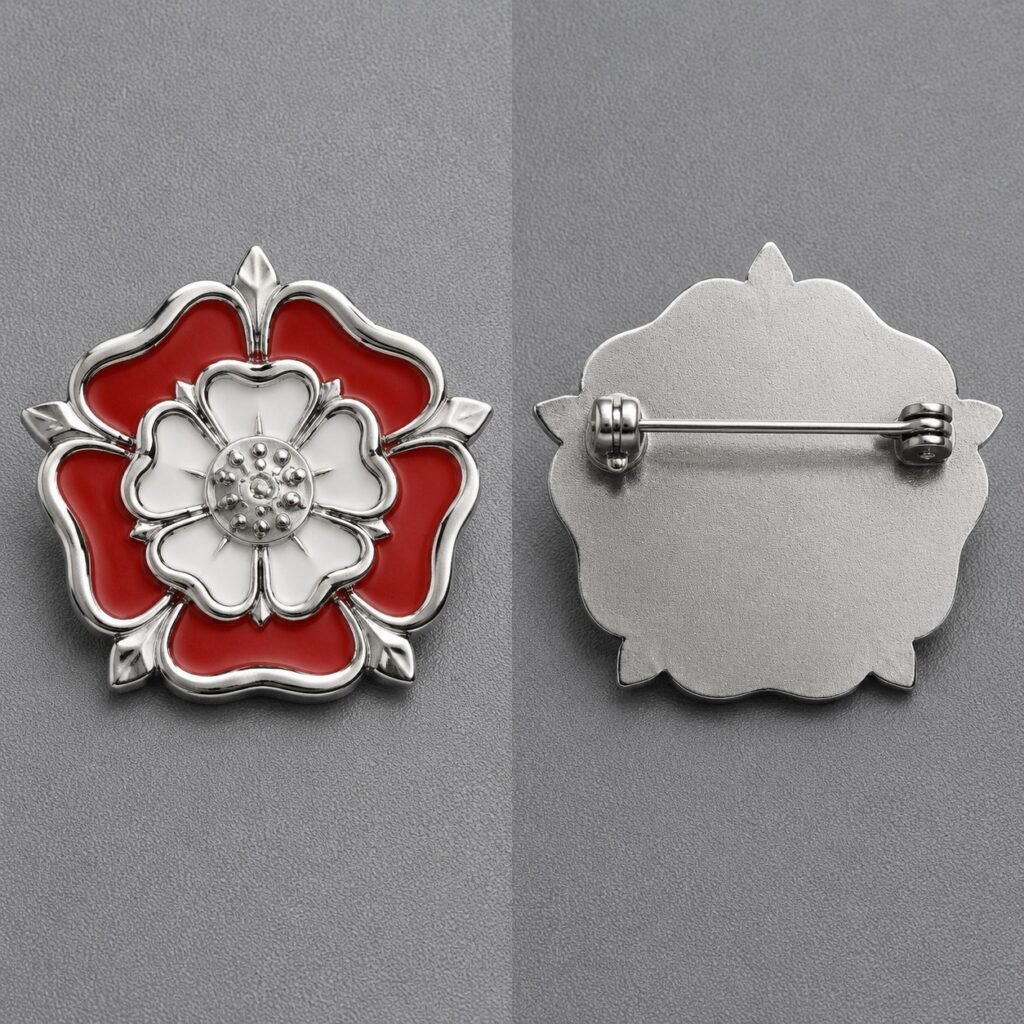
Brooches And Pins
We use the larger brooch surface to preserve layered petals, color zones, text, or a commemorative border. We confirm pin direction, hinge and catch structure, sharp-point protection, garment position, weight, back engraving, card fixing, and retail-packaging safety. Before release, we inspect the catch for secure closure, practical handling, and point protection.
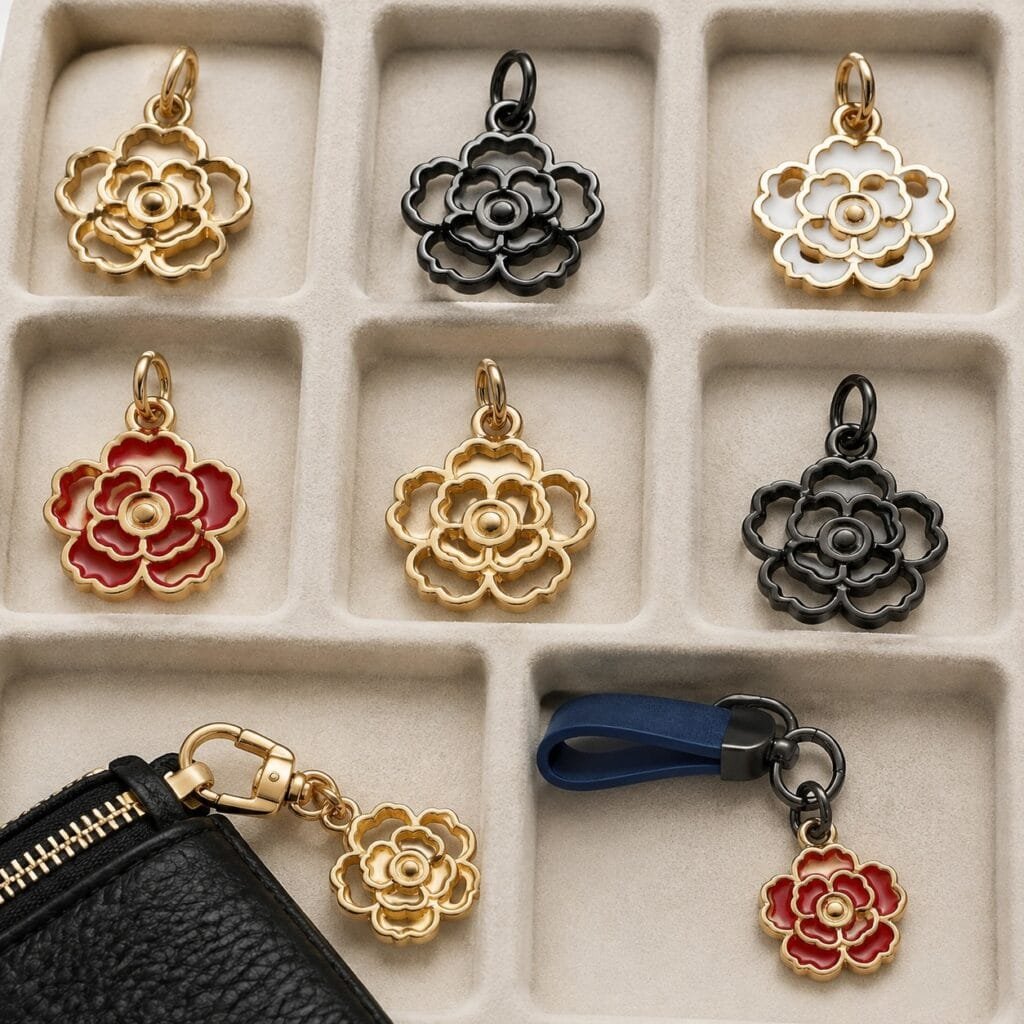
Charms And Accessories
We develop the motif as a detachable charm, bag charm, key accessory, zipper pull, or identification piece. We specify the connection, jump-ring closure, swivel or fixed orientation, engraving area, expected load, edge condition, dimensions, and use environment. Non-jewelry applications receive a separate load, attachment, labeling, and packaging review before production.
Matching Jewelry Sets
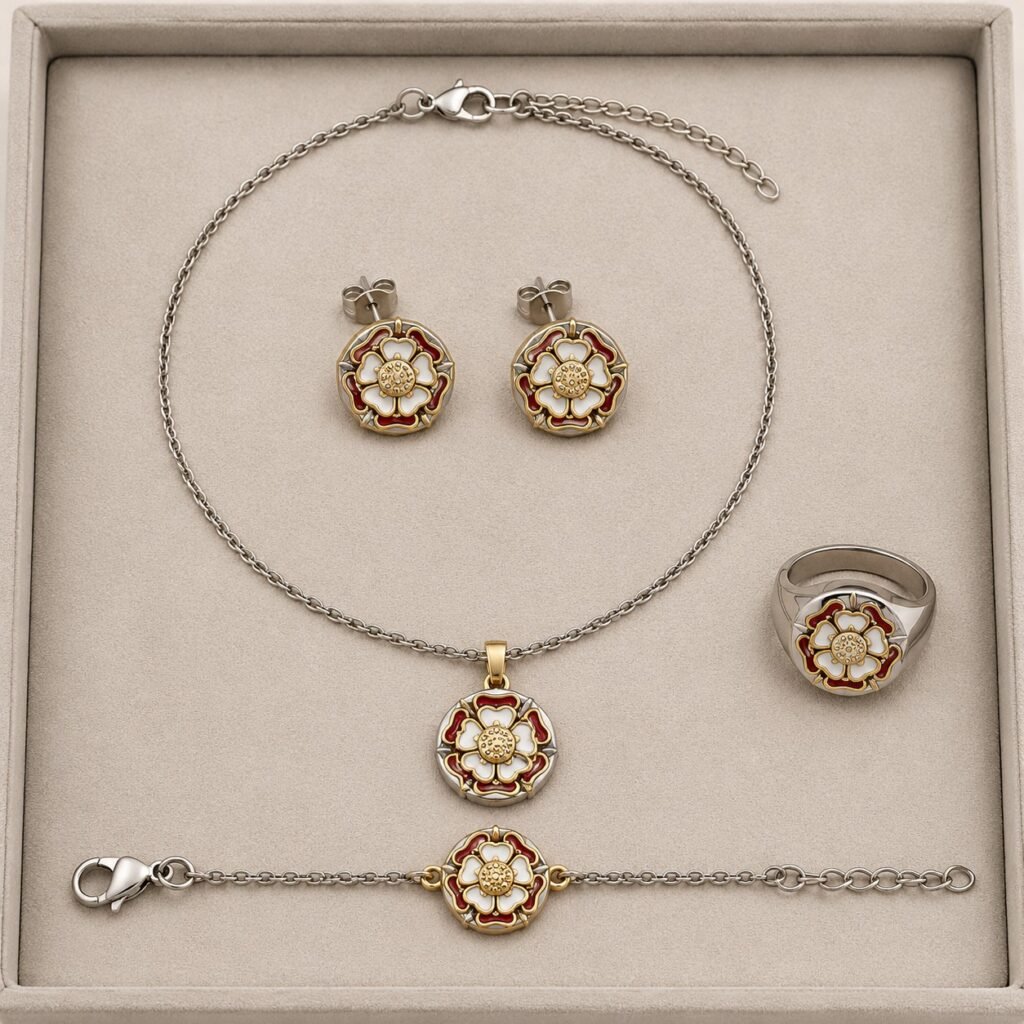
We coordinate pendants, earrings, rings, and bracelets through shared petal geometry, finish, color, logo, and packaging. Each SKU keeps its own engineering specification, while the approved master artwork and color standard control collection consistency. We document pairing, presentation order, and set-level inspection before packing begins for every approved set configuration.
Gift Souvenir Editions
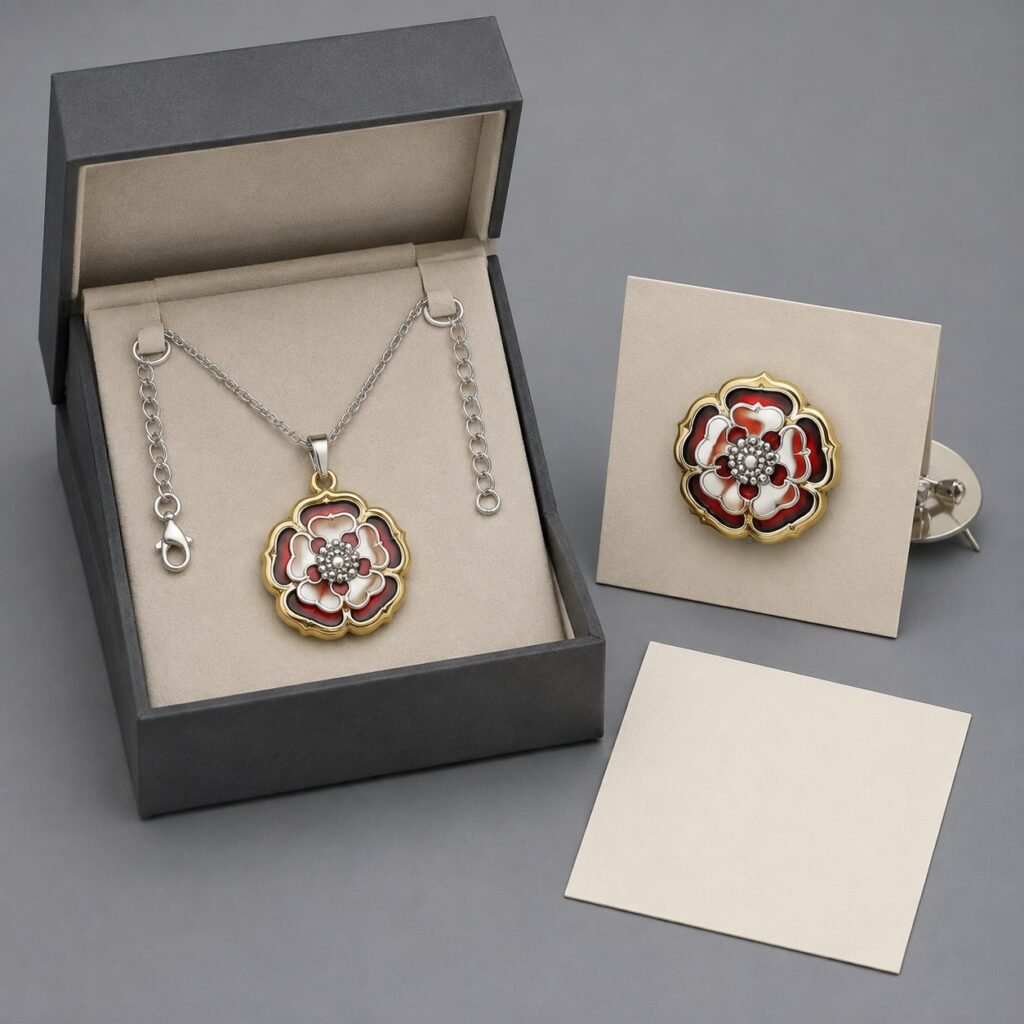
We create retail-ready editions with approved commemorative text, edition labels, story cards, product cards, barcodes, pouches, or gift boxes. Before development, we confirm authorization, channel, quantity, target retail price, launch date, packaging language, country labeling, and inspection requirements. Edition numbering and replacement terms are recorded in the SKU file when required.
Control Petal Detail, Strength, Weight, And Wearability
Small changes in petal width, negative space, relief, edge profile, or attachment position can alter appearance, strength, polishing access, coating coverage, and unit cost. Chicolink completes a design-for-manufacturing review before confirming the production route and sample plan. The review converts visual intent into controlled dimensions, tolerances, material forms, process assumptions, attachment details, validation items, and buyer decisions that can be inspected during bulk production.
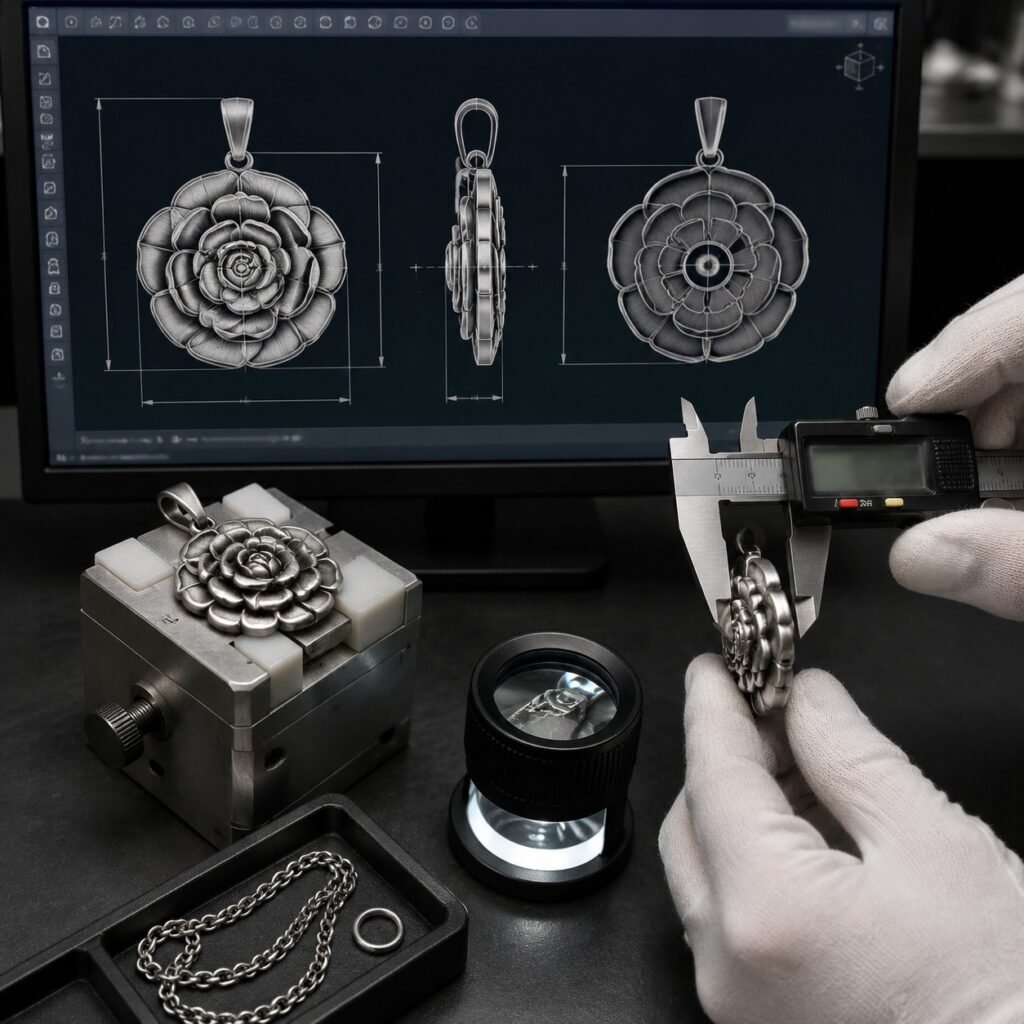
Turn The Approved Artwork Into A Measurable Specification
- Front, side, and back geometry: Define the overall length, width, thickness, relief height, recessed areas, back profile, and primary visual surface. Renderings alone are not used to control critical dimensions.
- Petals and metal bridges: Narrow gaps, fine outlines, and small metal bridges are checked against material thickness, cutting or casting limits, deburring access, and polishing loss. For sheet cutting, hole size and narrow-bridge width generally should not be smaller than the material thickness as an initial DFM reference; the final value requires engineering and sample approval.
- Casting thickness: Conventional solid cast sections may begin from approximately 0.8-1.2 mm for initial assessment. Local petals, long thin sections, recessed zones, and post-finishing dimensions require separate validation.
- Attachment engineering: Confirm bail type, internal opening, jump ring, fixed or moving pendant behavior, ear-post location, pin orientation, or bracelet connection. The attachment must support correct display and intended use.
- Surface access: Deep recesses, sharp valleys, undercuts, and enclosed cavities are reviewed for polishing, cleaning, drainage, coating, color filling, and inspection access.
- Wearability: Check edge rounding, skin-contact surfaces, center of gravity, pair weight, chain compatibility, rotation, and whether the product may expose sharp points after impact or wear.
- Controlled output: The review records the proposed process, key dimensions, tolerances, quality risks, customer decisions, sample validation items, file version, and approval status.
Match The Material To Structure, Finish, And Test Plan
Chicolink selects materials after reviewing the product category, wearing environment, geometry, machining route, finish, target market, cost objective, and customer test requirements. The product body, ear post, spring, screw, clasp, jump ring, and welding material may require separate entries in the BOM. Material grade is therefore one part of the specification, alongside supply form, dimensions, surface condition, coating system, direct skin contact, assembly method, inspection, and traceability.
| Material Or Component | Confirmed Chicolink Application | Tudor Rose Project Considerations | Required Confirmation |
|---|---|---|---|
| 304 stainless steel | Available in sheet, wire, bar, tube, and selected cast applications; supply is generally flexible | Suitable for many pendants, charms, cut patterns, chains, and structural parts after process review | Product structure, use environment, market, finish, test plan, and customer specification |
| 316L stainless steel | Contains molybdenum and generally offers better resistance to pitting | Higher hardness may increase forming, machining, welding, polishing, and correction difficulty for complex petals or relief | Wearing environment, structural complexity, production route, target cost, and sample validation |
| Cold enamel or epoxy | Creates colored recessed or filled areas under low- or medium-temperature curing conditions | Can express red-and-white zones, but cell shape, fill depth, overflow, bubbles, curing, polishing, and adhesion need control | Color reference, material naming, fill area, finish sequence, adhesion criteria, and compatibility test |
| Paint, lacquer, or resin fill | Supports decorative color where the approved process is suitable | Useful for selective petal color, fine accents, or price-positioned programs; it must not be described as fired enamel | Color code, surface preparation, curing route, edge acceptance, wear test, and packing protection |
| CZ, glass, crystal, or other stones | Supported through evaluated setting or adhesive routes | Can define the flower center or selected petals, but stone height, setting space, symmetry, and adhesion affect DFM | Material, shape, cut, size, color, quantity, setting method, and pull or push criteria |
| Chains, clasps, posts, and findings | Selected and specified separately from the main decorative body | Attachment materials and dimensions affect orientation, strength, comfort, coating color, and replenishment consistency | Material, dimensions, wire diameter, opening direction, welding or assembly, finish, and load requirement |
Decision Note
A stainless steel grade alone does not establish nickel-release performance, skin compatibility, coating durability, or market compliance. Testing must be defined for the specific material, finish, color, construction, sample, and destination market.
Compare Detail, Relief, Tooling, Volume, And Production Risk
Chicolink selects the production route according to whether the Tudor Rose is flat, layered, recessed, openwork, stone-set, colored, or fully three-dimensional. We balance tooling, unit cost, volume, finishing access, sample validation, and repeat-order needs. The selected route must preserve the approved design while remaining practical to clean, finish, inspect, pack, and reproduce. We document the trade-offs before the buyer approves the route.
| Process Route | Best-Fit Tudor Rose Structure | Main Strength | Key Risk To Validate | Commercial Consideration |
|---|---|---|---|---|
| Laser or wire cutting | Flat two-dimensional outlines, openwork petals, plates, and silhouette charms | Direct control from a 2D cutting file and efficient development of flat forms | Burrs, narrow bridges, distortion, edge rounding, hole position, and loss of fine features during polishing | Suitable when flat geometry and sheet construction meet the design objective |
| Stamping or hydraulic forming | Flat or curved medallions, repeated embossed patterns, and higher-volume parts | Repeatable forming after tool approval | Cracking, warping, uneven relief, spring-back, tool marks, and dimensional change after finishing | Requires tooling; value improves when volume and repeat demand justify the setup |
| Casting | Layered petals, sculpted relief, thicker medallions, complex backs, and integrated settings | Supports complex three-dimensional geometry | Shrinkage, porosity, incomplete fill, deformation, overweight sections, and over-polishing | Tooling, sample iteration, weight, and finishing labor affect cost and timing |
| CNC machining | Precision recesses, selected engraving, complex structure, or controlled hard edges | High dimensional control where tools can reach | Internal radius limits, deep narrow grooves, vibration, long machining time, and tool access | Best reserved for features that justify the machining time and cost |
| Laser engraving or etching | Fine outlines, text, dates, petal veins, recessed graphics, and back marks | Adds graphic definition without creating a separate component | Fine lines may merge, break, become uneven, or disappear after polishing and coating | Line width, spacing, depth, finish sequence, and readability must be sampled |
| Cold enamel or epoxy fill | Red-and-white petals, center accents, recessed brand colors, and decorative cells | Adds controlled color contrast to a metal motif | Bubbles, overflow, incomplete fill, contamination, cure variation, and adhesion | Color matching, application labor, curing, inspection, and protection affect quotation |
| 3D-printed prototype | Complex concept verification before production tooling | Helps review scale, relief, thickness, and visual balance | Prototype behavior does not automatically prove metal-production capability | Used as a development aid, not Chicolink's default mass-production method |
| MIM evaluation | Small complex parts with sustained repeat volume | Potential efficiency for suitable high-volume programs | High tooling investment, shrinkage control, and process suitability | Generally evaluated for programs around 5,000 pieces or more with continuing demand |
Use Finish And Contrast To Define The Rose
Chicolink can produce the Tudor Rose in bare steel, PVD color, textured surfaces, selective color filling, or raised-and-recessed contrast. Before bulk production, we confirm the finish sequence, color reference, approved sample, inspection method, and packaging protection. The finish plan also defines visual surfaces, contact points, recesses, component matching, permitted variation, test requirements, and repeat-order controls for every approved finish.
Polished Bare Steel
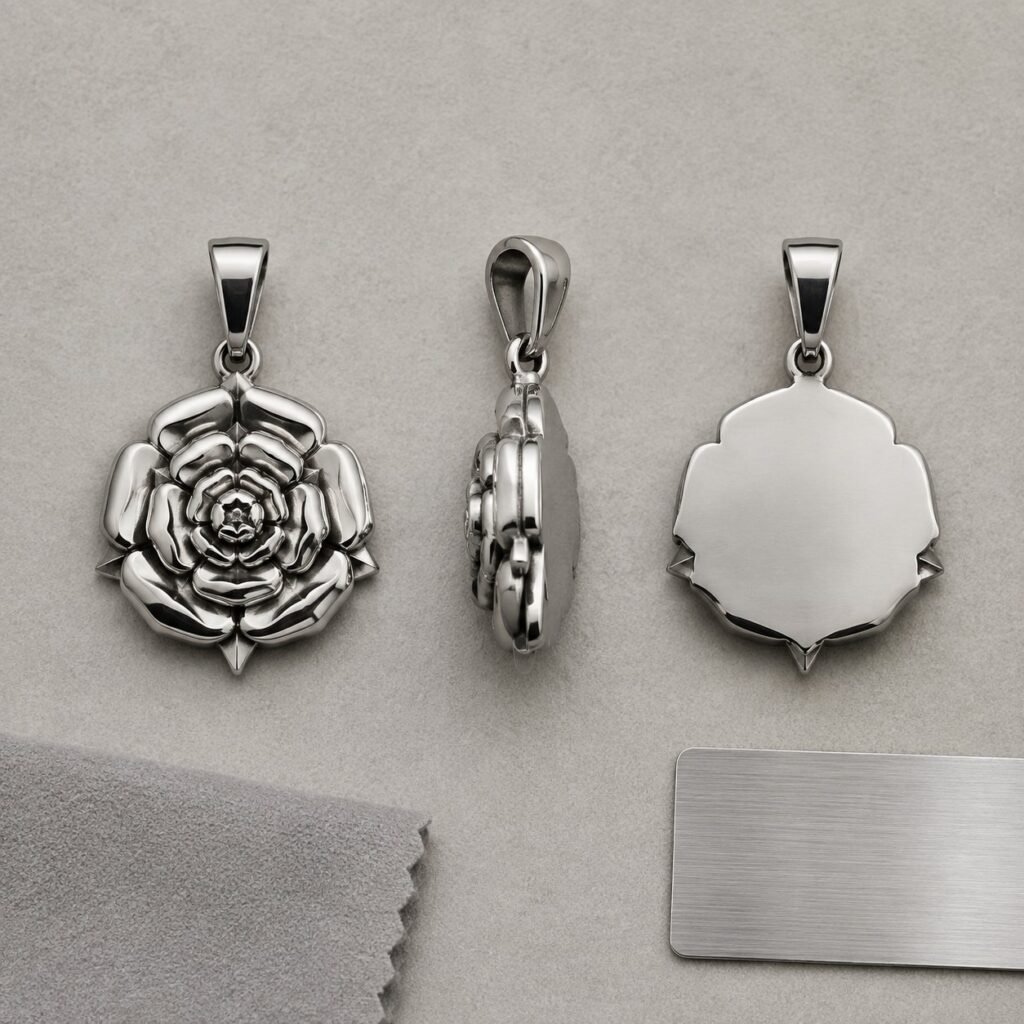
A polished bare-steel interpretation relies on reflection, relief, and clean edges rather than applied color. The design must provide polishing access around inner petals and recesses. Surface condition, visible tool marks, edge profile, passivation decision, and corrosion-test requirement are confirmed by project. The approved sample defines how much contrast remains between raised petals, valleys, borders, and the back surface during production and repeat orders.
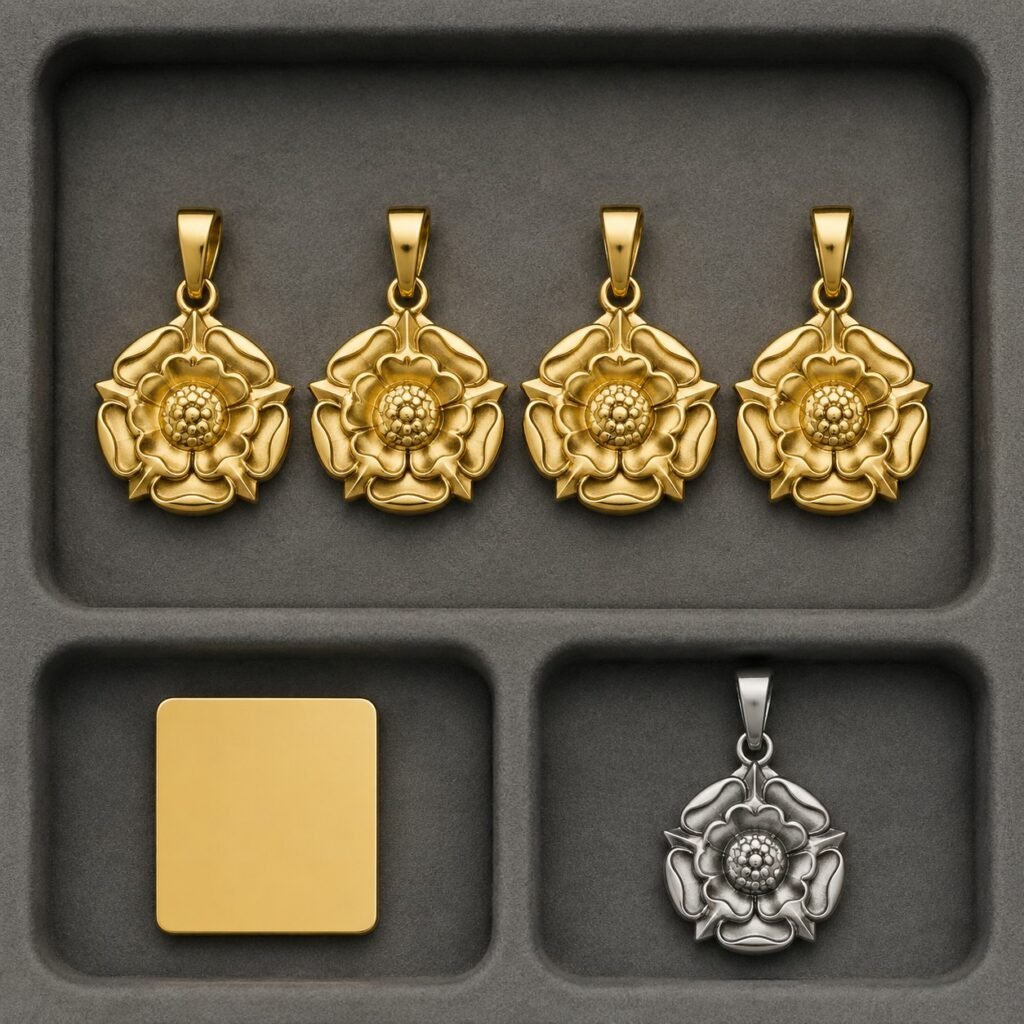
PVD Gold
PVD gold can give a heritage motif a premium retail position. Chicolink operates an in-house plating workshop with six PVD vacuum-coating machines. Color, pretreatment, layer structure, target thickness, hanging points, approved standard, measurement method, and test duration must be confirmed for the order. Chains, clasps, jump rings, posts, and pendants are reviewed for component-to-component color consistency during sampling and bulk inspection.
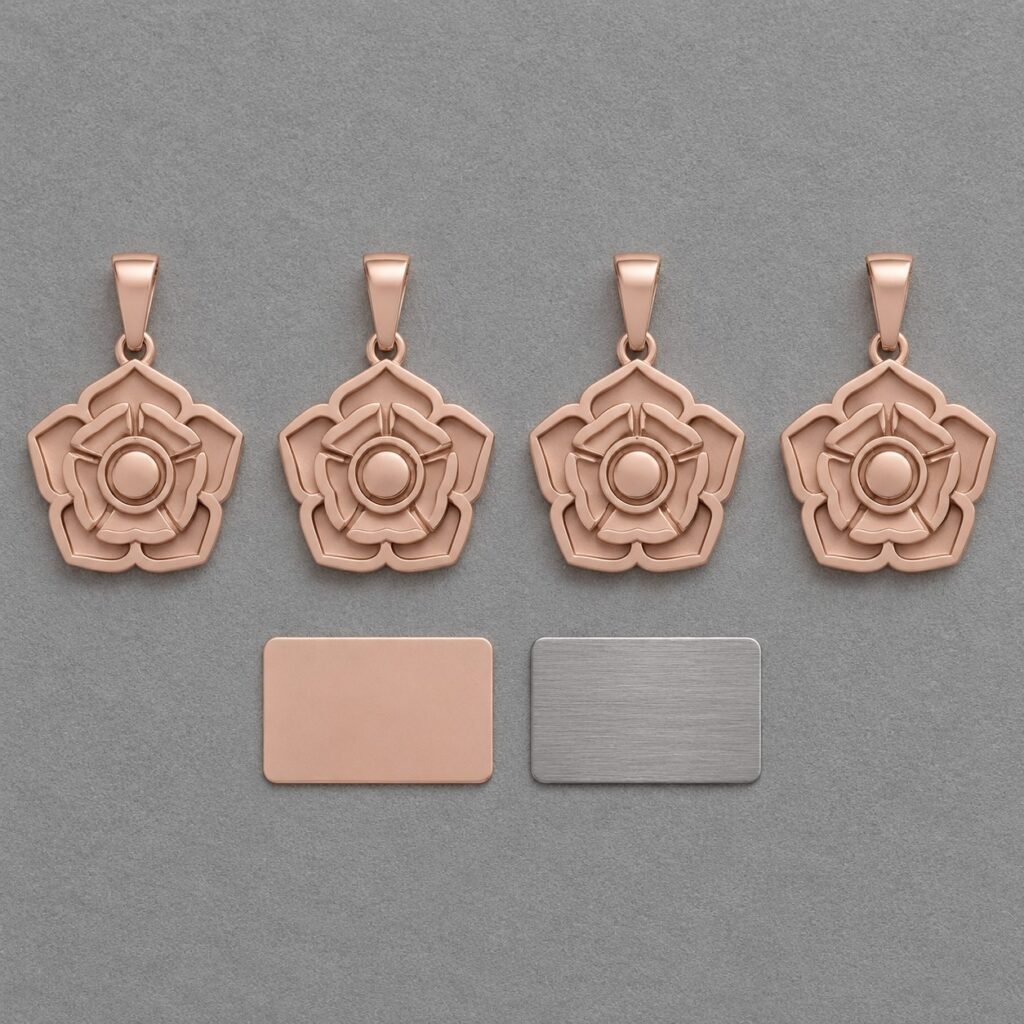
PVD Rose Gold
Rose-gold PVD creates a softer interpretation for fashion, bridal, or gift collections. A physical color sample or approved standard is required because screen colors are not production standards. Recess depth, surface texture, part orientation, and adjacent components can affect perceived color. Bulk inspection uses the agreed reference, viewing conditions, measurement locations, and permitted variation recorded for the project and each production batch.
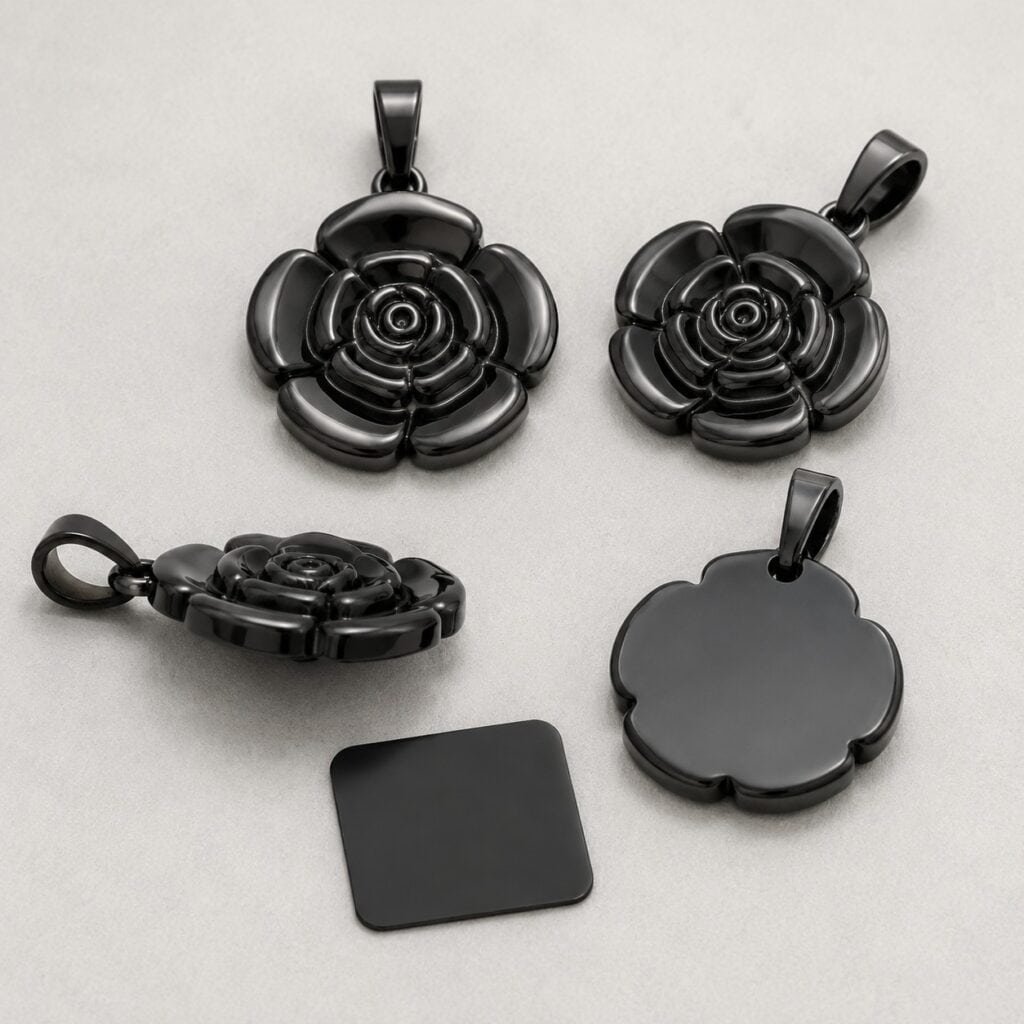
PVD Black
Black PVD can support men's, contemporary, or high-contrast Tudor Rose collections. Raised edges, deep recesses, attachment points, and post-assembly contact areas require review. The specification should define target appearance, permitted variation, test plan, and packaging protection against surface abrasion. Light reflection and texture are approved because they can change how the petal layers read visually during transport and storage.
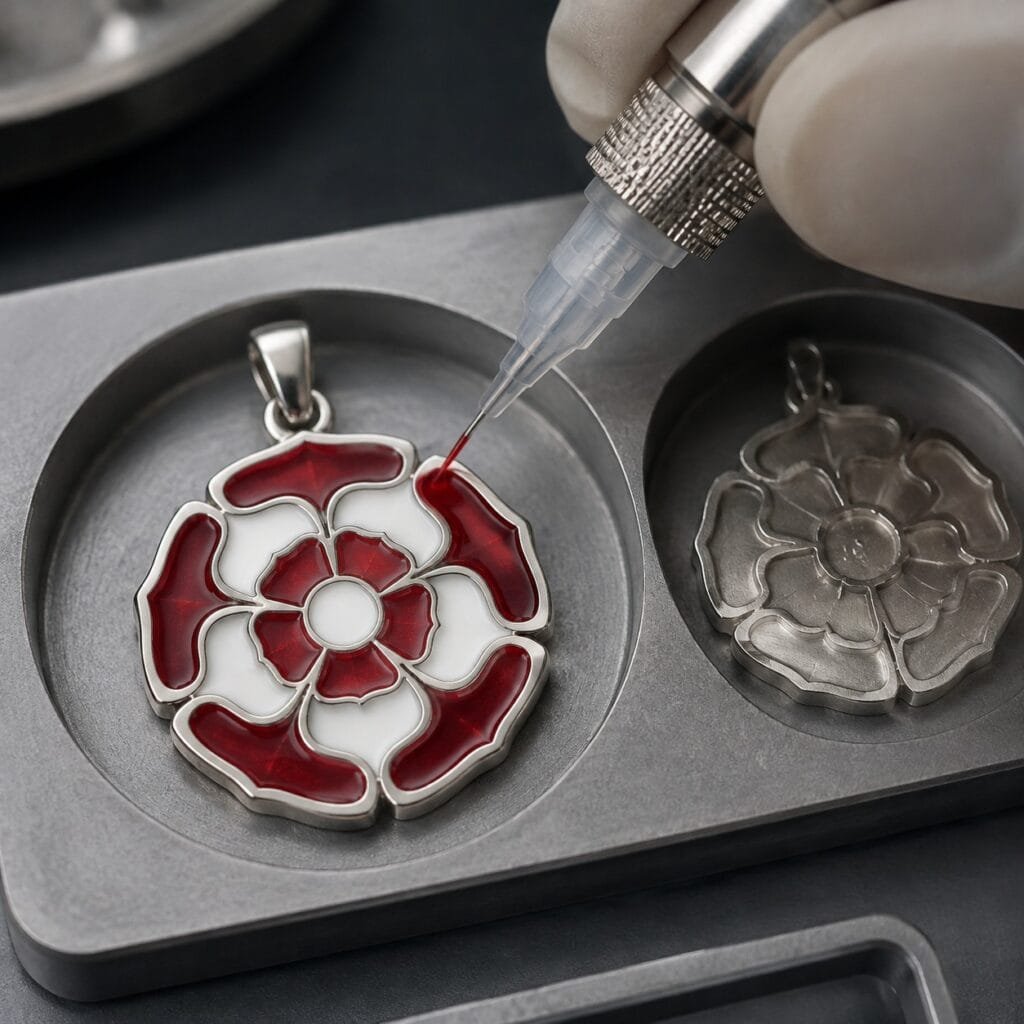
Red White Filling
Red-and-white cold enamel, epoxy, paint, lacquer, or resin filling can express the recognized color relationship of the motif. The exact material name, Pantone or physical color reference, cell boundaries, fill depth, surface level, curing route, adhesion check, and acceptance criteria must be documented. The buyer also approves whether small edges, corners, or recesses permit visible metal boundaries in the final specification.
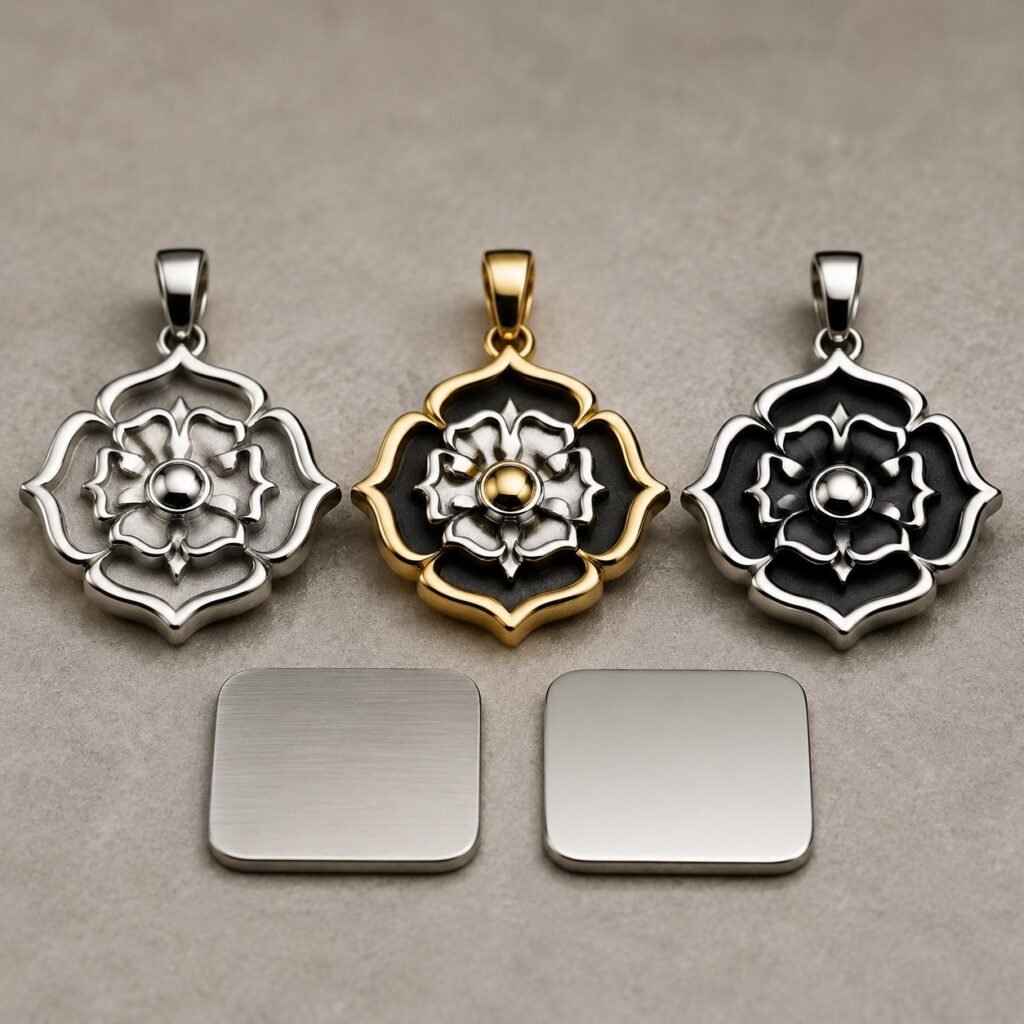
Two Tone Contrast
A two-tone or texture-contrast design can separate outer petals, inner petals, center detail, and border without filling every area. Chicolink evaluates the process sequence, masking or selective-treatment feasibility, color interaction, edge definition, inspection access, added handling, and impact on cost and lead time. A dedicated sample confirms whether the intended contrast remains stable after assembly, final cleaning, and placement in the approved retail pack.
Close Structural And Finishing Risks Before Tooling
Common Tudor Rose production risks begin before sampling: fine details may disappear during polishing, recesses may be difficult to clean, attachments may shift the pendant, and small color cells may fill unevenly. Chicolink records each risk during DFM review and assigns one action: approve, modify, validate through a defined sample, or hold until the missing requirement is confirmed.
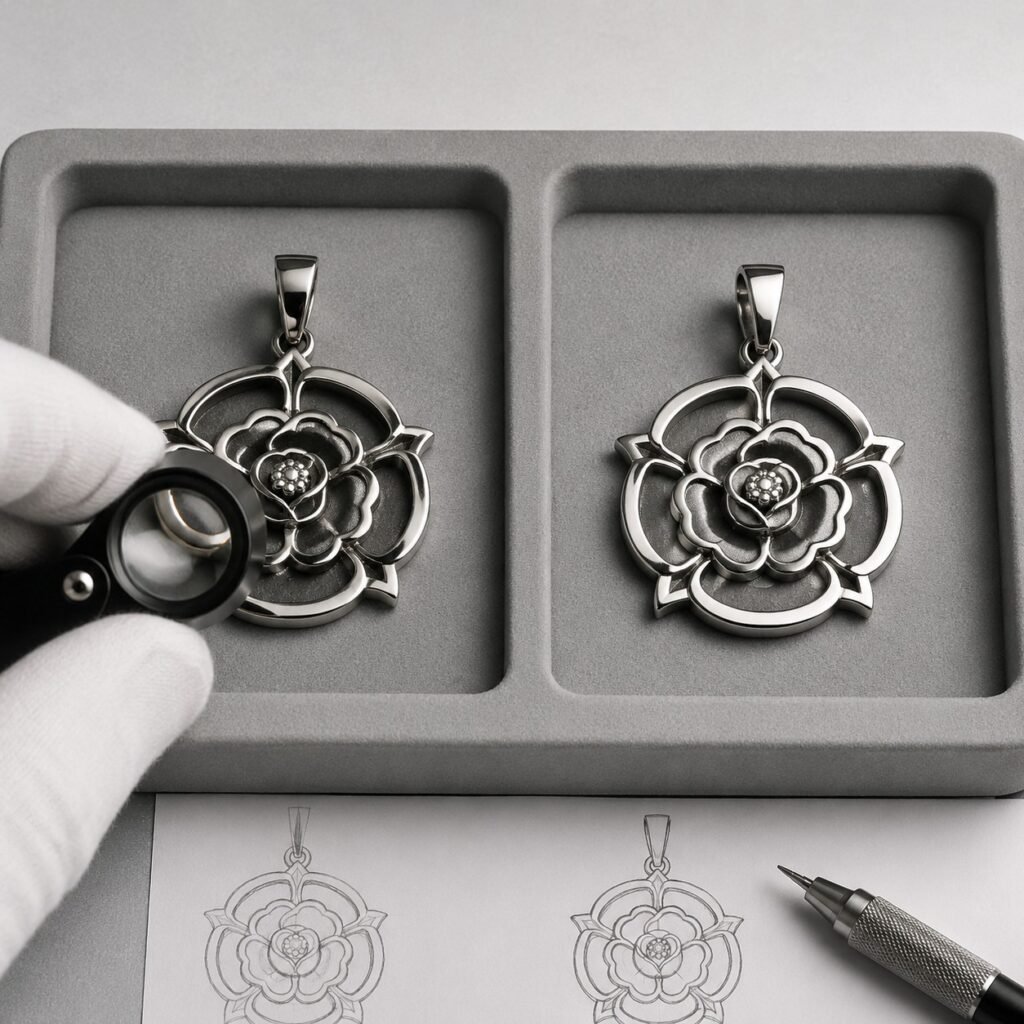
Eight Risks That Require A Project Decision
- Petal details disappear: Fine lines, narrow spacing, and shallow relief may merge or fade after casting, cutting, deburring, polishing, and coating. Chicolink compares the finished appearance, not only the CAD image.
- Narrow bridges bend or break: Openwork designs need enough metal around petal gaps, center details, and attachment points. Width is reviewed against material thickness, product size, process, and expected load.
- Deep recesses trap residue: Enclosed valleys can retain polishing compound, cleaning liquid, coating contamination, resin, or moisture. Drainage, cleaning access, and process order must be considered.
- Polishing changes symmetry: Repeated manual access around small petals can round one side more than another. Critical profiles and visual acceptance points should be defined on the approved sample.
- Color crosses cell boundaries: Red-and-white filling needs producible walls, controlled fill depth, clean surfaces, and an agreed edge standard. Very small cells may require enlargement, simplification, or another visual method.
- Coating appears uneven: Deep recesses, holes, edges, welding points, and hanging points may not receive the same coverage as the main face. Measurement locations and non-primary surfaces must be defined.
- The pendant hangs incorrectly: Bail position, center of gravity, chain thickness, connection-ring direction, and pendant movement determine front-facing behavior. These are checked on the assembled sample.
- Packaging damages the surface: Raised petals, stones, chains, and polished areas can contact each other during transport. Card fixing, individual bags, protective layers, anti-tangling, and box clearance are planned with the product.
Approve The Design, Finish, Function, And Production Standard
Chicolink uses staged approval to separate visual decisions from production assumptions. Each approved file, sample, color reference, and change record becomes part of the project specification before bulk production is released. This prevents an unapproved rendering, obsolete drawing, informal message, or reference image from replacing the signed product, finish, function, packaging, and inspection standard used by production teams.
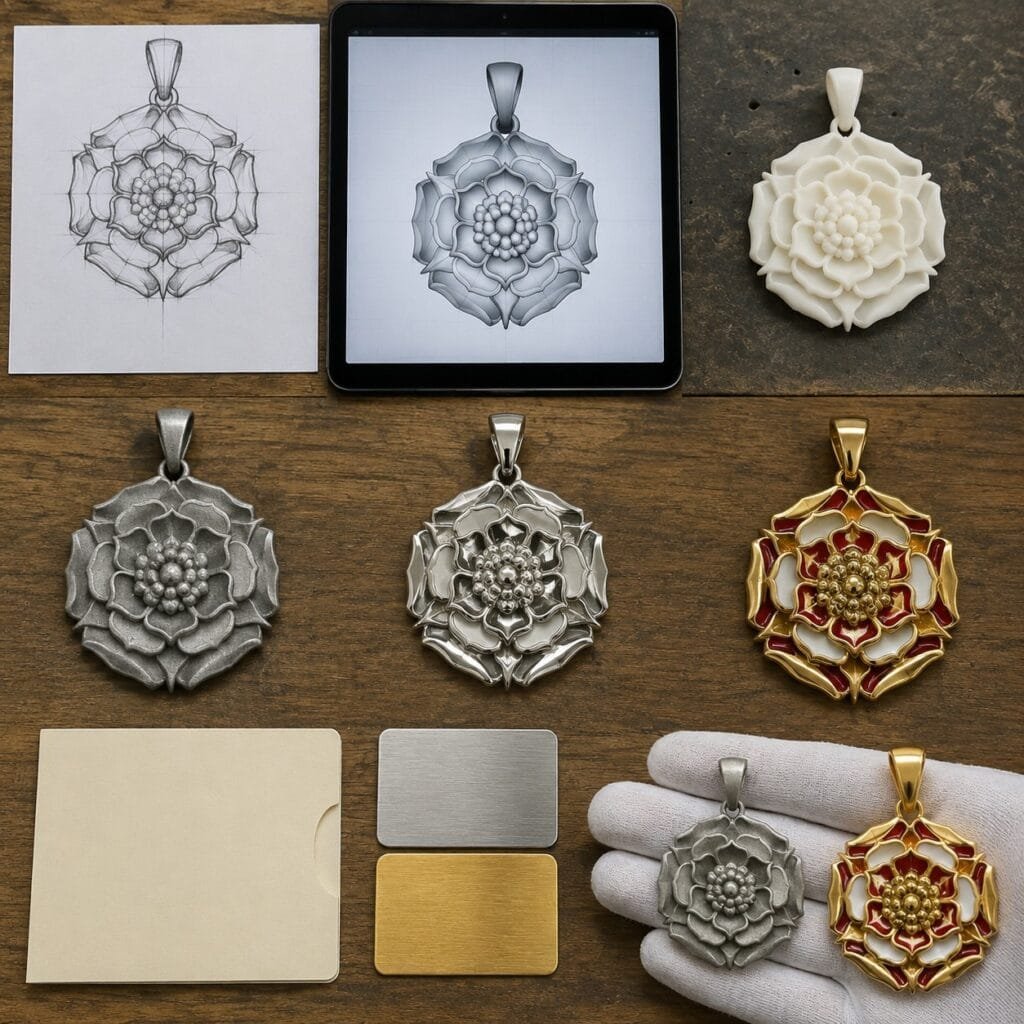
Seven Controlled Development And Approval Steps
1. Submit the project brief: Provide approved artwork or references, product category, dimensions, target quantity, destination market, finish, packaging, target price, test requirements, and required delivery date.
2. Complete feasibility review: We evaluate the material, structure, manufacturing route, tooling, surface access, decoration, attachment, quality risks, cost drivers, and information still requiring buyer confirmation.
3. Confirm quotation basis: The quotation identifies the agreed construction, quantity basis, color and size variants, tooling, sample requirement, packaging, testing, and commercial exclusions. Assumptions are closed before paid development starts.
4. Prepare controlled files: Drawings, CAD, BOM, artwork, logo position, color reference, stone map, chain, clasp, findings, and packaging files receive project and version identification.
5. Produce the required sample stage: Depending on risk, the project may use a visual prototype, white-metal sample, plated color sample, functional sample, packaging sample, or combined approval sample.
6. Record changes and approval: Each revision lists changed dimensions, structure, color, finish, decoration, logo, packaging, cost, or timing. Obsolete versions are removed from production use.
7. Release the production standard: The approved pre-production or golden sample, signed files, acceptance criteria, test plan, packing method, and approval record become the basis for first-piece confirmation and bulk inspection.
Select The Development Model That Matches Your Starting Point
Chicolink supports three starting points: complete technical files, a commercial concept that still needs product engineering, or confirmed products that need private labeling. We select the model according to design ownership, required development, tooling, quantity, differentiation, packaging, and approval scope. Confirming it early reduces unclear responsibilities, repeated revisions, cost changes, and schedule changes.
| Cooperation Model | Best Fit | Buyer Provides | Chicolink Provides | Project Boundary |
|---|---|---|---|---|
| OEM manufacturing | Brands with approved artwork, drawings, CAD, physical samples, or detailed specifications | Authorized files, dimensions, material, finish, logo, quantity, packaging, tests, target date, and approval contacts | DFM review, quotation, controlled files, sample execution, approved processing, in-house plating, QC, packing, and shipment coordination | Chicolink manufactures to the confirmed specification; changes require documented review and approval |
| ODM development | Brands with a Tudor Rose concept, target market, price position, product direction, and sales channel but no final production design | Commercial brief, target buyer, preferred categories, visual direction, target price, quantity plan, destination market, and launch timing | Style and structure proposals, material and process recommendations, collection planning, sample development, packaging coordination, and production planning | Development support is based on a defined commercial project and is not an unconditional free-design service |
| Private-label execution | Buyers using confirmed Chicolink styles or an approved custom collection with their own branding | Logo files, brand colors, packaging artwork, SKU and barcode data, labeling, pack configuration, quantity, and delivery requirement | Product marking, jewelry cards, pouches, gift boxes, care or story cards, barcode labels, packing execution, and export coordination | Product and packaging MOQs, color versions, artwork approval, and delivery timing are confirmed separately |
Connect The Jewelry, Story, Packaging, And SKU System
Chicolink coordinates product marking and private-label packaging through one approved brand system. After the buyer confirms authorization, artwork, dimensions, materials, quantities, and channel requirements, we connect the Tudor Rose motif to product names, color variants, pack configurations, barcode data, care content, retail presentation, carton information, and repeat-order records. This creates one traceable system for launch, replenishment, and later artwork or packaging revisions.

Product Brand Marks
We apply approved logos through laser marking, etching, stamping, embossing, a logo tag, or another confirmed route. We specify the file format, converted fonts, location, direction, dimensions, safe area, depth, minimum readable detail, and visibility during wear. We approve the mark on a finished sample before bulk production. The sample controls readability, position, depth, color, and surface condition during replenishment.
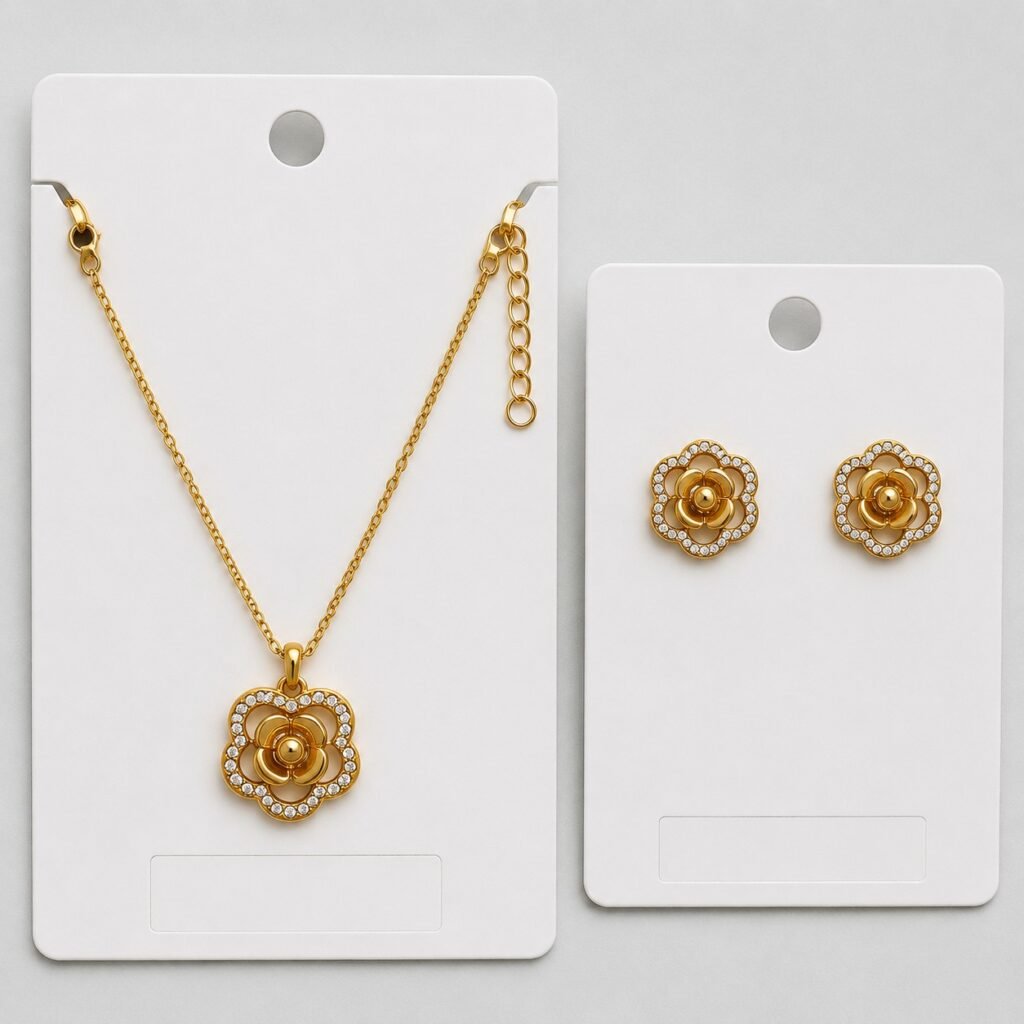
Collection Jewelry Cards
We coordinate cards for necklaces, earrings, rings, bracelets, brooches, and sets. We confirm card size, material, print colors, logo, product name, fixing method, hanging hole, barcode area, warnings, country information, and finish protection. The packed sample verifies product placement, chain routing, earring orientation, card strength, barcode position, and final presentation. We also check protection during storage, shipment, and retail display.
Story Care Cards
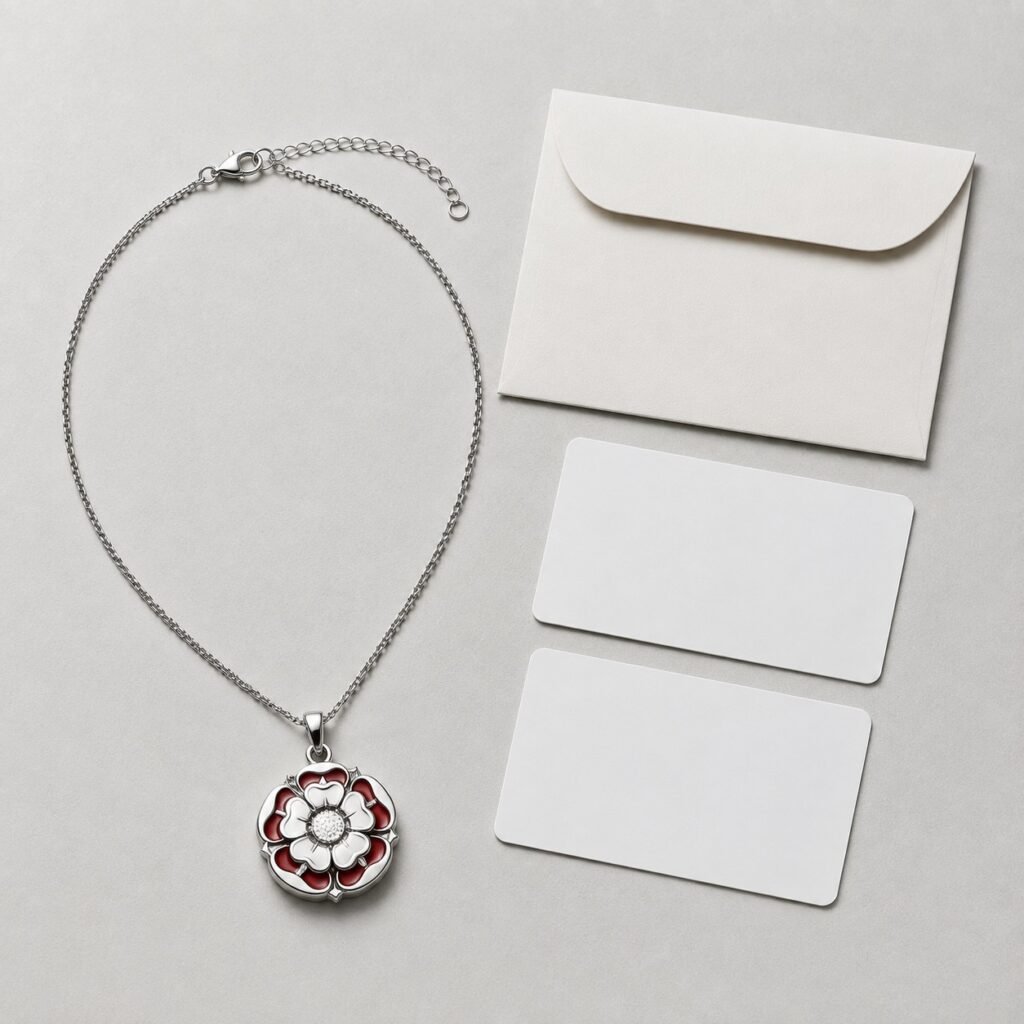
We print only buyer-approved collection stories, product descriptions, care instructions, material statements, and gift messages. The buyer approves claims and translations. Content does not imply royal, government, museum, or licensing approval without documentation. Before mass printing, we confirm the version, language, print proof, required legal review, and pack allocation for each packaging version. Approved files receive a version and release status.
Pouches Gift Boxes
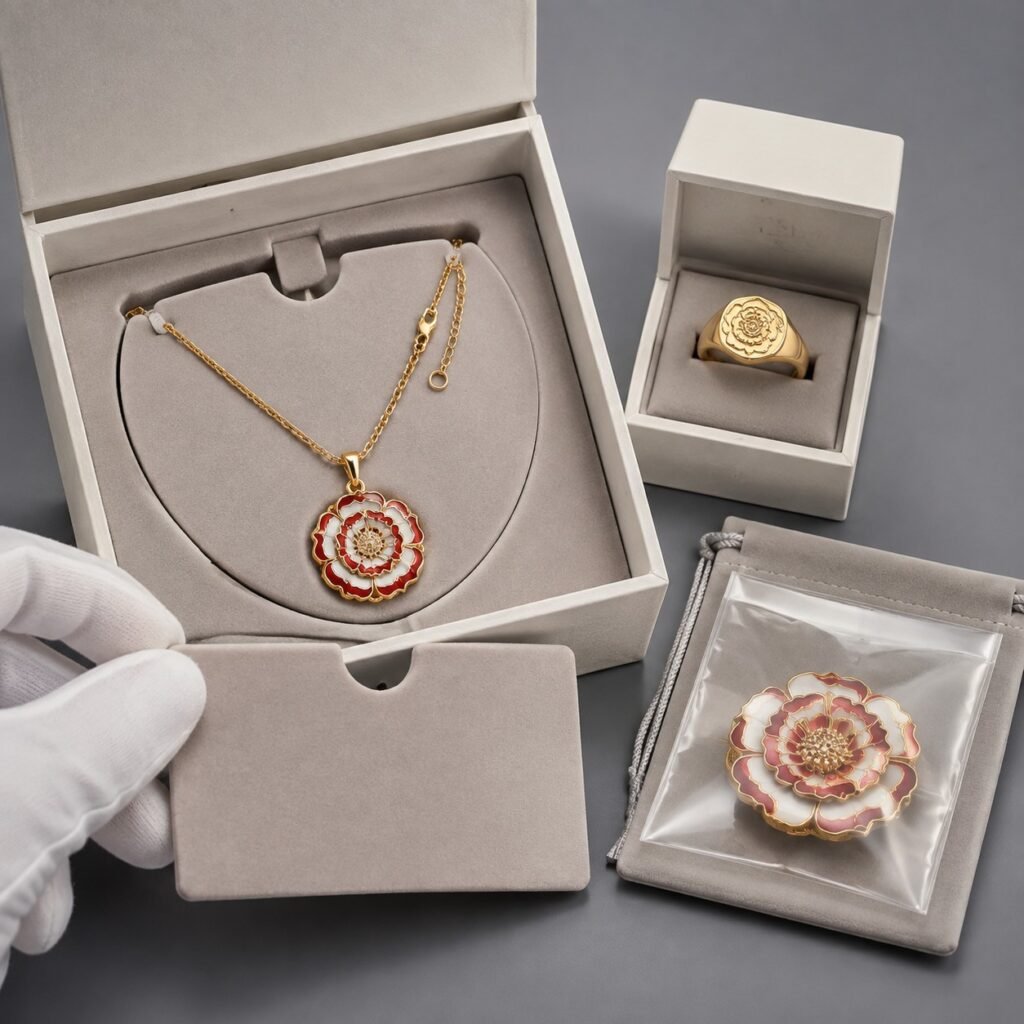
We coordinate pouches, gift boxes, inserts, ribbons, sleeves, and protective layers with the collection position. Using the finished jewelry and card, we review dimensions, movement, tangling, surface contact, stone pressure, presentation, transit protection, and packaging MOQ. A packaging sample verifies fit, opening experience, color, logo, insert pressure, and protection under the expected transport conditions. The final pack also receives protection checks.
Barcode SKU Labels
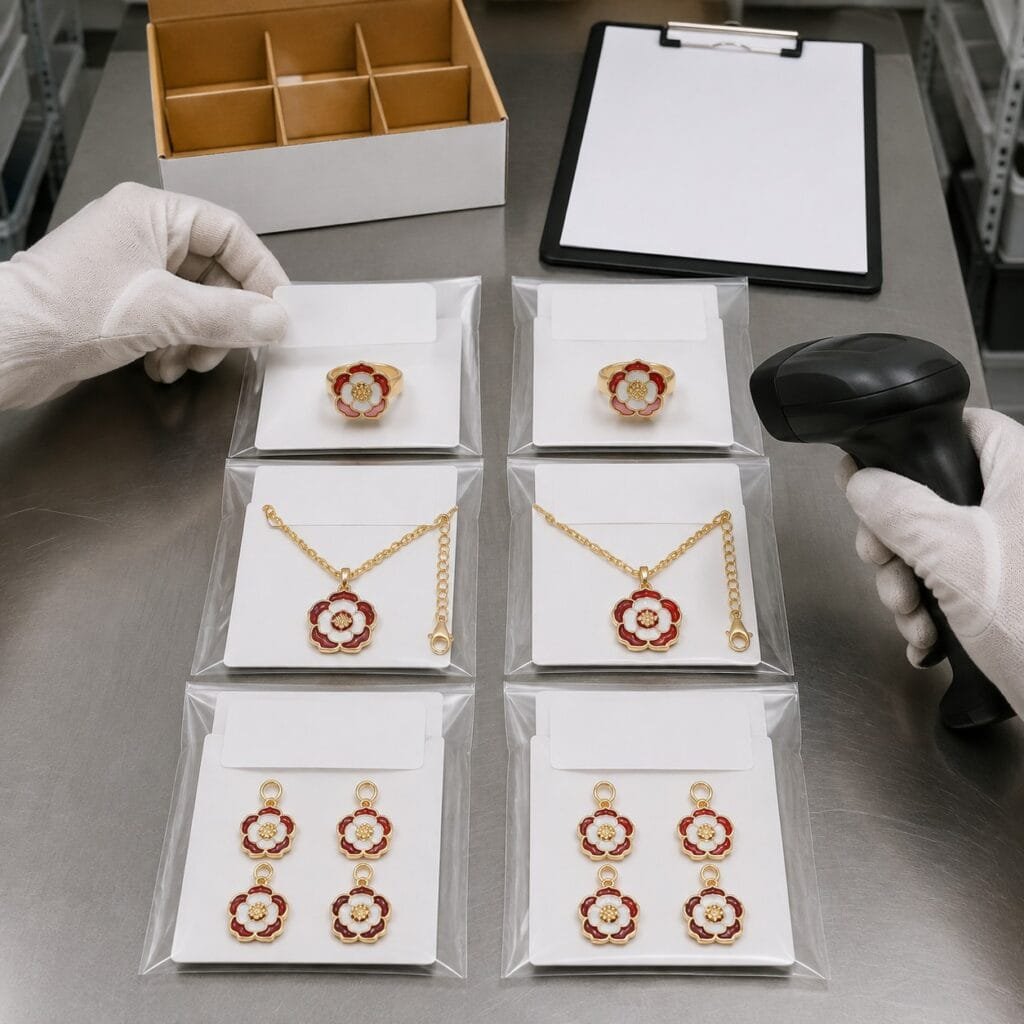
We control the product name, style number, size, color, finish, barcode, market label, and pack quantity through an approved SKU file. Variant data matches the purchase order, production record, inspection report, packaging artwork, carton mark, packing list, and commercial invoice. The buyer confirms barcode ownership, format, placement, scanning, and revisions before printing. Approved data files remain linked to each production order.
Retail Ready Sets
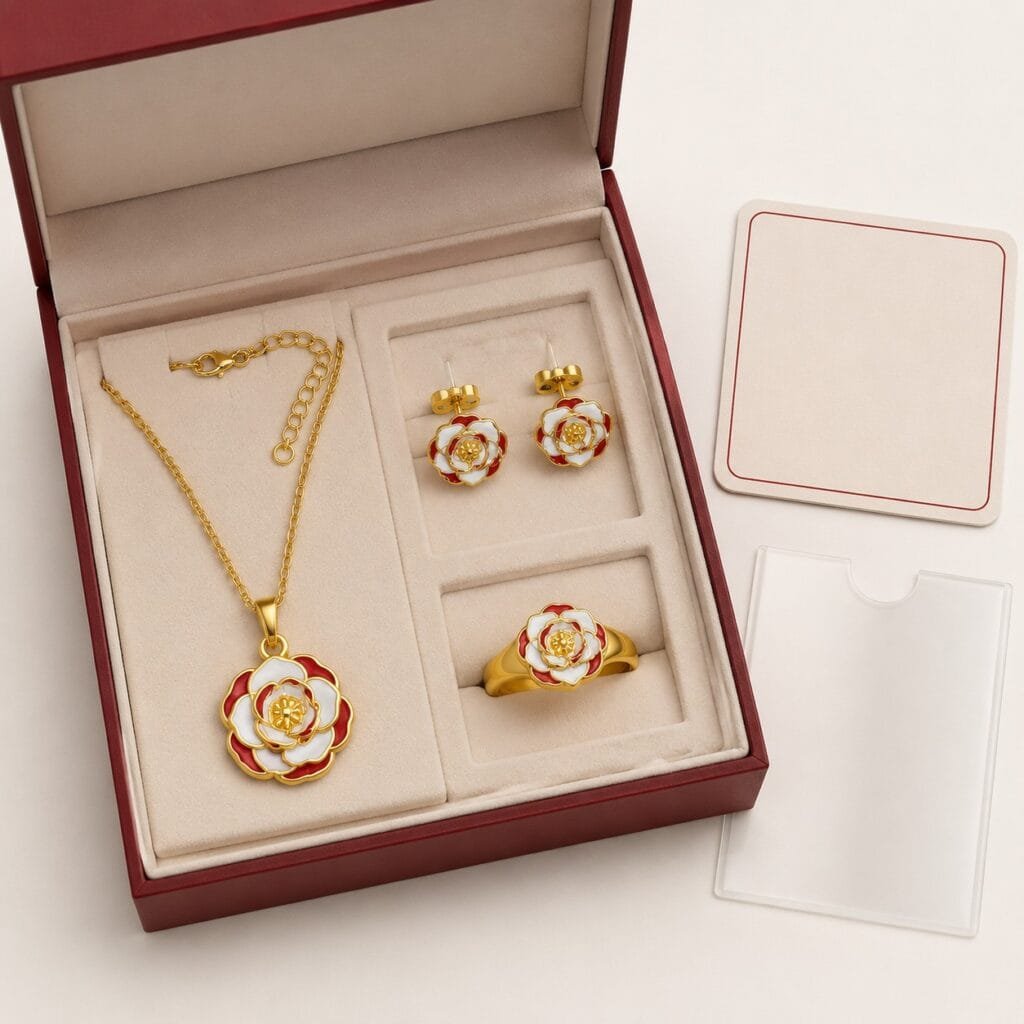
We combine approved products, packaging, inserts, labels, and packing instructions into repeatable sets. Before bulk packing, we define each SKU's components, box orientation, spare parts, sealing requirement, master-carton quantity, and acceptance criteria. Assembly records prevent missing, duplicated, reversed, or mismatched components during shipment release and later replenishment orders. The approved set sample remains the packing and inspection reference during replenishment.
Manufacturing Resources Behind A Controlled Tudor Rose Collection
Chicolink integrates design, engineering, metal processing, in-house plating, quality control, packaging, and production planning in Dongguan, China. We use these resources for custom development, bulk production, documented approvals, and repeat orders. Final scheduling depends on the approved product, process, order mix, inspection plan, and available capacity within the requested delivery window.
Operating Since 2012
Chicolink Jewelry was established in June 2012 in Dongguan, Guangdong, China. We manufacture and export stainless steel jewelry for wholesale, OEM, ODM, and private-label projects, including product development, packaging, quality control, bulk production, and export coordination based on confirmed specifications.
5,500+ Square Meters
Our factory covers more than 5,500 square meters. Defined internal teams manage production planning, metal processing, polishing, plating, assembly, inspection, packaging, material movement, and project follow-up. This structure assigns responsibility across the main stages of a custom Tudor Rose jewelry order.
400+ Staff
More than 400 staff support our manufacturing operations. PMC, production, R&D, quality control, purchasing, plating, assembly, packaging, and shipment teams work from confirmed order requirements and approved document versions. The required departments are assigned according to each project's structure and process route.
Nine Development Specialists
Our development team includes six jewelry designers and three jewelry engineers. They handle style development, drawing review, structural assessment, process selection, sample follow-up, DFM recommendations, specification control, and unresolved technical decisions before production release. Project assignments depend on scope and development stage.
200,000+ Pieces Monthly
Our monthly production capacity exceeds 200,000 pieces. Actual output and delivery still depend on product complexity, tooling, material, color, plating batches, decoration, inspection, packaging, current order mix, and the approved production plan. We confirm capacity and schedule for each order.
58 Major Machines
Our factory has 58 major machines: five CNC machines, four casting machines, three laser-cutting machines, five laser-welding machines, three laser-logo machines, six stamping machines, four bending machines, seven drilling machines, eight polishing machines, four wax-injection machines, and three lathes. These machines support the approved route for each custom program.
Six PVD Machines
Our in-house plating workshop includes six PVD vacuum-coating machines and supports PVD/IP, water plating, and other approved electroplating routes. We manage specifications, pretreatment, sample approval, process monitoring, inspection, issue handling, and batch traceability under the confirmed project requirements for production orders.
Multi Stage QC
Our quality functions include incoming, in-process, final, plating-process, and finished-product inspection. We also coordinate buyer-appointed third-party inspection after confirming the inspection company, standard, sampling plan, timing, documents, cost responsibility, reinspection terms, and shipment-release authority. The confirmed inspection plan controls release.
Follow A Tudor Rose Project Through Chicolink Production
Chicolink documents Tudor Rose development with our own factory images and videos. Each stage connects the workpiece to its approved drawing, sample, process requirement, or inspection record. The sequence covers engineering, metal processing, polishing, in-house plating, decoration, assembly, measured inspection, and packing. We do not use stock images as evidence of our operations.
Artwork CAD Review
Our designers and engineers review the authorized rose artwork, CAD model, and dimensioned specification before sampling. We check the file version, petal geometry, overall size, attachment position, visual surfaces, and unresolved decisions. Approved and obsolete versions are separated so production teams use the current project standard while confidential buyer information remains protected.
Cut Form Cast
We process the rose according to its approved route: laser cutting for flat outlines, stamping for formed medallions, casting for layered relief, or CNC for selected precision features. Operators compare in-process pieces with the controlled drawing and first-piece requirement before the work moves to deburring, polishing, surface treatment, or decoration.
Deburring And Polishing
Our operators remove burrs, round specified edges, and polish raised petals while protecting approved recesses and outlines. We compare the surface with the approved sample and inspect areas where polishing access is limited. This stage controls sharp edges, tool marks, uneven rounding, lost detail, residual polishing compound, and inconsistent reflection.
In House Plating
Our in-house plating workshop manages confirmed PVD/IP, water-plating, and other approved electroplating routes. We control pretreatment, racking or hanging points, process parameters, sample color, inspection, issue handling, and batch traceability. The approved route is set for the specific material, structure, finish, and color; one setting does not apply to every product.
Color And Decoration
We apply cold enamel, epoxy, resin filling, paint, stones, or another approved decoration according to the specification. Operators control cell preparation, fill level, color reference, curing, stone position, cleaning, and adhesion. Inspection focuses on incomplete filling, overflow, bubbles, contamination, uneven edges, loose stones, and differences from the approved rose sample.
Assembly And Function
We assemble chains, jump rings, clasps, ear posts, brooch pins, bracelet connections, and matching sets to the approved instructions. During assembly, we check rose orientation, movement, closure, alignment, component color, pair matching, and connection security. The first assembled piece is compared with the approved sample before the remaining quantity proceeds.
Measured Quality Checks
Our inspectors measure the characteristics defined in the quality plan, including dimensions, weight, color, plating thickness, chain length, pair matching, surface condition, and attachment strength. Where measured values are required, inspection records contain the actual result, method, sample point, and specification rather than only a pass or fail mark before shipment release.
Packing And Shipment
We pack each approved SKU with its specified card, bag, gift box, barcode, protective layer, set arrangement, and carton configuration. Packing checks cover product count, variant, logo, label, chain placement, surface protection, and branded components. Shipment release follows completion of the required final inspection, packing records, and buyer-appointed inspection when applicable.
Inspect The Details Buyers Notice Across Every Batch
We build the inspection plan around the approved sample, controlled drawing, BOM, color standard, functional requirements, packaging specification, and buyer test plan. Tudor Rose projects receive checks focused on motif recognition and the construction selected for each SKU. Inspection points cover incoming material, semi-finished work, first-piece approval, surface treatment, assembly, final product, and packing so defects are addressed before shipment.
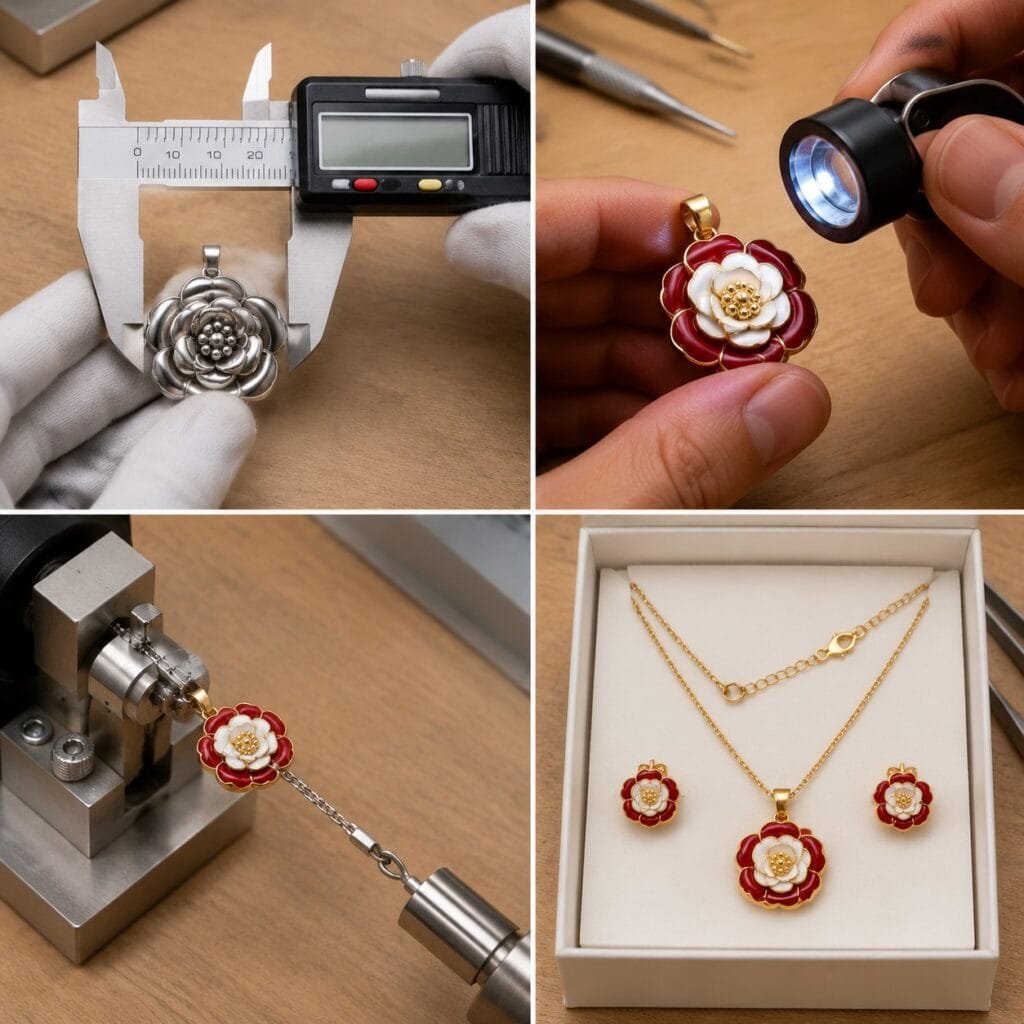
Critical Quality Points For Heritage Motif Jewelry
- Motif and surface: Inspect petal symmetry, center position, relief, negative space, engraving readability, edge rounding, polishing consistency, scratches, pits, exposed base, color-fill boundaries, bubbles, overflow, stones, and visible assembly marks.
- Dimensions and weight: Record actual pendant size, thickness, hole or bail opening, ring dimensions, chain length, ear-post dimensions, bracelet size, finished weight, pair weight difference, and other drawing-controlled values using the stated measurement condition.
- Color consistency: Compare production against the approved sample or standard. Our internal reference is ΔE00 <= 1.5 for standard polished or mirror surfaces and ΔE00 <= 2.0 for brushed, sandblasted, or antique surfaces. The instrument setup, light, locations, sample count, and customer standard must be fixed in the inspection plan.
- Plating thickness: When a nominal thickness is specified, our internal reference allows a batch-average deviation of +/-10%, a single-point deviation of +/-20%, and no primary visual-surface point below 80% of nominal thickness. The agreed XRF, cross-section, or other method and measurement locations control acceptance.
- Connections and function: Internal pull-test references use five pieces per style: 30 N for small decorations and ear-post connections, 40 N for pendant rings, jump rings, and clasps, 30 N for main necklace structures, and 60 N for main bracelet structures, held for 10 seconds. Customer drawings or standards override these references.
- Production gates: Incoming inspection, semi-finished inspection, first-piece confirmation, plating and color inspection, in-process checks, final inspection, packing inspection, nonconforming-product control, and batch records are applied according to the confirmed quality plan.
- Shipment release: The approved product, quantity, variant ratio, logo, barcode, card, box, protective method, carton information, inspection status, and required documents are checked before shipment approval.
Match Every Test To The Product And Destination Market
We coordinate product testing and third-party inspection after the buyer confirms the destination market, product construction, material, coating, color, direct skin-contact areas, packaging, applicable standard, laboratory, sample quantity, cost, and schedule. A report applies only to its stated scope. We plan testing before production when it affects material, coating, sample quantity, delivery, labeling, or market claims.
| Requirement | Chicolink Reference Or Support | Project Decision | Reference Cost |
|---|---|---|---|
| Salt-spray test | Internal defaults: 24 hours for bare stainless steel, 48 hours for plated or PVD products, and 72 hours for higher-corrosion requirements or as specified by the buyer | Confirm standard, solution, pH, temperature, sample position, scribing, inspection interval, cleaning, sample quantity, and acceptance | Approximately USD 2 per hour |
| Artificial-sweat test | Internal reference: 40 +/- 2 degrees C for 24 hours at pH 4.7 +/- 0.2; post-test color difference <= 2.0 with no blackening, corrosion, blistering, peeling, base exposure, significant gloss loss, or weld/clasp abnormality | Confirm solution formula, contact method, sample suspension, cleaning, drying, inspection points, and customer requirement | Approximately USD 100 |
| Nickel-release testing | We can coordinate EN 1811, EN 12472 where relevant, SGS, HKPC, or a buyer-specified laboratory | Confirm direct skin-contact parts, material, coating, color, wear preparation, sample count, destination market, and report scope | SGS approximately USD 500 per color; HKPC approximately USD 120 per color |
| Lead and cadmium | Testing support is available for the product, material, coating, decoration, and market in scope | Confirm legal or buyer limit, method, sample preparation, color variants, report holder, and required documentation | Quoted by laboratory and project |
| Abrasion resistance | Available when the finish, print, color filling, coating, or buyer standard requires wear evaluation | Confirm equipment, load, medium, cycles, inspected area, color or appearance limit, and post-test function | Approximately USD 120 |
| REACH and market documentation | We can support REACH, California Proposition 65, nickel-related, lead-free, and cadmium-free requirements as applicable to the project | Confirm destination, applicable substance or migration limits, product scope, report validity, and document recipient | Quoted by scope |
| RoHS or CE requests | RoHS is used only when the product falls within its scope. Ordinary non-electronic stainless steel jewelry is not automatically presented as CE-applicable | Buyer and Chicolink review product function and the applicable regulation before making a claim | Quoted if applicable |
| Third-party inspection | Chicolink supports buyer-appointed pre-shipment inspection, sampling, document review, and factory-audit coordination | Confirm inspection company, AQL or other plan, timing, reinspection, access, report language, cost, and release authority | Quoted by inspection provider |
Build The Commercial Plan Around A Confirmed Specification
Chicolink quotes Tudor Rose projects after confirming the product, dimensions, material, process, color, quantity, size mix, packaging, testing, tooling, and delivery requirement. The figures below are business references rather than automatic commitments; the approved quotation and production schedule govern each order. We quote each option against a defined specification because weight, coating, color count, tooling, testing, packaging, and variant mix affect price and timing.
| Commercial Item | Chicolink Reference | Conditions To Confirm |
|---|---|---|
| Regular or existing-style MOQ | Usually 120 pieces per style | Stock, selected SKU, finish, color, size mix, packaging, and availability |
| OEM or ODM MOQ | Usually 500 pieces per style | Tooling, material, color, plating batch, size, stones, decoration, packaging version, and production difficulty |
| Existing-style sample time | Usually 3-7 working days | Sample availability, selected finish, packaging, payment, and required checks |
| OEM or ODM custom sample time | Usually 25-30 working days | Begins from confirmed requirements, payment, approved files, material, process, tooling, color, and sample scope |
| Existing-style bulk time | Usually 20-30 working days | Confirmed order, material, color, packaging, production schedule, and inspection requirement |
| OEM or ODM bulk time | Usually 25-45 working days | Begins according to the written order and approved production conditions; complexity and testing can affect timing |
| Sample and tooling charges | Sample charges usually apply. Deduction of sample or tooling charges depends on order value and written agreement | Artwork, CAD, prototype, mold type, revisions, color samples, packaging samples, and test samples |
| Tooling charges | Quoted after DFM and process selection; no fixed online tooling price applies to every design | Size, geometry, accuracy, tool material, expected life, process, fixtures, revisions, and project requirement |
| MIM evaluation threshold | Generally evaluated for suitable programs around 5,000 pieces or more with continuing demand | Tooling investment, geometry, material, shrinkage, annual demand, and repeat-order plan |
| Quantity tolerance | Historical internal reference is approximately +/-5% | The purchase order must define permitted overage or shortage, settlement, remaining goods, and freight responsibility |
See How A Multi-SKU Tudor Rose Brief Is Structured
This representative scope shows how Chicolink can organize an authorized cultural-gift collection before quotation and sampling. It defines the buyer inputs, engineering decisions, approval gates, quality controls, and commercial variables we would manage. It is not a completed customer case and does not claim an order, test result, sales outcome, endorsement, or undocumented manufacturing history.
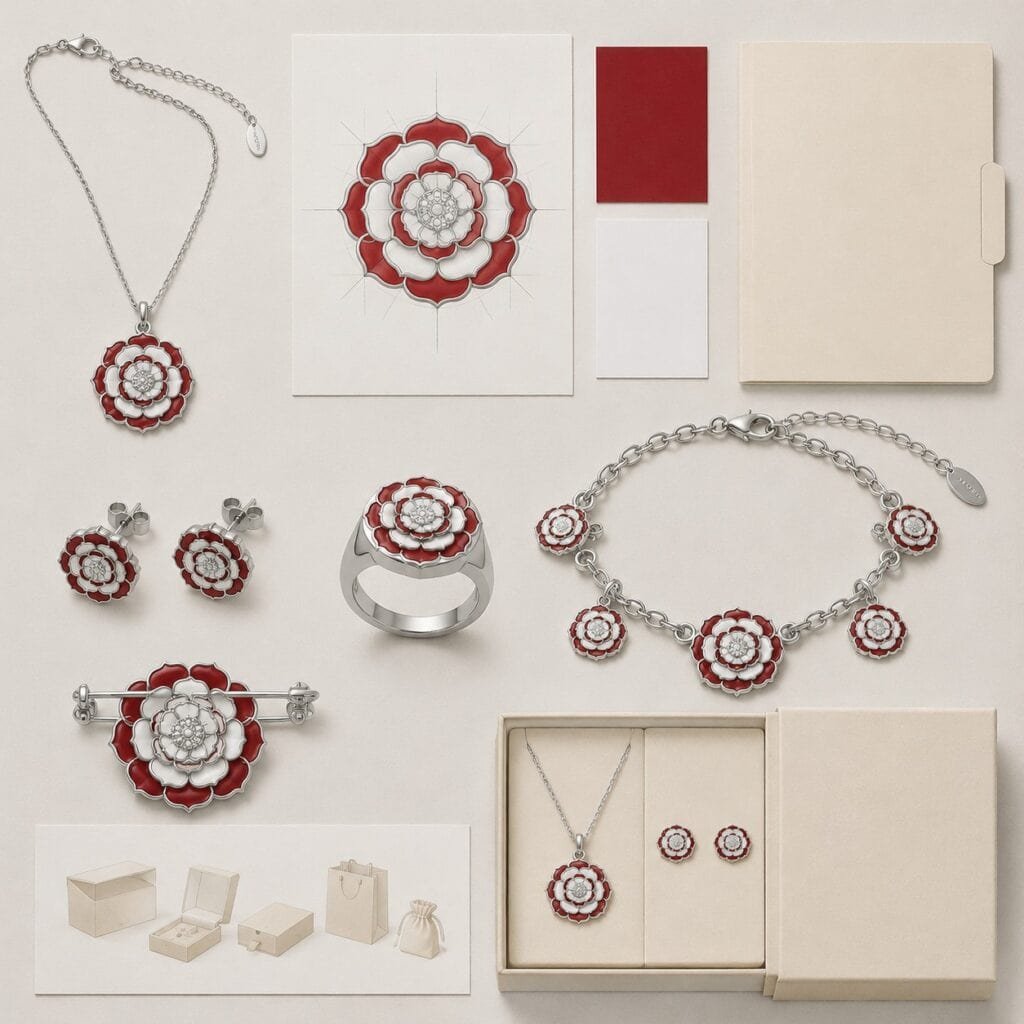
Representative Six-SKU Collection Plan
Use Scenario
A European cultural-gift buyer plans an authorized six-SKU Tudor Rose-inspired collection for museum retail, online sales, and seasonal gifting. The proposed assortment includes one hero pendant, matching earrings, a signet ring, a charm bracelet, a brooch, and a boxed pendant-and-earring set.
Key Challenge
The layered rose must remain recognizable at several scales while using a consistent visual system. The buyer also needs controlled red-and-white color, safe edges, correct pendant orientation, matched earring weight, readable back marking, coordinated packaging, barcode control, and a specification suitable for repeat orders.
Chicolink Solution
- Establish one approved master motif and define the permitted simplification for each product size.
- Compare casting, laser cutting, stamping, engraving, and cold-enamel or epoxy routes by SKU.
- Create separate drawings and BOMs for each product while maintaining shared color, logo, and packaging standards.
- Validate the white-metal structure, plated color, decorative filling, function, and packaging before the production release.
- Set inspection points for motif symmetry, dimensions, weight, coating, filling, attachments, SKU labels, and set packing.
Result
We would deliver a quotation-ready and sample-ready project package: approved artwork basis, SKU list, proposed process routes, open decisions, drawing and BOM requirements, sample stages, quality checkpoints, packaging brief, and commercial assumptions. Because this is a planning example, it does not report a completed production result or customer endorsement.
Project Data
- Representative scope: 6 SKUs
- Proposed color system: 1 shared red-and-white reference plus selected metal finishes
- Product control: 1 master motif with SKU-specific engineering files
- Packaging control: coordinated cards, story content, barcode data, and gift-box requirements
- Commercial basis: quantities, MOQ, sample charges, tooling, tests, and schedule confirmed by written quotation
British Tudor Rose Jewelry Manufacturing FAQ
Chicolink answers the main questions about location, design rights, files, product scope, materials, color, MOQ, timing, quality control, packaging, and testing. Review these points before sending the artwork, quantity, target-market requirements, and approval contacts for a Tudor Rose-inspired stainless steel jewelry project. The answers also clarify when we need written approval or project-specific testing.
Is Chicolink A British Jewelry Manufacturer?
No. Chicolink Jewelry is a stainless steel jewelry manufacturer in Dongguan, China. We manufacture British Tudor Rose-inspired jewelry for global B2B buyers. The wording describes the jewelry theme, not a UK manufacturing origin.
Can You Copy An Existing Brand's Tudor Rose Design?
We develop from buyer-owned or authorized artwork, original briefs, approved drawings, and lawful references. We do not present copied third-party retail designs as original development. Buyers must confirm rights to supplied logos, official emblems, museum assets, fonts, and licensed content.
Which Design Files Can We Submit?
We can review DWG, DXF, PDF, JPG, CDR, STEP, IGES, STL, 3DM, editable logo files, sketches, reference images, or physical samples. Please also provide dimensions, material, finish, quantity, market, packaging, tests, target price, and delivery date.
Which Tudor Rose Products Can You Manufacture?
We can evaluate pendants, necklaces, earrings, rings, bracelets, bangles, brooches, pins, charms, key accessories, jewelry sets, and gift-box sets. Final feasibility depends on structure, material, process, finish, quantity, tests, and approved samples.
Should We Choose 304 Or 316L Stainless Steel?
The choice depends on product structure, wearing environment, manufacturing route, target market, cost, and testing. 304 supply is generally flexible. 316L usually offers better pitting resistance, but its higher hardness can increase difficulty for complex forming, machining, welding, polishing, and correction.
Can You Make Red-And-White Tudor Rose Details?
Yes, after process evaluation. Options may include cold enamel, epoxy, resin filling, paint, lacquer, or another approved method. We confirm the exact material name, color reference, cell geometry, fill level, curing, adhesion, inspection criteria, and compatibility with the metal finish.
What Is The MOQ For Custom Production?
OEM and ODM projects usually start at 500 pieces per style. Regular or existing styles usually start at 120 pieces per style. Final MOQ depends on tooling, material, colors, sizes, plating batches, packaging, stones, process difficulty, and whether variants can be mixed.
How Long Do Samples And Bulk Production Take?
Existing-style samples usually take 3-7 working days, and custom OEM or ODM samples usually take 25-30 working days. Existing-style bulk orders usually take 20-30 working days; custom bulk production usually takes 25-45 working days. Final timing follows confirmed project conditions.
How Do You Control Sample-To-Bulk Consistency?
We use approved drawings, BOMs, artwork, color references, pre-production or golden samples, first-piece confirmation, in-process checks, plating inspection, final inspection, packing checks, change records, and batch traceability. The buyer's approved standard and inspection plan control acceptance.
Can You Support Packaging And Third-Party Testing?
Yes. Chicolink supports private-label cards, pouches, gift boxes, care or story cards, barcodes, labels, and pack execution. We can also coordinate SGS, HKPC, buyer-appointed testing, or pre-shipment inspection after scope, standard, samples, cost, timing, and report applicability are confirmed.
Start Your British Tudor Rose Jewelry Project
Send Chicolink the information already available for your British Tudor Rose-inspired jewelry program. You do not need to have every engineering detail finalized, but a clear commercial brief helps us identify the correct development route and the decisions required before quotation or sampling.
What To Include
- Your original or authorized artwork, sketch, CAD file, reference image, or physical-sample information
- Product categories, intended use, overall dimensions, size range, chain or attachment preference, and target weight if available
- Preferred material, bare-steel or PVD finish, red-and-white or other color requirements, stones, engraving, and logo position
- Target market, sales channel, customer profile, target retail or purchase price, and expected order quantity by style, color, and size
- Jewelry cards, pouches, gift boxes, story or care cards, barcode labels, retail-display, FBA, or other packing requirements
- Required tests, third-party inspection, labeling, documents, sample approval process, launch date, and requested delivery date
- The person or team responsible for approving artwork, CAD, color, samples, packaging, testing, and production release
After reviewing the brief, Chicolink will identify missing specifications, evaluate material and manufacturing feasibility, outline the proposed sample stages, and prepare the quotation basis. Tooling, sample charges, MOQ, testing, packaging, and timing are confirmed in writing for the individual project. Uploaded files are used to evaluate the inquiry and should contain only material you are authorized to provide.
File Guidance
Product type | Size | Material | Finish/color | Quantity | Market | Packaging | Tests | Target date