
Greek Key & Mythology Jewelry Manufacturer
Develop distinctive Greek-inspired stainless steel collections with controlled engineering, in-house plating, documented sampling, and scalable B2B production.
Chicolink Jewelry is a B2B stainless steel jewelry manufacturer in Dongguan, China. We develop Greek Key, Meander, Medusa, Athena, Zeus, Poseidon, Pegasus, and related mythology concepts for established brands, importers, distributors, and retail programs.
- Convert approved artwork into production-ready CAD and specifications.
- Match motif detail with suitable forming, casting, engraving, and finishing routes.
- Control samples, plating, inspection, packaging, and repeat production under one project record.

Built for Buyers Managing Complete Greek Jewelry Collections
Greek-inspired programs involve more than isolated designs. Chicolink aligns motif language, product structure, price points, finishes, packaging, compliance, and replenishment with the buyer's channel and approval process. Before sampling, we identify decisions that affect cost and repeatability. During production, we maintain approved drawings, samples, color references, and packaging versions. This gives product, purchasing, quality, and supply-chain teams one shared project basis.

Global Brand Product Teams
- Build a coordinated capsule or core collection around approved Greek visual codes instead of unrelated motifs.
- Translate a brand brief into product families, dimensions, target weights, process routes, plating options, and sample priorities.
- Record artwork, CAD, finish, logo, packaging, and approval versions so design and purchasing teams review the same specification.
- Plan development around the target price, launch window, market requirements, and expected order scale supplied by the buyer.

Importers and Distributors
- Balance recognizable commercial motifs with rings, pendants, chains, bracelets, earrings, and men's accessories suited to the destination market.
- Confirm quantities by style, color, size, and packaging version before quotation because these variables can affect MOQ and plating batches.
- Prepare product identification, packaging, carton, inspection, and shipment information for the agreed order scope.
- Maintain order, SKU, production batch, plating batch, inspection, and packing records for repeat-order follow-up.
Multi-Store Retail Programs
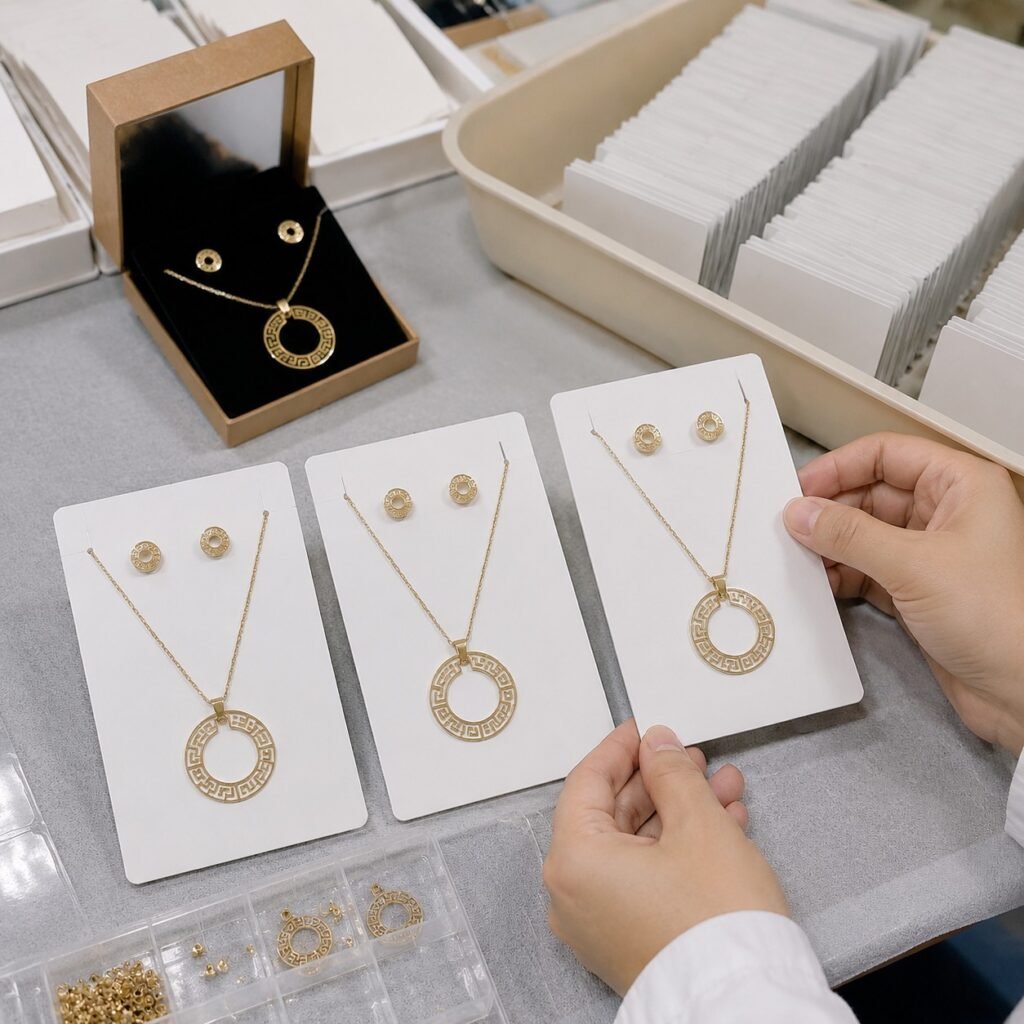
- Develop products that can be measured, inspected, packed, labeled, and replenished under a consistent retail specification.
- Define visible surfaces, acceptable appearance, dimensions, clasp or connection performance, logo position, card layout, barcode, and pack-out requirements.
- Use approved samples and written quality criteria as references before bulk production.
- Coordinate customer audits or third-party quality inspections when they are included in the confirmed project plan.
Established Wholesale Programs
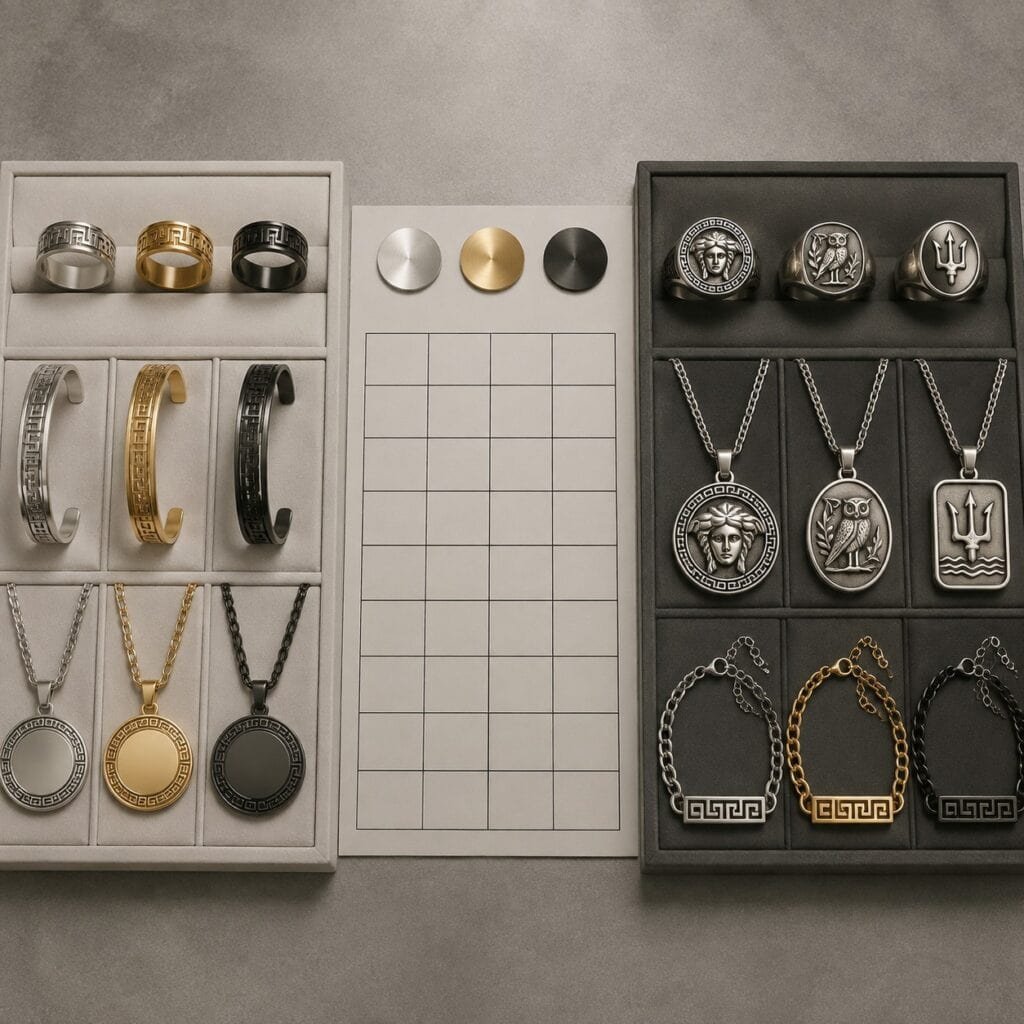
- Combine faster-to-source regular products with OEM or ODM styles when a buyer needs both replenishment and collection differentiation.
- Separate proven product structures from new molds or unverified details so the development risk is visible before purchase decisions are made.
- Confirm assortment ratios, finish variants, packaging levels, and delivery priorities by SKU.
- Support wholesale, private-label, and bulk-production requirements without presenting unapproved concepts as production-ready items.
Match Greek Motifs with Commercial Product Structures
Chicolink plans each motif together with its product structure, scale, wearing direction, and finish. A Greek Key border that fits a wide cuff may lose continuity on a narrow ring. A detailed Medusa portrait needs enough area and relief to remain clear after polishing and plating. We use the following matrix to start product planning, then confirm feasibility, dimensions, tooling, weight, cost, and testing through engineering review and sample approval.
| Motif Direction | Suitable Product Structures | Engineering Focus | Typical Collection Role |
|---|---|---|---|
| Greek Key / Meander | Rings, bangles, cuffs, chain links, hoop earrings, pendant borders | Repeat pitch, line width, corner definition, pattern closure, seam alignment | Core geometric family that can repeat across multiple categories |
| Medusa | Coin pendants, signet rings, medallions, statement earrings | Facial readability, hair and serpent separation, relief depth, reverse weight reduction | Recognizable mythology centerpiece for statement and men's collections |
| Athena and Owl | Medallions, signet rings, pendants, stud details | Helmet layers, eye and feather definition, symmetry, small-detail retention | Wisdom, strategy, and heritage-led capsule direction |
| Zeus and Thunderbolt | Pendants, rings, bracelet plates, charms | Sharp-point control, lightning silhouette, attachment strength, wearing orientation | High-impact symbol for men's, unisex, or symbolic collections |
| Poseidon and Trident | Pendants, signet rings, cuffs, bracelet plaques | Long-point strength, edge radius, balanced relief, negative space | Marine, power, travel, and resort-related product stories |
| Pegasus | Pendants, medallions, earrings, charm components | Wing separation, thin-section strength, silhouette balance, snag prevention | Motion-led or aspirational statement products |
| Laurel and Column Details | Ring shoulders, pendant frames, cuffs, earrings | Repetition scale, symmetry, polish access, transition into the main motif | Supporting visual language that connects a full collection |
| Labyrinth and Coin Borders | Rings, pendants, bangles, reversible medallions | Path clarity, border spacing, center alignment, front-to-back orientation | Graphic or architectural alternative to figurative mythology pieces |
Two Design Systems Require Different Manufacturing Decisions
Greek Key jewelry and mythology jewelry share a visual world but require different engineering controls. Chicolink reviews geometric repeats separately from figurative relief. We check whether the reference suits the product width, process, and finish, then define approval points for motif proportion, surface hierarchy, weight, edge treatment, and artwork use before tooling and sampling.

Greek Key Is a Continuous Geometric System
- Repeat logic: The pitch, line width, spacing, and corner radius must work together. Changing only one value can make the pattern look compressed or uneven.
- Closure: On rings and closed bangles, the repeat must meet at the circumference without an obvious partial segment. Ring size changes may require a pattern adjustment rather than simple scaling.
- Joints and openings: We plan transitions at cuff openings, chain-link joints, hinges, and weld areas so the motif is not cut unless the approved design requires it.
- Finishing allowance: Polishing can soften narrow channels and sharp corners. Plating and color filling can change the apparent width of recessed or raised lines. These effects are considered before the customer approves the drawing.

Mythology Jewelry Is a Figurative Relief System
- Recognition: Faces, helmets, hair, wings, feathers, lightning, and tridents need sufficient area and separation to remain readable at jewelry scale.
- Relief hierarchy: We distinguish primary facial planes, secondary textures, and background fields through controlled depth differences, so the hierarchy remains legible after casting, cleaning, polishing, and surface treatment.
- Wearability: Spear points, wing tips, serpents, and deep undercuts are reviewed for sharp edges, snagging, cleaning access, deformation, and mold release.
- Artwork responsibility: Chicolink develops from buyer-approved references and reviews manufacturability. The buyer confirms the right to use trademarks, licensed characters, museum imagery, contemporary artwork, and other protected material. Chicolink does not provide legal ownership opinions.
Engineering Greek Details for Repeatable Bulk Production
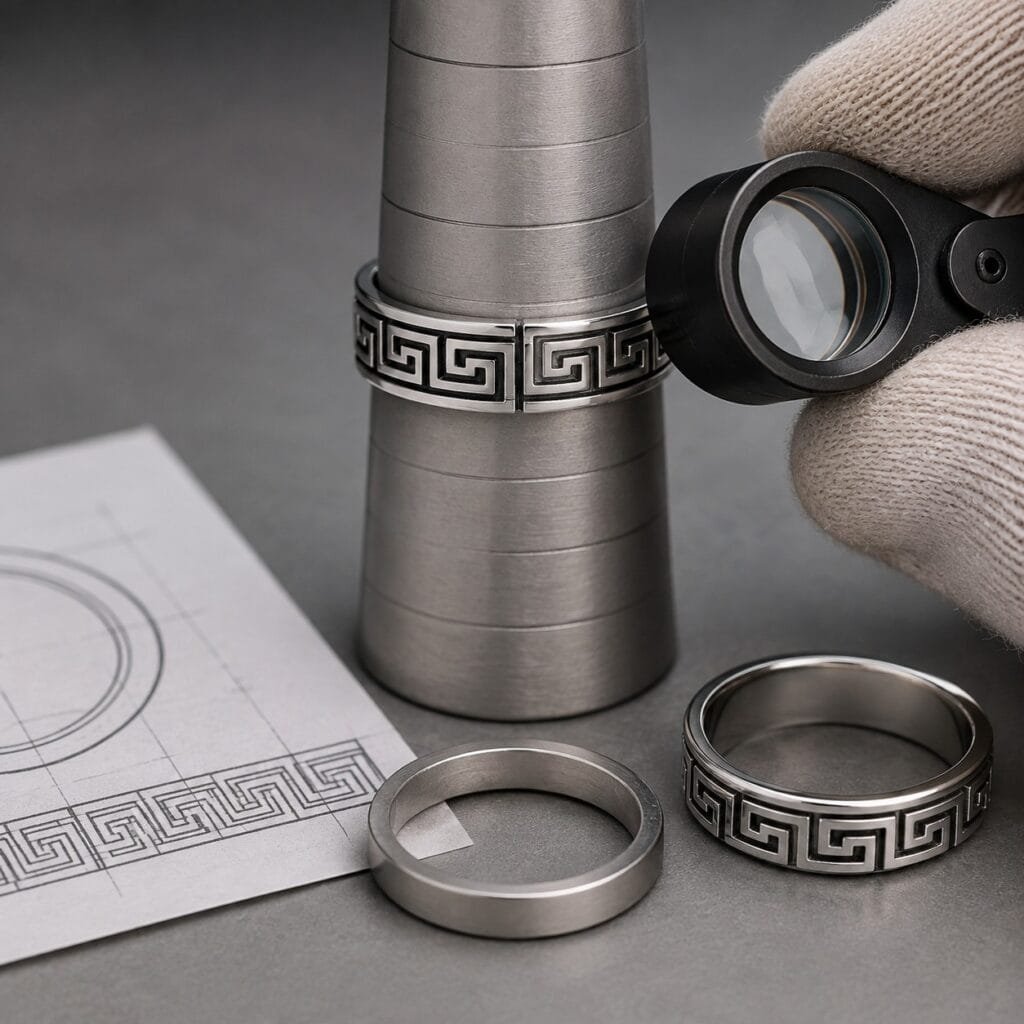
Chicolink uses design-for-manufacturability review to protect the visual idea and identify structural, finishing, cost, and lead-time risks before bulk production. We review the reference, dimensions, material, quantity, finish, packaging, and market requirements. Our designers and engineers turn the open points into drawing and sample checks. Final tolerances and process parameters follow the approved specification, sample, and written customer standard.
Five Engineering Checkpoints
1. Pattern fit and dimensional reference
Greek Key width, repeat pitch, border spacing, motif centerline, ring circumference, pendant orientation, and visible surface zones are dimensioned. Flexible chains and curved products are assessed in their actual assembled state rather than as flat artwork alone.
2. Relief, recess, and polish access
Deep grooves, blind corners, narrow gaps, and layered portraits are checked for tool access, mold release, cleaning, polishing, plating coverage, and inspection visibility. Areas that cannot be finished consistently are revised before sampling.
3. Weight and structure
We select solid, hollow, openwork, or reverse-relieved construction according to target weight, strength, size, price position, and deformation risk. We assess pendant loops, ring shoulders, bracelet plates, ear posts, and connections separately.
4. Edges and wearing contact
Lightning points, trident tips, wing edges, coin rims, ring interiors, and cuff openings receive defined radii or chamfers where required. The check covers comfort, snagging, sharp burrs, assembly, and packaging contact.
5. Approval-ready specification
The review output can include a proposed process route, key dimensions, material, target weight, finish zones, tooling needs, quality risks, sample validation points, and open decisions. No unconfirmed drawing is released as the bulk-production reference.
Choose Material, Process, and Finish as One System
Material grade alone does not determine product quality. Chicolink chooses the process from the geometry, relief, thickness, target weight, finish, quantity, test plan, and price position. We commonly work with 304 and 316L stainless steel and use casting, CNC, stamping, laser cutting, engraving, etching, polishing, texturing, PVD/IP, water plating, and approved color-filling processes. We confirm the final route through drawing review and sample validation.
| Design Objective | Material Decision | Possible Process Route | Finish Direction | Approval Focus |
|---|---|---|---|---|
| Recessed Greek Key on a ring or bangle | 304 or 316L based on market, structure, price, and processing needs | CNC patterning, engraving, etching, stamping, or a confirmed combination | Steel color, high polish, brushed, sandblasted, or PVD | Pattern closure, groove clarity, internal comfort, color coverage |
| Raised Meander border | Grade and raw-material form selected after profile review | Casting, pressing, stamping, CNC, or combined finishing | Bright border with matte field, single-color PVD, or approved contrast treatment | Border height, corner retention, polish access, visual symmetry |
| Medusa or deity relief | Material and construction selected for detail, weight, and scale | Casting with finishing operations; CNC or laser detail where technically suitable | High polish, matte contrast, PVD color, or approved recessed color treatment | Face readability, relief hierarchy, reverse structure, edge safety |
| Open Pegasus or trident silhouette | Grade and thickness selected for thin-section strength | Laser cutting, wire cutting, stamping, CNC, casting, or a combined route | Polished, brushed, sandblasted, steel color, or PVD | Thin-point strength, distortion, burr removal, pendant balance |
| Color-filled Greek channels | Material and fill system confirmed together | Pattern formation followed by approved resin, epoxy, paint, or other confirmed filling route | Gloss, matte, transparent, or opaque fill with compatible metal finish | Fill depth, bubbles, overflow, adhesion, plating compatibility |
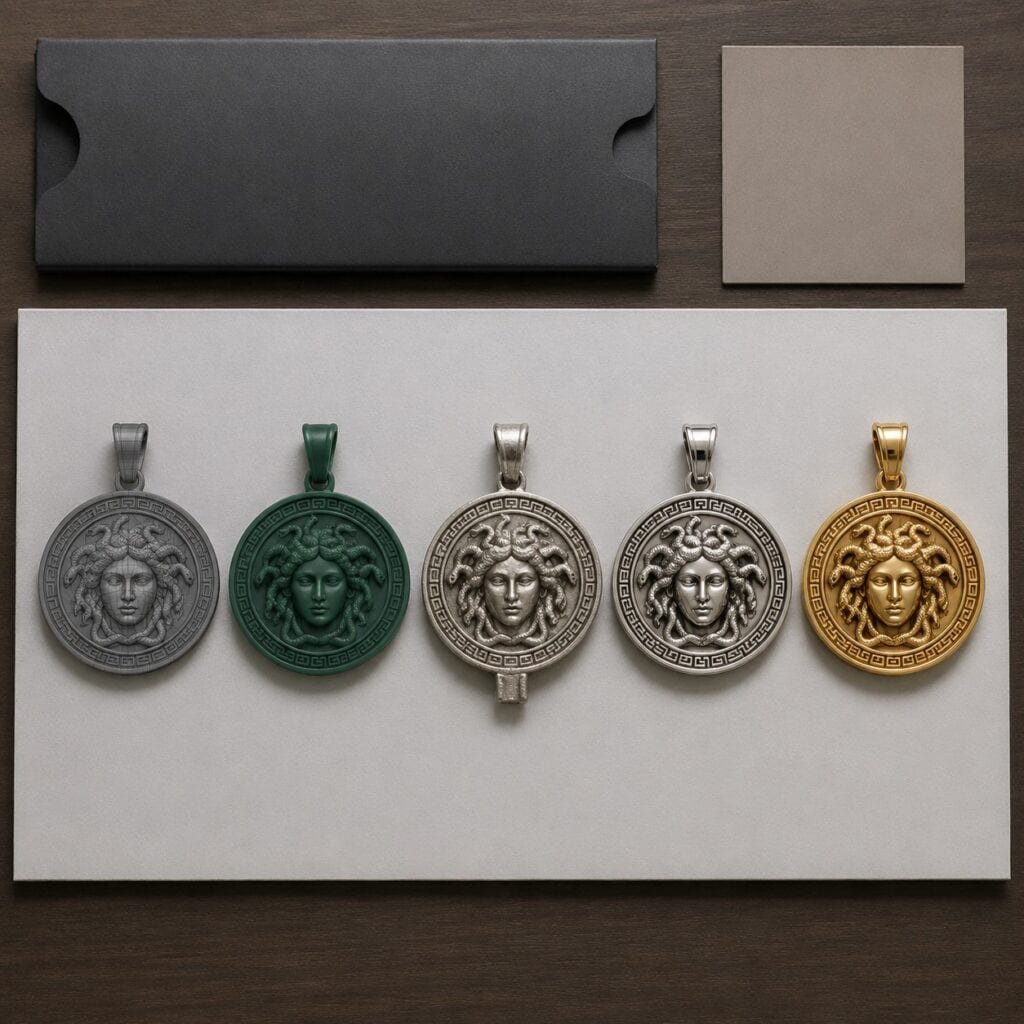
| Multi-finish mythology medallion | Base material, layer structure, and masking feasibility reviewed per design | Casting or forming, selective polishing/texturing, then confirmed surface treatment | Bright/matte contrast, gold, rose gold, black, gunmetal, or other approved color | Finish boundary, color standard, masking marks, batch repeatability |
From Design Brief to an Approved Production Sample
Chicolink uses each sample to answer defined production questions. We link it to the drawing, material, dimensions, target weight, finish, logo, packaging, and intended purpose. An existing-product sample shows available workmanship or finish references; an OEM/ODM sample validates a customer-specific structure. We quote the applicable fees, timing, tooling, testing, and delivery before development starts.
Sample Approval Workflow
1. Submit the brief: Provide product type, motif, reference files, dimensions, target weight or price, quantity per style, finish, market, packaging, and required launch date.
2. Confirm source files: Identify the buyer-approved files, licensed references, and concepts that require a new interpretation.
3. Complete engineering review: Chicolink assesses structure, process access, tooling, pattern continuity, relief readability, wearing contact, plating, assembly, and likely production risks.
4. Approve the quotation scope: The quotation separates the product configuration from applicable drawing, prototype, mold, sample, testing, packaging, and delivery charges.
5. Review drawings: The customer checks motif proportions, dimensions, wearing direction, logo, finish zones, and other decision points before physical development.
6. Produce and inspect the sample: The sample is checked against its approved version for dimensions, weight, surface, color, structure, function, and applicable packaging details.
7. Control revisions: Requested changes are evaluated for new CAD work, tooling, material, finish, cost, and schedule impact. Revised files receive a new version rather than replacing the approval record silently.
8. Seal the production reference: The confirmed sample, drawings, BOM, color reference, logo file, and packaging version form the basis for first-article and bulk inspection. The written customer standard takes priority where one is supplied.
Control PVD Color Inside the Manufacturing Workflow
Recessed Greek Key channels, polished relief, matte fields, and raised portraits reflect color differently. Chicolink operates an in-house plating workshop with six PVD vacuum coating machines. We manage pretreatment, approved color references, process monitoring, inspection, nonconformity handling, and plating-batch traceability within the production workflow. We define the system from the substrate, structure, polish level, color, thickness, use environment, packaging, tests, and customer standard.
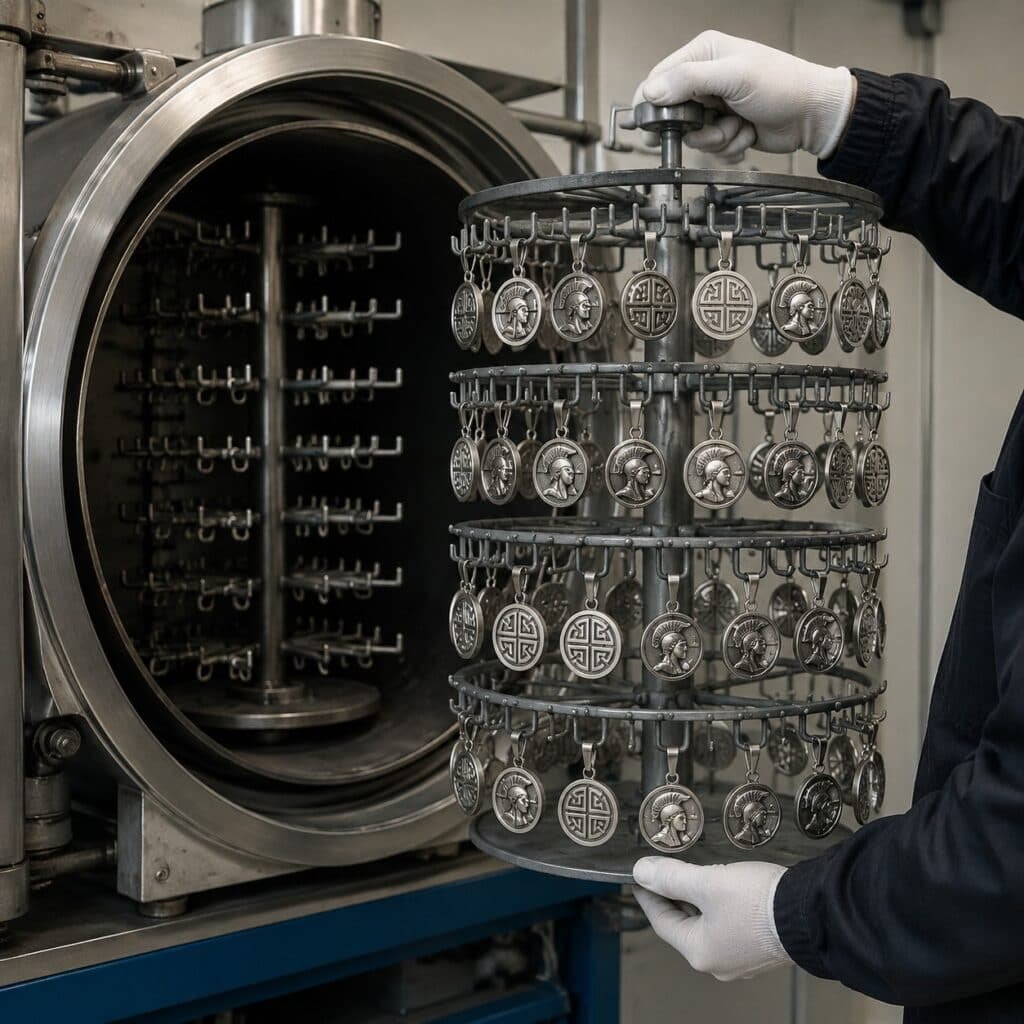
Plating Decisions Recorded Per Project
- Substrate, product structure, visible A/B/C surfaces, and required polish or texture.
- PVD/IP, water plating, or another approved in-house electroplating route.
- Color name, approved color sample, base layer, top layer, target thickness, and allowed variation.
- Groove, recess, edge, hole, weld, stone, resin, and masking conditions that can affect coverage.
- Salt-spray, artificial-perspiration, rubbing, or other agreed test requirements.
- Protective handling and packaging needed to reduce contact and abrasion after plating.
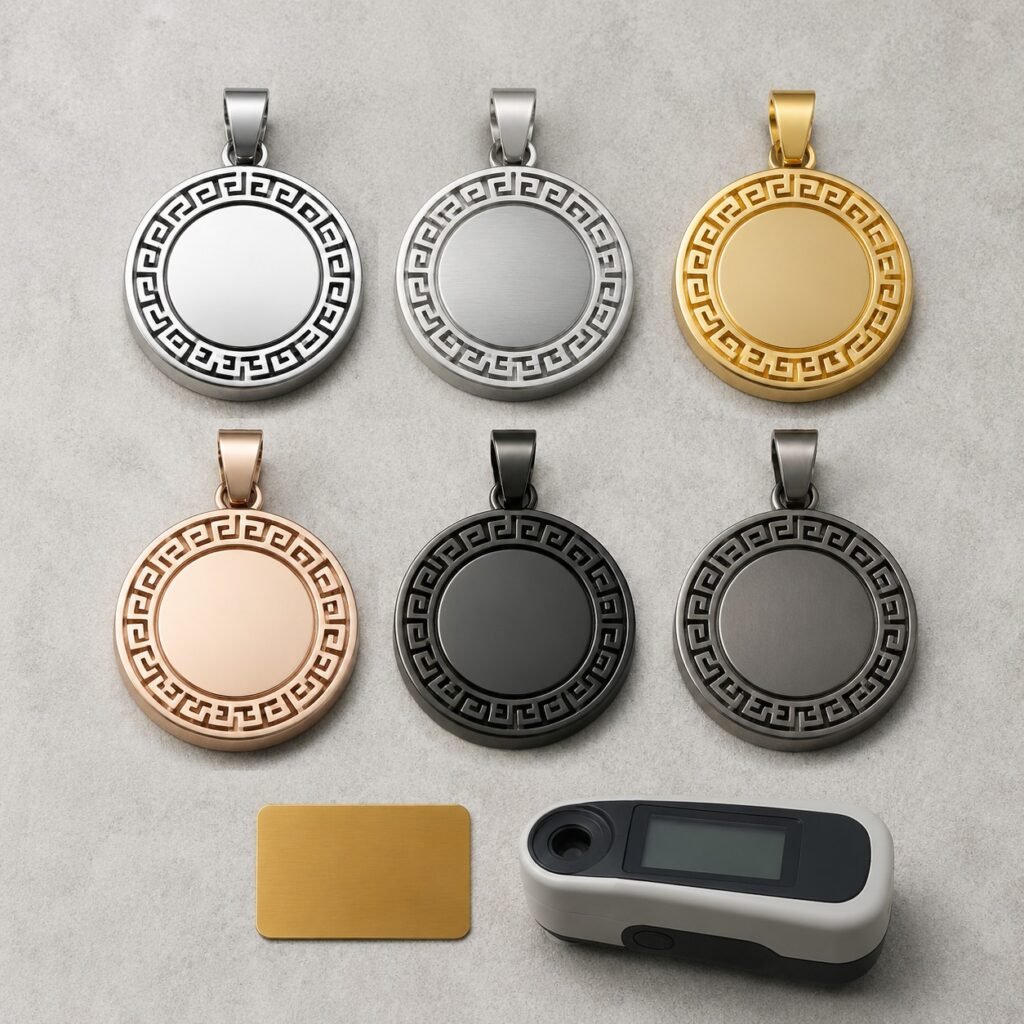
Reference Controls
For selected gold-color PVD projects, available reference structures include E1 Standard at approximately 0.4 μm TiN plus 0.05 μm Au/Gold, and E2 Thicker Gold at approximately 0.7 μm TiN plus 0.1 μm Au/Gold. Water-plated rhodium or silver-color structures may be specified at 3–5 μm or adjusted to the project. These are reference configurations, not automatic specifications for every SKU.
Unless the customer specifies another standard, Chicolink's internal references are ΔE00 ≤ 1.5 for polished or mirror surfaces and ΔE00 ≤ 2.0 for brushed, sandblasted, or antique-effect surfaces. We confirm thickness, measurement method, points, tolerances, visual acceptance, and test conditions for each material, color, construction, and order.
Scale Production with Defined Quality and Traceability
Chicolink Jewelry was established in June 2012 in Dongguan, China. Our factory covers more than 5,500 square meters and employs over 400 people, including six jewelry designers and three jewelry engineers. Monthly capacity exceeds 200,000 pieces. We operate CNC, casting, stamping, laser cutting, laser welding, polishing, plating, assembly, and packaging processes. We also support factory audits and customer-appointed quality inspections when included in the project plan.
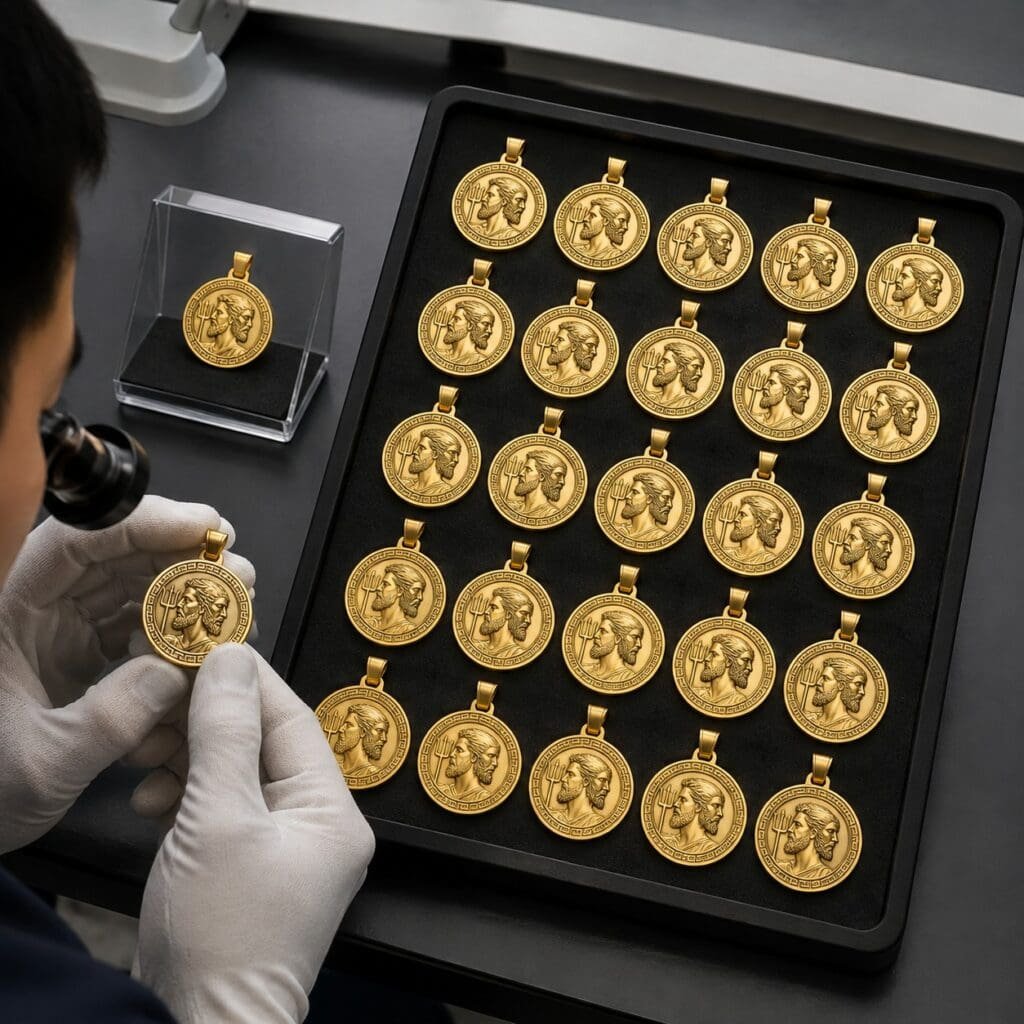
Quality Gates for Greek-Inspired Products
- IQC: Verify raw-material grade and condition, components, stones, and packaging materials before use.
- IPQC: Check molds, first articles, dimensions, Greek Key alignment, relief definition, welds, water marks, burrs, polishing, texture, plating color, assembly, and stone setting where applicable.
- FQC: Inspect appearance, color, dimensions, function, structure, surface defects, logo, accessories, and packaging against the approved reference.
- Pre-packing control: Use 100% inspection or an agreed sampling plan according to product and channel risk.
When the customer or order does not specify another plan, Chicolink's default is normal inspection, General Inspection Level II: Critical defects Ac 0/Re 1, Major defects AQL 1.0, and Minor defects AQL 2.5. Customer-approved inspection standards, drawings, samples, quality agreements, and test requirements take priority over internal defaults.
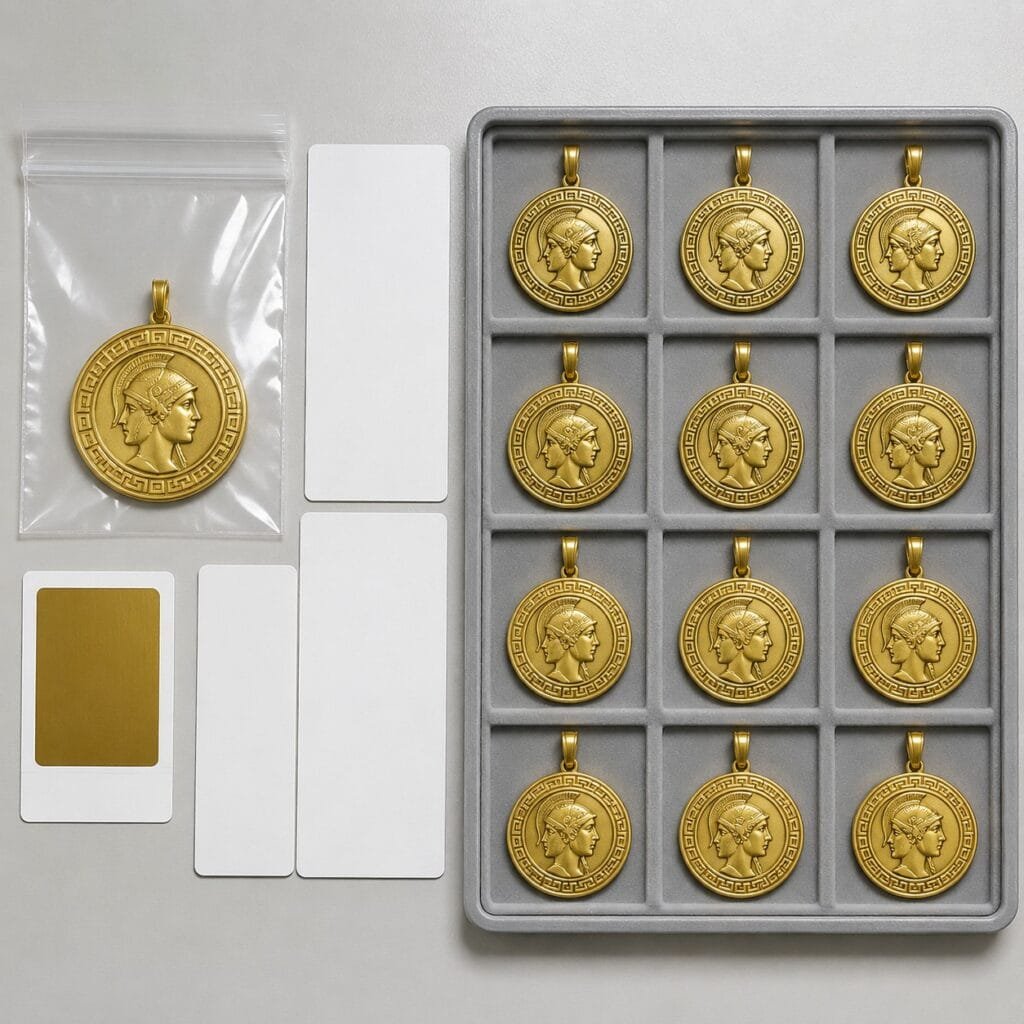
Records That Support Repeat Orders
We identify production batches by order and SKU and link them to drawing or sample versions, material batches, work orders, key processes, plating records, inspections, nonconforming-product handling, packaging, cartons, and shipment records. These records support variance investigation and replenishment planning. We still reconfirm current materials, colors, specifications, and production conditions for each order.
Select Tests by Product, Market, and Risk
Chicolink selects tests from the product, material, plating structure, color, skin-contact area, component design, market, and buyer's quality agreement. We conduct applicable internal checks and coordinate SGS, HKPC, or a customer-appointed laboratory or inspector for confirmed scopes. Each report covers only the stated samples, materials, colors, plating structures, standards, and conditions; it does not automatically cover every SKU, batch, or market.
| Requirement | Chicolink Reference or Support | Relevant Greek Jewelry Risk | Confirmation Required |
|---|---|---|---|
| Salt-spray resistance | Internal defaults: 24 hours for bare stainless steel, 48 hours for plated/PVD products, or 72 hours for higher-resistance projects; customer standards take priority | Corrosion, pitting, blistering, peeling, exposed substrate, color change, clasp function | Standard, solution, duration, sample state, inspection method, acceptance criteria |
| Artificial perspiration | Internal reference: 40±2°C for 24 hours at pH 4.7±0.2 | Skin-contact surfaces, recessed Meander channels, welds, clasps, color and gloss change | Formula, exposure method, sample quantity, color limit, customer requirement |
| Tensile strength | Internal references include 40 N for pendant rings/connectors, 30 N for main necklace structures, and 60 N for main bracelet structures; five samples held for 10 seconds | Heavy mythology pendants, trident or charm connections, chain and clasp failure | Product loading direction, fixture, applicable load, quantity, customer standard |
| Torque and drop | Structure-specific torque references and a one-meter bare-product drop test are available where applicable | Threaded parts, ear posts, attached ornaments, relief components, deformation or sharp edges | Product construction, sample quantity, test direction, packaging status, acceptance criteria |
| Nickel release | Support for EN 1811, EN 12472, and other confirmed nickel-related tests | Direct and prolonged skin contact for relevant EU-market products | Material, color, plating layers, wear pretreatment, standard version, laboratory |
| Lead and cadmium | Lead Free and Cadmium Free testing support according to the target market and product scope | Base material, solder, components, stones, coatings, or decoration materials | Restricted substances, market limit, sample composition, laboratory, report scope |
| REACH / California Proposition 65 | We arrange testing or document support for confirmed products and requirements | Requirements vary by substance, product, and exposure | Current requirement, SKU, material, finish, laboratory, buyer specification |
| Third-party inspection | We coordinate SGS, HKPC, or a customer-appointed organization for agreed tests or pre-shipment inspection | Verification before a large shipment | Agency, scope, date, fees, samples, report recipient, shipment schedule |
Prepare Each Collection for Private Label Delivery
Chicolink prepares the product and private-label details as one delivery system. We align product names, logo placement, cards, barcodes, SKUs, finish identification, care information, pack-out, and abrasion protection with the buyer's channel. Product and packaging versions stay under the same project record. We confirm packaging construction, printing, quantity, tests, delivery, and cost for the actual collection rather than applying a generic package.
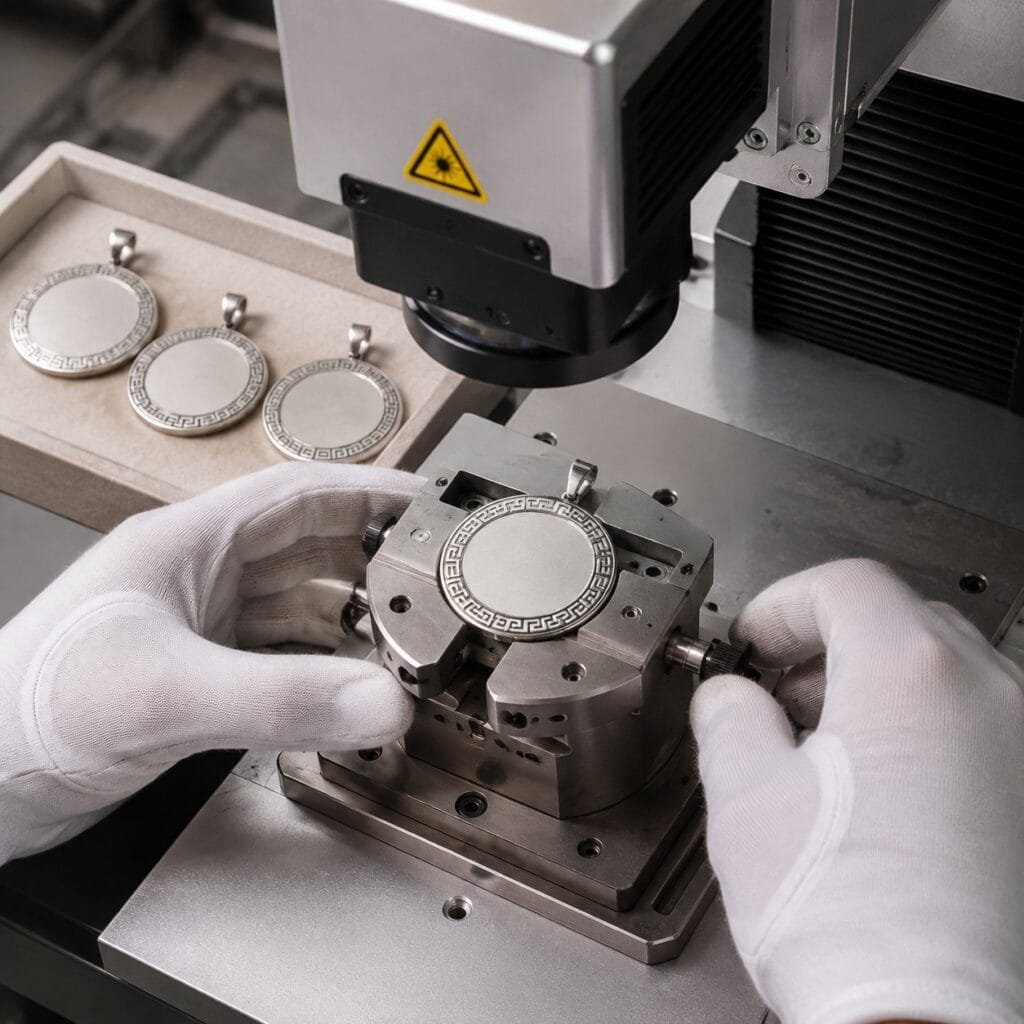
Product Identity Control
- Confirm laser engraving, etching, stamping, tag, or another approved logo route according to the product structure and visible surface.
- Record the logo artwork version, dimensions, position, orientation, depth or appearance, and whether the mark belongs on the product, tag, card, or package.
- Review logo placement around Greek Key borders and mythology reliefs so the mark does not interrupt a repeat, cover a key feature, or create an unsuitable wearing surface.
- Approve the physical result before bulk execution.
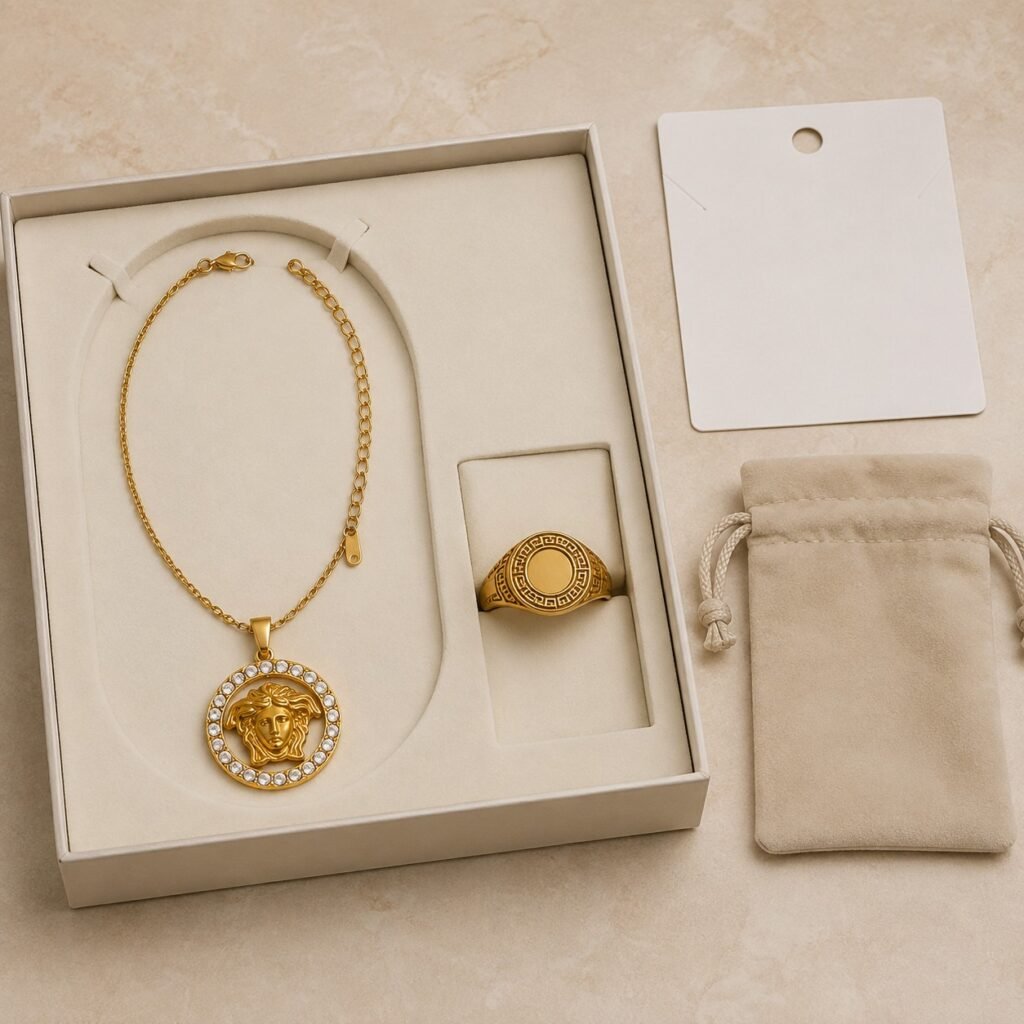
Retail Card and Box System
- Coordinate jewelry cards, boxes, pouches, and set packaging with the approved products and collection hierarchy.
- Confirm brand color, material, dimensions, surface finish, insert construction, product fixing method, and text version.
- Protect raised Medusa portraits, polished Meander channels, sharp symbolic silhouettes, chains, and paired earrings from pressure, tangling, or direct abrasion.
- Separate packaging samples and versions where product and packaging approvals follow different schedules.
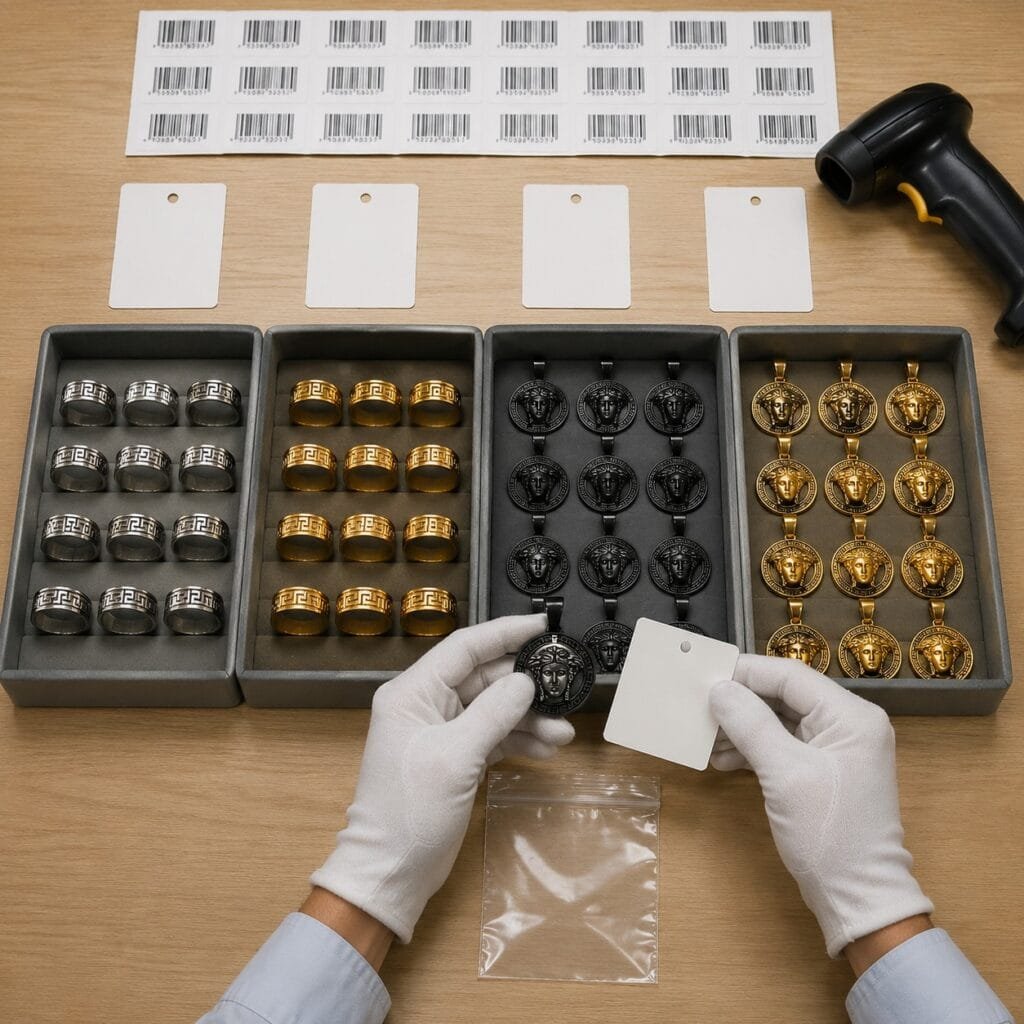
SKU and Barcode Accuracy
- Map style, size, color, plating, set combination, and packaging version to the buyer's SKU structure.
- Confirm barcode type, number source, label dimensions, print position, language, country or channel information, and carton marking requirements supplied by the customer.
- Check product, card, label, inner pack, outer carton, and packing list before shipment.
- We evaluate Amazon FBA or other channel-specific packaging against the buyer's current instructions.

Approval and Pack-Out
- Define whether each unit, pair, or set is packed in a bag, pouch, card, box, or combined retail pack.
- Confirm cleaning, protective film, anti-scratch separation, spare parts, care card, quantity per inner box, carton data, and inspection access.
- Link the packaging version to the corresponding product SKU and color so a product revision does not leave obsolete labels or images in use.
- Include third-party inspection access in the packing schedule when required.
Review MOQ, Cost, and Lead Time Before Sampling
Commercial terms depend on structure, material, size, weight, process, mold, finish, decoration, packaging, tests, quantity, and delivery. The figures below are Chicolink's common or internal references, not fixed terms for every design. We issue a formal quotation after reviewing the relevant SKU, quantity, color, size, packaging, quality, and schedule information.
| Commercial Item | Chicolink Reference | Important Qualification |
|---|---|---|
| First inquiry response | Target within 6 hours | We may confirm receipt, request missing information, or report the evaluation status before issuing a formal quotation |
| Regular or available product MOQ | Commonly 120 pieces per style | Inventory, color, size, packaging, and shipping date must be confirmed by SKU |
| OEM/ODM MOQ | Commonly 500 pieces per style | MOQ may be calculated by style, color, size, plating batch, material, stone, mold, or packaging version |
| Existing-product sample time | Usually 3–7 working days | Subject to sample availability, color, quantity, packaging, payment, and dispatch arrangement |
| OEM/ODM sample time | Usually 25–30 working days | Starts from confirmed scope and applicable approvals; complexity, tooling, revisions, plating, stones, and testing can change timing |
| Existing-product bulk time | Usually 20–30 working days | Subject to stock status, order quantity, finish, packaging, inspection, payment, and shipment plan |
| OEM/ODM bulk time | Usually 25–45 working days | Starts according to the written order schedule after required approvals; tooling, materials, testing, and packaging can affect completion |
| Sample and mold charges | Sample fees normally apply; mold, tooling, drawing, prototype, and delivery costs are quoted where applicable | Whether a sample or mold fee is credited against a bulk order depends on the order value and written agreement |
| Artificial-perspiration test | Internal fee reference approximately USD 100 | Confirm method, samples, facility, reporting, and current quote |
| Salt-spray test | Internal fee reference approximately USD 2 per hour | Duration, method, preparation, inspection, and reporting affect the final charge |
| Rubbing-resistance test | Internal fee reference approximately USD 120 | Confirm equipment, cycles, load, surface, samples, and acceptance standard |
| Nickel-release test | Internal references: SGS approximately USD 500 per color; HKPC approximately USD 120 per color | Confirm laboratory, standard, pretreatment, material, plating layers, colors, samples, and current quote |
| Quantity tolerance | Common internal reference approximately ±5% | The accepted overage or shortage, remaining goods, invoicing, and freight responsibility must be agreed for custom orders |
| Reference payment term | 50% deposit and 50% balance before shipment | Actual payment ratio, credit term, L/C, T/T, PayPal, or other agreed arrangement depends on customer credit, order value, and contract |
Greek Jewelry Manufacturing FAQ
These answers cover key technical and purchasing questions for Greek-inspired stainless steel jewelry. Chicolink documents final decisions against the design, material, finish, market, quantity, and customer-approved standard.
Can a Greek Key close seamlessly around a ring?
Chicolink can close the pattern cleanly by planning repeat pitch, line width, circumference, and ring size together. One layout may not fit every size, so we adjust spacing or use a controlled end point where needed. The customer approves the drawing and sample before bulk production.
Which files should we send for development?
Send the clearest available JPG, PNG, PDF, AI, DXF, STEP, or relevant design file. Include dimensions, product type, motif direction, target weight or price, material, color, quantity, market, packaging, and launch date. Chicolink will identify any missing drawing or engineering details.
Is 316L always required for mythology jewelry?
No. Chicolink selects 304 or 316L from the market, wearing environment, structure, processing requirements, price position, and buyer specification. 316L generally offers better resistance to pitting, but it can affect processing of complex structures. We confirm the grade for each product.
How are small mythology details kept visible?
We review product area, relief hierarchy, feature spacing, polish access, mold release, and finish. Faces, feathers, hair, helmets, and inscriptions may need simplification or enlargement. We confirm readability through drawings and a physical sample, not from a screen image alone.
Can we use museum or online reference images?
Send reference images only when you have the right to use them. Ancient subject matter may be public domain, while a modern photograph, drawing, reconstruction, logo, licensed character, or branded interpretation may remain protected. Chicolink reviews manufacturability but does not provide legal ownership opinions.
How do you control sample-to-bulk consistency?
We link the approved sample to its drawing, BOM, dimensions, weight, finish, color, logo, and packaging version. First-article and process inspections check the agreed control points. Bulk acceptance follows the approved sample, written standard, order, and inspection plan. We record approved changes as new versions.
Can sizes or colors be mixed under one MOQ?
Chicolink assesses this by project. Sizes may require separate pattern layouts, molds, fixtures, or assortment ratios. Colors may require separate plating batches and packaging versions. We confirm any mixed-size or mixed-color arrangement in the quotation after reviewing the style, material, finish, quantities, and production plan.
Does PVD mean the jewelry never fades?
No. Chicolink does not make unconditional “never fades” claims. PVD performance depends on pretreatment, layer structure, thickness, color, geometry, wear, sweat, chemicals, abrasion, storage, and packaging. We define the plating specification and arrange relevant tests when required. Results apply only to the tested configuration and conditions.
Can you support EU and US requirements?
Yes. Chicolink supports product-specific testing and documentation for confirmed nickel, lead, cadmium, REACH, and California Proposition 65 requirements where applicable. Tell us the destination market and standard before sampling. We verify each report's sample, material, color, plating structure, standard, laboratory, date, and scope before use.
How is color managed on repeat orders?
We reference the approved color sample, product specification, plating route, target thickness, and previous batch records. Because material, polishing, texture, geometry, and plating conditions can affect appearance, we confirm and inspect each new order. Historical records support control but do not replace current production checks.