
Hawaiian-Inspired Tropical Stainless Steel Jewelry Manufacturer
Develop commercially structured tropical collections through controlled engineering, sampling, in-house PVD plating, bulk production, private labels, and export coordination.
Chicolink Jewelry develops Hawaiian-inspired tropical stainless steel jewelry for established brands, wholesalers, retailers, and destination retail programs. We can start from authorized artwork, a reference sample, CAD files, an existing style, or a collection brief.
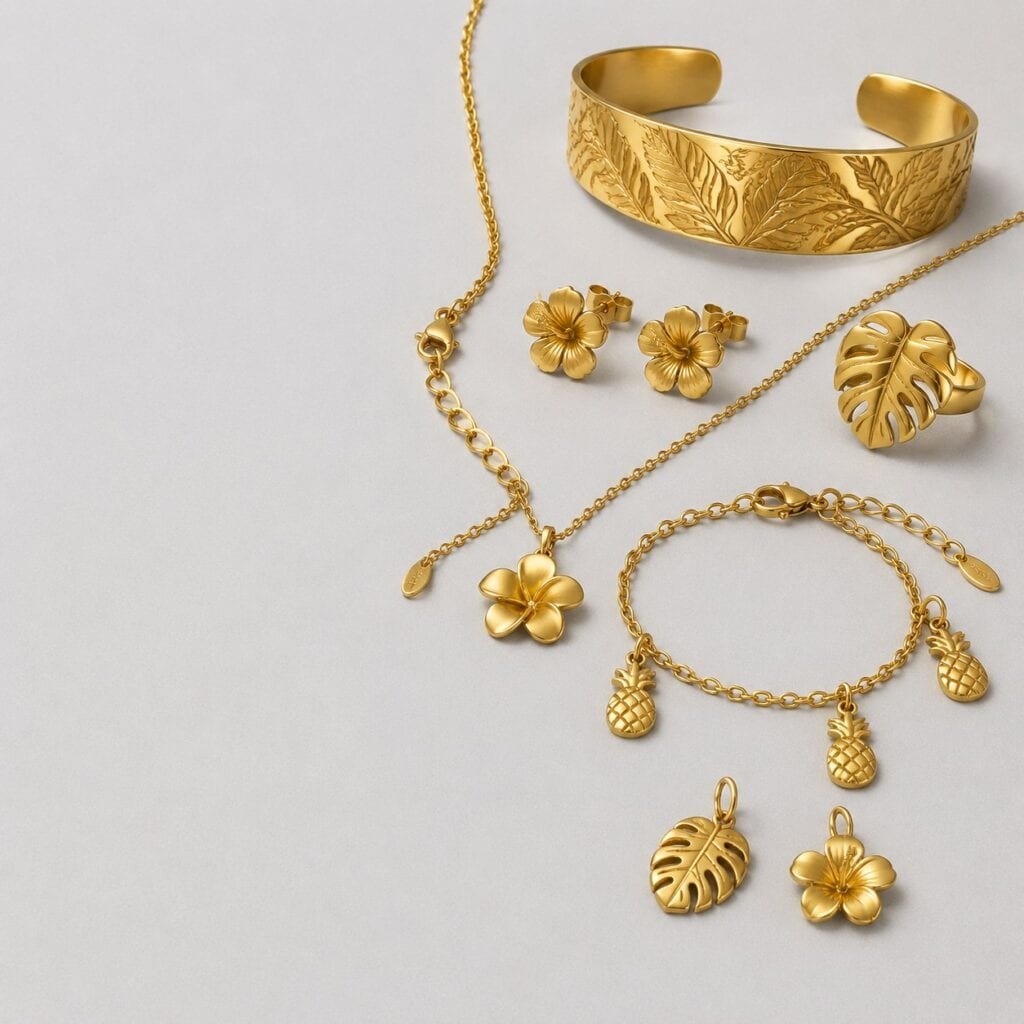
- Plumeria, hibiscus, tropical leaves, fruit, shoreline, location, and continuous-pattern concepts
- Necklaces, earrings, rings, bracelets, bangles, anklets, charms, and coordinated sets
- OEM, ODM, private-label, packaging, testing, inspection, and replenishment support
Define Hawaiian-Inspired Tropical Jewelry Before Development
“Hawaiian jewelry” can refer to different product traditions. Before quoting, we define whether the project is a contemporary tropical collection, a traditional-style personalized design, or an adjacent nautical program. This decision controls the artwork, product structure, process, naming, and approval route.

Contemporary Tropical Jewelry Programs
We use “Hawaiian-inspired tropical jewelry” for contemporary stainless steel collections based on an authorized island or tropical design direction.
- Typical visual codes: Plumeria, hibiscus, palm and monstera leaves, pineapple, coconut, tropical fruit, sunlight, shoreline forms, coordinates, destination names, and customer-owned patterns.
- Typical commercial use: Seasonal capsules, resort retail, destination gifts, summer collections, private-label programs, and long-term tropical product lines.
- Production options: Depending on the design, we may use casting, stamping, laser cutting, CNC work, engraving, polishing, PVD plating, cold enamel, resin filling, stone setting, or assembly.
- Manufacturing origin: Chicolink manufactures in Dongguan, China. We do not describe our products as made in Hawaii, Native Hawaiian products, or authentic Hawaiian heirloom jewelry.
- Traditional-style requests: Personalized names, scroll patterns, dark recesses, and heirloom-inspired details receive a separate artwork and process review. We evaluate whether stainless steel engraving, etching, stamping, cast relief, or filling can produce the requested effect.
- Adjacent themes: Shells, sea animals, anchors, compasses, and other marine subjects belong primarily to Chicolink’s dedicated shell, sea-life, or nautical development scopes. They may support a tropical collection but should not control this page.
Match Tropical Collections to the Buying Program
We structure each project around its commercial purpose. Seasonal launches, evergreen collections, destination-exclusive programs, and multi-market extensions require different SKU plans, tooling, colors, packaging, approval schedules, and replenishment records.
Seasonal Capsule
A seasonal capsule needs a fixed launch window and a focused design story. We define hero motifs, supporting products, colorways, samples, packaging, and approval deadlines before bulk scheduling. Must-launch SKUs remain separate from optional extensions so late additions do not delay the core collection. Tooling, decoration, PVD colors, packaging, testing, and Golden Sample approval determine the final production and delivery schedule.
Evergreen Core Line
An evergreen tropical line must remain recognizable and repeatable beyond one season. We record each SKU’s released drawing, BOM, material, color reference, components, packaging file, and inspection points. New colors or extensions become controlled versions rather than silent substitutions. Repeat orders use the latest released records, approved changes, and relevant batch history. This protects the released design across later production batches.
Destination Exclusive
A resort retailer or regional distributor may need destination names, coordinates, exclusive colors, or channel-specific packaging. We confirm artwork rights, spelling, orientation, engraving area, package version, barcode structure, store allocation, and reorder needs. Product bodies may be shared across locations, but every name, code, label, and pack-out version remains separately controlled throughout sampling, production, inspection, and replenishment. This supports accurate repeat orders.
Multi-Market Extension
A multi-market brand may keep one tropical design language while changing dimensions, colors, labels, packaging, or compliance evidence by region. We create a SKU matrix that separates shared specifications from market-specific requirements. This reduces duplicate tooling and prevents the wrong artwork, test scope, barcode, or packaging version from entering a regional production batch. Each regional release retains its own approval evidence.
Build Motifs With a Clear Tropical Design Language
We organize authorized artwork into six motif families with shared proportions, line language, relief depth, color logic, and components. This keeps the assortment recognizable while allowing each necklace, earring, ring, bracelet, or charm to use a suitable structure.
Tropical Florals
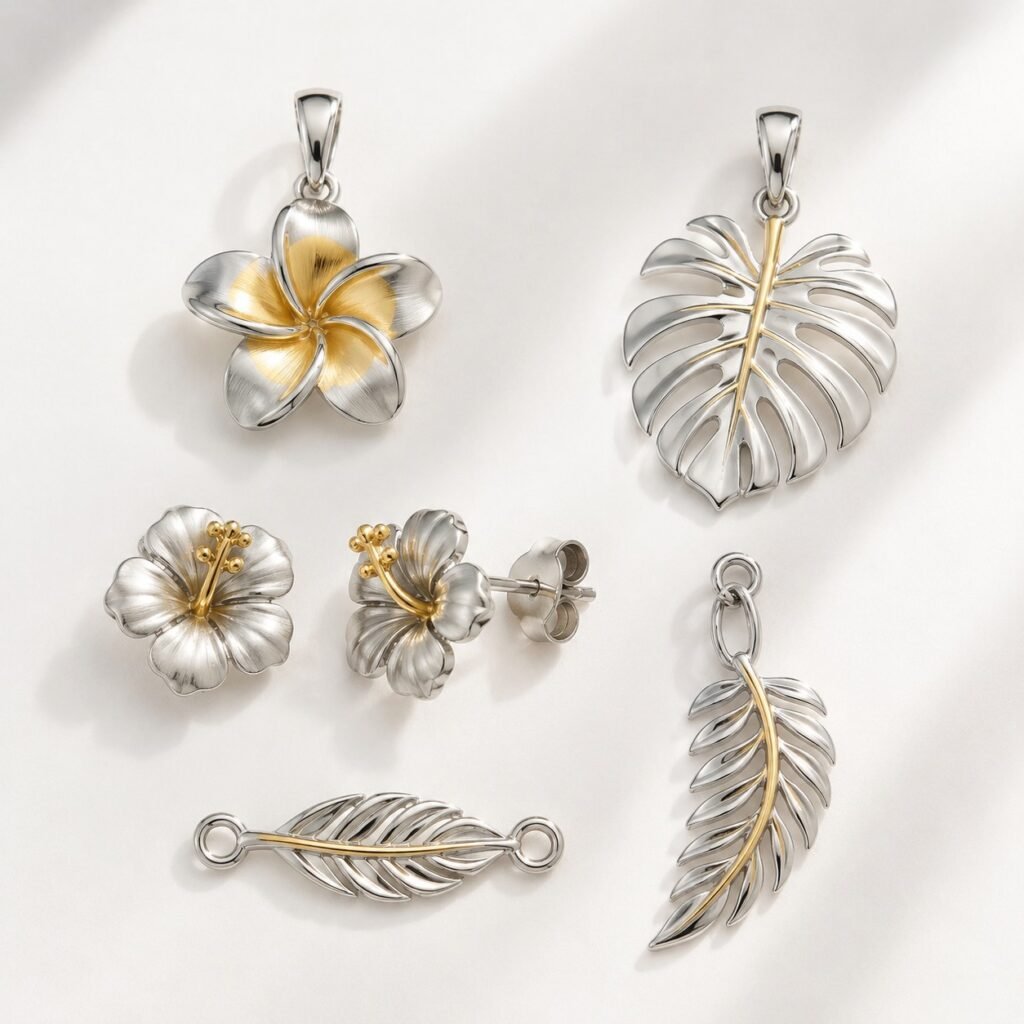
Plumeria and hibiscus concepts may use open petals, overlapping layers, engraved outlines, recessed centers, stones, or colored filling. Chicolink reviews petal thickness, edge radius, relief transition, polishing access, stone or filling position, and connection placement. The flower must retain its identity after casting, forming, polishing, and plating without leaving thin points, hidden residue, or uncomfortable edges. We record the released petal profile.
Places and Names
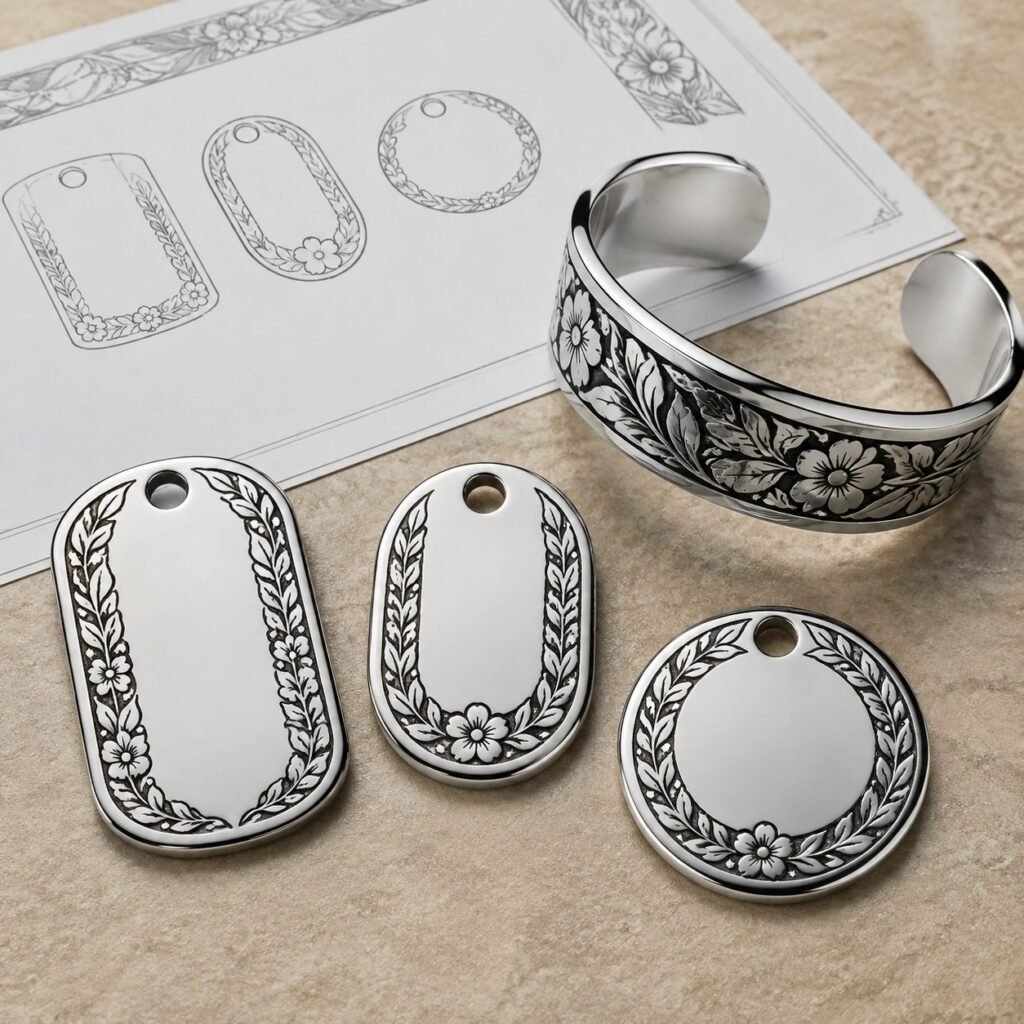
Coordinates, destination names, dates, initials, and approved words can make a tropical collection location-specific. Chicolink confirms exact spelling, font ownership, converted vector artwork, minimum readable size, engraving or relief depth, orientation, safe margins, and version codes. Personalized or location-based products require strict file control because a correct product structure with the wrong name or coordinate is still an unusable SKU.

Fruit Icons
Pineapple, coconut, citrus, and other tropical fruit motifs combine recognizable outlines with repeated surface detail. Chicolink determines whether crosshatching, texture, leaves, color zones, and dimensional features should be engraved, stamped, cast, filled, or assembled. The design must avoid dense grooves that trap polishing compound, excessive thickness, weak top leaves, or decoration areas that cannot be inspected consistently during bulk production.
Extend Tropical Motifs Across Commercial Product Families
We adapt motif proportion, thickness, relief, connections, weight, movement, and finish to each wearing position instead of scaling one artwork mechanically. Every SKU receives its own drawing, BOM, dimensions, components, inspection points, packaging method, and approval record.

Cuffs and Bangles
Tropical cuffs and bangles can carry continuous engraving, relief, cutouts, names, or colored recesses. Chicolink records internal length and width, opening, cross-section, wall thickness, symmetry, pattern orientation, edge radius, adjustment limits, hinge or lock structure, and packaging support. Thin cutout cuffs are reviewed for spring-back and permanent deformation before sampling.

Earrings
Plumeria studs, leaf drops, tropical hoops, and asymmetric pairs require different engineering. Chicolink checks ear-post diameter and effective length, welding position, vertical alignment, closure, pair direction, single-ear weight, center of gravity, connecting rings, and packing protection. Large floral faces may need reduced thickness or a revised post position to avoid forward tilting.
Chain Bracelets
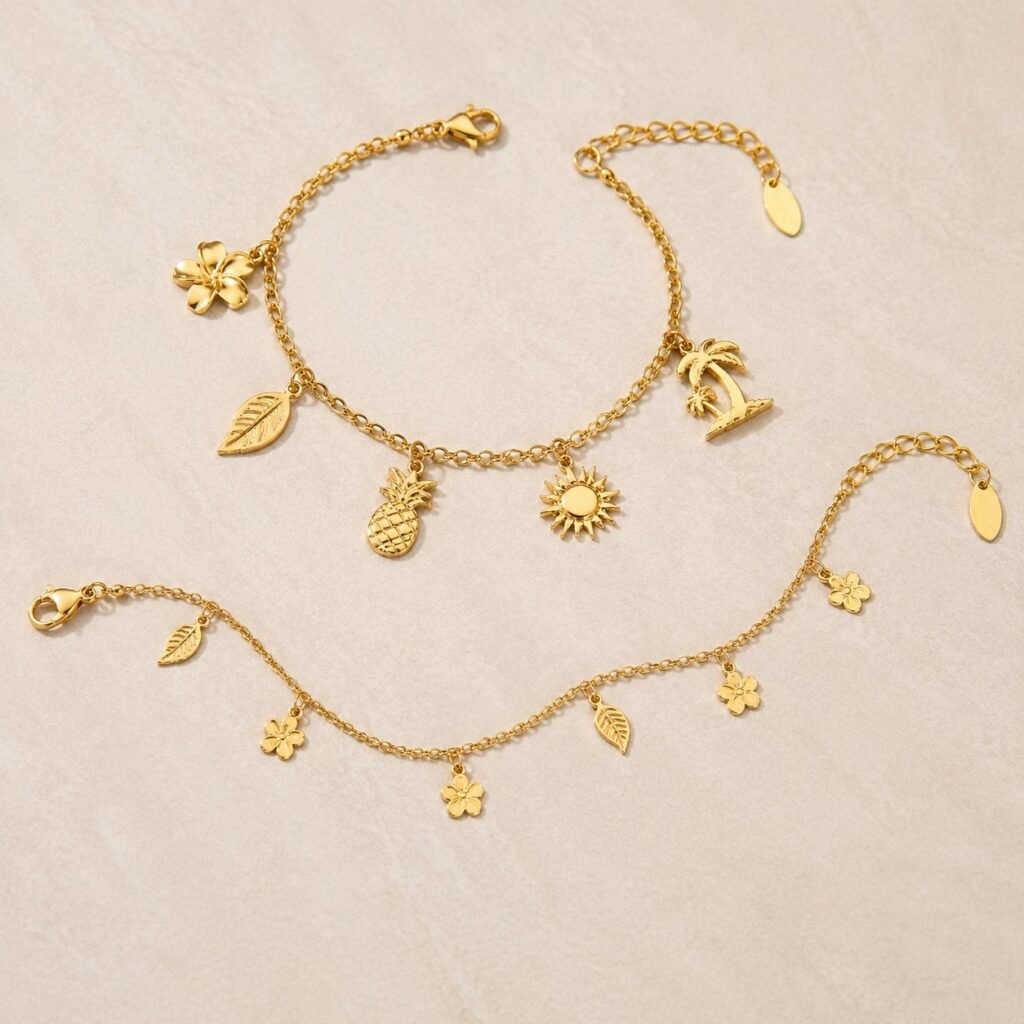
A tropical bracelet may use a center motif, repeated charms, stations, or a coordinated clasp and logo tag. Chicolink confirms wrist range, finished length, extension, component spacing, connection strength, charm movement, chain twisting, clasp operation, and skin-contact surfaces. Repeated decorative parts require quantity and orientation checks during assembly and final inspection.
Coordinated Sets
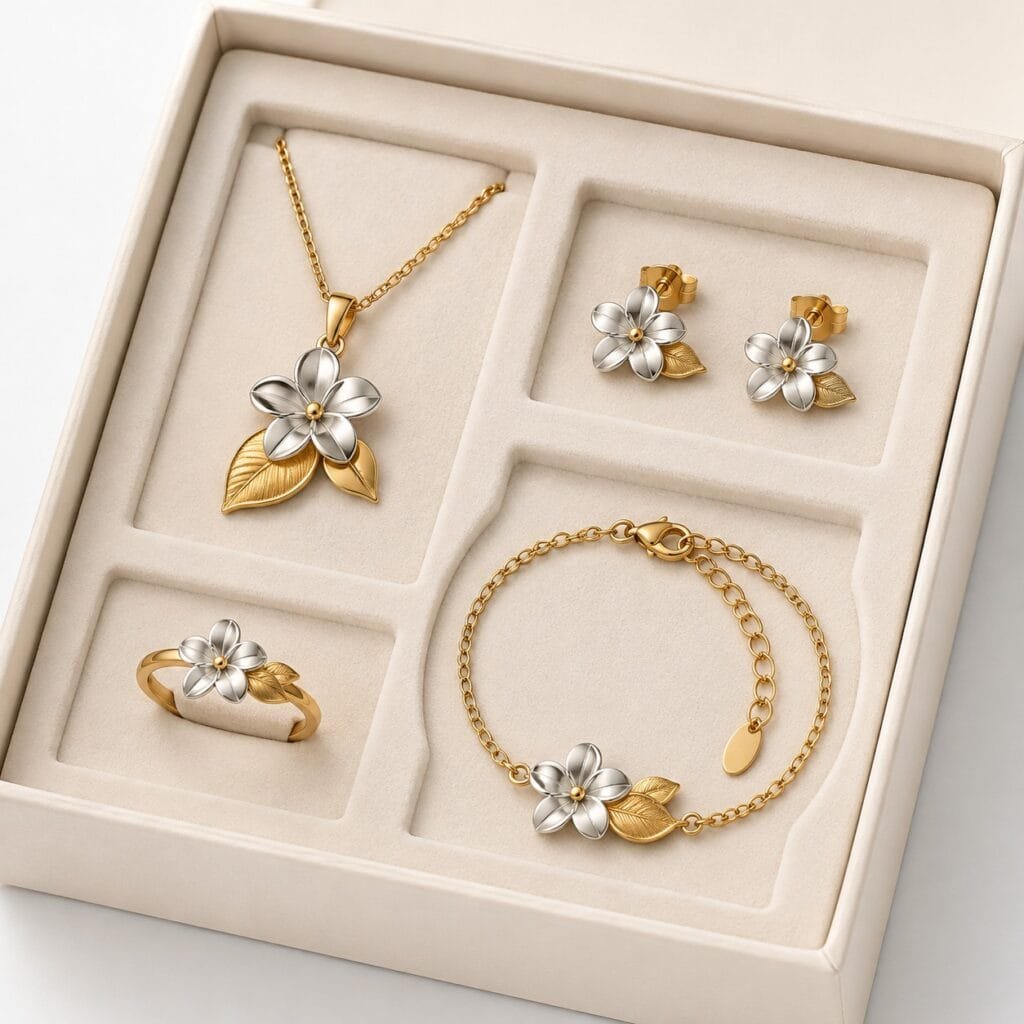
A set may combine a necklace, earrings, ring, bracelet, or anklet through shared motif proportions and finishes. Chicolink controls each item as an individual SKU while recording the set configuration, included quantities, color match, product placement, packaging insert, barcode, missing-part check, and carton allocation. Shared appearance does not replace product-specific structure and inspection requirements.
Match Each Tropical Motif to Its Production Route
We select the production route from the motif geometry, material form, order volume, finish, and required detail. After reviewing the artwork, we define the process, tooling, key dimensions, tolerances, sample checks, cost factors, and timing. The options below are routes Chicolink can evaluate, not automatic specifications.
| Motif Structure | Chicolink Route to Evaluate | Critical Controls | Product Applications | Required Project Inputs |
|---|---|---|---|---|
| Dimensional plumeria or hibiscus | Casting, wax development, CNC-assisted master development, polishing, PVD, optional stone or filling | Petal thickness, relief transition, shrinkage, porosity, polishing access, sharp tips, back structure | Pendants, studs, rings, center charms | Artwork, target size, thickness, weight, finish, decoration, quantity |
| Flat palm or monstera silhouette | Stamping or laser cutting, deburring, forming, polishing, PVD | Narrow bridges, cutout size, edge condition, warping, hanging point, plating contact | Earrings, pendants, charms, stations | Vector outline, sheet thickness, curvature, dimensions, color, quantity |
| Pineapple or fruit texture | Casting, stamping, engraving, etching, filling, or combined route | Texture depth, leaf strength, groove cleaning, fill boundaries, color separation | Pendants, studs, charms, rings | Detail level, relief type, color zones, finish, target price |
| Name, date, or coordinate plate | Laser cutting, laser engraving, etching, stamping, CNC, PVD | Spelling, font rights, character size, safe margins, orientation, version control | Pendants, bracelets, anklets, cuffs | Editable artwork, exact text, dimensions, quantity by version |
| Continuous cuff or ring pattern | Laser engraving, etching, stamping, cast relief, optional cold enamel | Pattern repeat, seam position, curvature, depth, size range, polish loss | Cuffs, bangles, rings, wide pendants | Flat artwork, repeat length, product sizes, finish, filling requirements |
| Layered sunset or botanical scene | Laser-cut layers, casting, stamping, welding, filling, stone setting | Layer alignment, weld location, total weight, negative space, color boundaries | Statement pendants, earrings, brooches, sets | Layer file, exploded view, target weight, finish map, assembly method |
Resolve Floral and Leaf Details Before Tooling
Thin petals, narrow leaf bridges, dense veins, and deep recesses can weaken, distort, trap polishing compound, or lose definition in metal. Before tooling, we complete a DFM review and identify the dimensions, structural revisions, and sample checks needed to control these risks.

Convert Artwork Into Measurable Production Features
A visual rendering is not a complete production specification. Our DFM review converts it into measurable features and approval points.
- Edges: We define the thinnest edge, local thickness, radius, and polish allowance. Sharp tips receive a radius or structural support.
- Openwork: As an initial review rule, holes and narrow bridges in stamped or laser-cut parts should not be smaller than the material thickness. Geometry and finishing may require larger values.
- Cast relief: Initial wall-thickness review may begin around 0.8–1.2 mm for conventional solid cast structures. Long petals, projections, recessed backs, and polishing loss require separate evaluation.
- Fine detail: We record vein or engraving width, spacing, depth, and post-polish readability. Details that merge or disappear are enlarged or simplified.
- Color recesses: Groove geometry, filling access, overflow control, curing, and final finishing are reviewed together.
- Process access: Grooves and overlapping layers must permit cleaning, drainage, plating, and inspection. Connections and process contact points stay away from principal appearance surfaces where possible.
- DFM record: We issue the selected route, revisions, key dimensions, tooling, sample checks, open assumptions, and release conditions.
Select Surface Treatments That Preserve Tropical Details
We plan engraving, relief, texture, filling, polishing, and plating as one finish system. Before sample approval, we define the principal appearance surfaces, color reference, recesses, contact points, process sequence, and inspection method so finishing does not erase or obscure the tropical details.
| Surface or Decoration | Tropical Visual Use | Structure to Confirm | Main Production Risk | Approval Evidence |
|---|---|---|---|---|
| Laser engraving | Leaf veins, coordinates, names, line florals, fine surface patterns | Line width, depth, spacing, font, direction, safe margin | Weak readability, uneven depth, polish loss, wrong text version | Approved artwork, position drawing, engraved sample |
| Etching | Repeated botanical patterns and shallow graphic fields | Artwork polarity, depth, edge definition, protected areas | Under-etching, over-etching, blurred boundaries | Artwork version, etched sample, appearance criteria |
| Stamping or embossing | Repeated texture, pineapple grids, floral outlines | Tooling, relief height, material thickness, forming direction | Incomplete pattern, distortion, die marks, spring-back | Tooling sample, dimension report, surface standard |
| Cast relief | Dimensional flowers, leaves, fruit, sculpted scenes | Wall thickness, draft, water gate, back relief, polish access | Porosity, shrinkage, weak tips, softened detail | Metal sample, dimensions, weight, approved relief |
| Cold enamel or epoxy | Petal centers, tropical color fields, black pattern recesses | Recess depth, color boundary, fill level, curing route | Overflow, bubbles, uneven surface, weak adhesion | Color sample, fill sample, adhesion criteria |
| Resin or colored filling | Wider decorative fields and polished inlay effects | Groove geometry, layer thickness, grinding allowance | Shrinkage, contamination, cracking, polish exposure | Filled sample, color reference, finish approval |
| High polish, brushing, or sandblasting | Contrast between petals, leaves, backgrounds, and borders | A/B/C surfaces, grain direction, texture boundary | Rounded details, inconsistent grain, visible tool marks | Surface sample, appearance-zone drawing |
| PVD/IP plating | Gold, rose gold, black, or other approved collection colors | Base preparation, target color, layer structure, contact point | Shade variation, recess coverage, exposure at contact points | Approved color sample, plating specification, batch record |
Engineer Tropical Jewelry for Stable Everyday Wear
Before sample approval, we check how each product moves, balances, contacts the skin, closes, and fits its packaging. Necklaces, earrings, rings, cuffs, charm products, and sets receive product-specific dimensions and functional checks rather than one shared appearance standard.
Pendant Balance
The bail, jump ring, chain path, and center of gravity determine whether a tropical pendant faces forward or repeatedly flips. Chicolink checks the largest chain profile, opening after plating, pendant thickness, back relief, logo position, and movement on the selected chain. Asymmetric leaves and flowers may need an adjusted connection point or concealed balancing feature. We approve the hanging state with the selected chain.
Earring Stability
Floral studs and leaf drops must balance around the actual ear-post or hook position. Chicolink records post diameter, effective length, welding area, alignment, ear-back type, single-ear weight, pair difference, and drop connections. We correct sharp petals, exposed welds, forward-tilting faces, loose closures, and incorrect left-right orientation before release. Packing protection also prevents the ear post from bending during international shipment.
Ring Continuity
A continuous tropical pattern must align across the top, sides, and bottom of the ring without weakening the band. Chicolink confirms size system, inner diameter, band width, bottom thickness, pattern repeat, open-ring adjustment zone, polish allowance, and comfort surface. Wide bands, relief designs, and non-round profiles require sample fitting and defined measurement methods. The released drawing identifies the pattern seam and size reference.
Cuff Fit
A patterned cuff requires controlled internal dimensions, opening width, cross-section, spring-back, and edge radius. Chicolink evaluates whether the intended adjustment will cause permanent deformation or damage engraving, filling, or PVD. Open ends, pattern termination, inside polish, main stress area, symmetry, and packaging support are included in the product specification. The sample records the approved fit and adjustment range before production.
Charm Movement
Repeated charms can collide, turn backward, catch adjacent links, or concentrate force on small rings. Chicolink controls charm spacing, connection direction, jump-ring wire diameter, welding, chain compatibility, finished length, extension, and pull requirement. We review the assembly sample in natural hanging and moving conditions, then record the released spacing and connection direction for consistent bulk-line assembly and final inspection.
Set Compatibility
Products in a coordinated set should match visually without sharing unsuitable dimensions. Chicolink separately controls pendant weight, earring scale, ring profile, bracelet movement, anklet spacing, and packaging fixation. Color references, motif proportions, component finishes, set quantities, product orientation, and missing-part checks are linked to the approved set and SKU records. The approved pack-out sample confirms final product placement and protection.
Control Cultural References, Artwork Rights, and Product Names
Customer references can contain trademarks, protected artwork, destination names, traditional patterns, or culturally sensitive symbols. Before tooling, we record the source, authorization status, approved use, product name, and claims for each design. Files without sufficient authorization remain references and do not enter production.
Approve the Design Source Before Production
We apply these controls to Hawaiian-inspired tropical jewelry projects.
- Source: We record whether artwork is customer-owned, licensed, commissioned, public-domain, independently developed, or reference-only.
- Market references: A competitor image may show proportion or finish, but it does not authorize copying protected artwork, trademarks, packaging, or distinctive designs.
- Cultural language: The customer confirms the meaning and sales wording for traditional-looking patterns, Hawaiian words, places, or culturally specific symbols.
- Origin: Chicolink manufactures in Dongguan, China. We do not label our products “made in Hawaii,” “Native Hawaiian product,” or “authentic Hawaiian heirloom jewelry.”
- Variable artwork: An approved artwork sheet controls spelling, punctuation, coordinates, font, orientation, and SKU allocation.
- Files and confidentiality: We accept confirmed editable formats such as AI, EPS, SVG, CDR, PDF, DWG, or DXF. NDA support, controlled access, revision records, and obsolete-file control are available.
- Release: Tooling and production start only after required design information and customer authorization are recorded.
Build a Commercially Balanced Tropical Jewelry Assortment
Chicolink converts the approved tropical design language into a SKU plan that can be quoted, sampled, inspected, packed, and replenished. The objective is not the largest possible assortment. We define the commercial role of each SKU, identify shared tooling and components, and separate necessary variants from options that create cost, plating, packaging, or inventory complexity.
| Assortment Role | Function in the Collection | Chicolink Development Focus | Main Decision Before Sampling |
|---|---|---|---|
| Hero design | Carries the strongest floral, leaf, fruit, or patterned identity | Distinctive geometry, finish, photography value, coordinated extensions | Which motif and product should control the visual language? |
| Core repeat style | Supports longer selling periods and replenishment | Stable structure, repeatable components, controlled color, practical packaging | Which specifications must remain unchanged across orders? |
| Entry-price SKU | Gives the buyer a lower-cost opening product | Reduced weight, simpler decoration, shared components, efficient process | Which details can be simplified without losing motif recognition? |
| Statement SKU | Supports a higher visual or retail position | Larger scale, dimensional relief, layered construction, stones, filling, or special finish | Which added complexity produces commercial value? |
| Matching product | Extends a proven motif into another category | Product-specific proportion, weight, connection, size, and comfort | Which visual elements should be shared and which must change? |
| Personalization version | Adds a name, coordinate, date, initial, or destination | Artwork matrix, version control, engraving area, SKU and packaging mapping | How many text versions and quantities belong to each version? |
| Color extension | Adds PVD or decorative color variants | Color sample, plating lot, filling color, variant ratio, test scope | Is each color commercially necessary at its individual MOQ? |
| Replenishment SKU | Supports repeat orders or phased delivery | Released files, Golden Sample, batch history, packaging data, approved changes | What record and inventory conditions govern the reorder? |
Control Development From Brief to Golden Sample
Throughout development, we separate confirmed requirements, open decisions, and engineering assumptions. Each gate produces a defined output before work advances, keeping artwork, dimensions, colors, personalization, packaging, tests, and commercial terms linked to the correct SKU version.
Project Brief
We register the buying program, target market, product categories, motif direction, quantities, price position, delivery objective, packaging, testing, and available files. Missing information is listed for confirmation instead of being silently converted into a production requirement. The brief becomes the project’s first controlled record.
Artwork Scope
We review artwork ownership, motif family, editable files, names, coordinates, fonts, cultural positioning, logo use, and product allocation. The approved source and revision become the reference for engineering; outdated or unauthorized files are removed from the active project route and marked as obsolete.
Engineering Review
Our engineering review covers material form, manufacturing route, wall thickness, cutouts, relief, edges, connections, movement, finish, decoration, tooling, weight, dimensions, tolerances, and inspection access. The output states whether the design is feasible, requires revision, needs sample validation, or cannot proceed as submitted.
Commercial Scope
We define quantity by style, color, size, plating batch, personalization version, and packaging version. Tooling, samples, decoration, tests, inspection, payment, trade terms, and timing assumptions are separated so the quotation can be tied to a measurable project scope and version.
CAD and Tooling
Where required, we prepare or review 2D drawings, 3D files, engraving layouts, color maps, BOM information, molds, fixtures, or prototypes. Key dimensions and unresolved risks remain visible in the file record before metal sampling begins. The drawing version follows the corresponding tool or sample.
Sample Validation
We define each sample’s purpose before review: appearance, structure, dimensions, fit, movement, surface, PVD color, decoration, Logo, packaging, or function. A concept or appearance sample does not become the bulk standard until its release scope and linked files are approved.
Revision Closure
Every requested change is linked to the affected drawing, BOM, artwork, color, sample, packaging file, quotation, or schedule. Chicolink records open issues and obtains approval for the revised version before old information is removed from purchasing, production, inspection, and packing use.
Golden Sample Release
Bulk production begins only after the agreed production authority is released. This normally links the Golden Sample to the current drawing, BOM, material, finish, artwork, packaging, test plan, and acceptance criteria. Customer-approved deviations and written standards take priority over Chicolink’s default references.
Plan MOQ, Cost, Samples, and Launch Timing
We quote from the actual design and variant structure. Floral relief, open leaves, multiple PVD or fill colors, destination-name versions, custom packaging, and market-specific tests can create separate tooling, processing, approval, or MOQ conditions. Final terms follow our review of the complete SKU plan.
| Commercial Item | Chicolink Usual Reference | Conditions to Confirm |
|---|---|---|
| Stock or regular-style MOQ | Usually 120 pieces per style | SKU availability, permitted color or size mix, packaging, stock status, replenishment, shipment timing |
| OEM/ODM MOQ | Usually 500 pieces per style | Tooling, material, motif detail, color, size, plating batch, filling, stones, packaging version, production difficulty |
| Existing-style sample | Usually 3–7 working days | Sample availability, selected color, Logo, packaging, stock condition, payment, shipping |
| Custom OEM/ODM sample | Usually 25–30 working days | Final artwork, DFM closure, CAD, tooling, material, decoration, PVD, revisions, packaging sample |
| Existing-style bulk order | Usually 20–30 working days | Stock or material availability, finish, quantity, packing, inspection, payment, shipment plan |
| Custom OEM/ODM bulk order | Usually 25–45 working days | Golden Sample, released files, tooling, material, plating, decoration, packaging, testing, inspection, quantity |
| Sample and tooling fees | Normally apply | Design route, mold, prototype, number of versions, finish, stones, filling, packaging, test samples |
| Quantity tolerance | Common reference approximately ±5% | Accepted overage or shortage, billing, remaining materials, shipping, and written order terms |
Keep Bulk Color, Packaging, and Replenishment Aligned
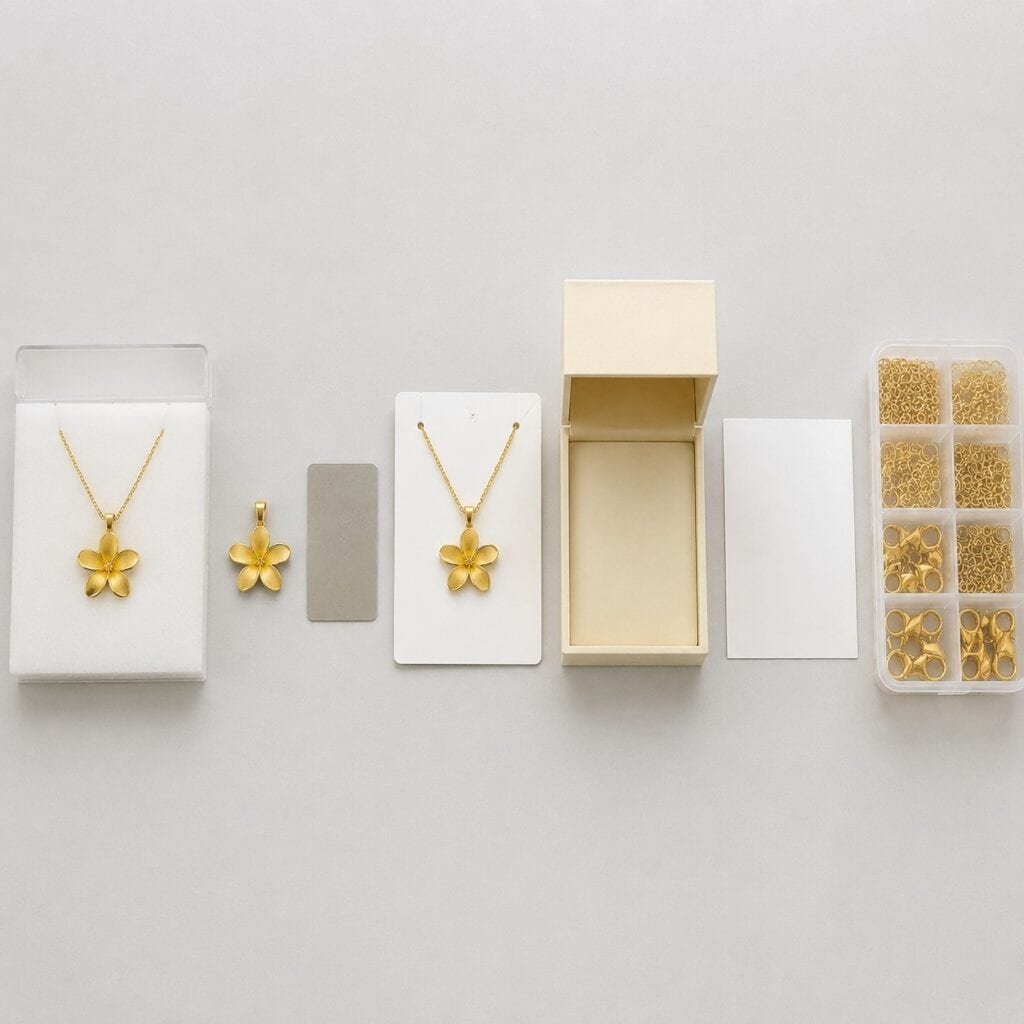
A tropical collection may share motifs across products, colors, destinations, and packaging versions. We link every finished SKU to its color reference, components, artwork, barcode, pack-out, and batch records. This prevents the wrong branded package or an obsolete version from entering shipment or replenishment.
Control the Retail Version Through Its Full Lifecycle
We manage these connections for released tropical jewelry programs.
- Color: Before bulk plating, we identify the physical color sample, plating specification, appearance surface, process sequence, and measurement method. Our six PVD machines support the released in-house route and plating-batch record.
- SKU: Product body, material, dimensions, color, size, personalization, components, logo, and set configuration map to the customer code.
- Pack-out: The packaging version controls card, pouch or box, insert, barcode, label, orientation, accessories, and unit quantity. Protection addresses scratches, pressure, bent posts, and tangled chains.
- Replenishment: We review the released drawing, BOM, production authority, color, components, packaging, relevant batch history, complaints, and approved changes.
- Changes: New materials, colors, chains, engravings, packaging, tests, or markets require review and do not inherit approval automatically.
- Traceability: Order, SKU, production, plating, inspection, packing, carton, and shipment records support investigation and repeat-order comparison.
Match Tropical Jewelry Risks to Tests and Evidence
We select tests from the product structure, material, finish, target market, and customer requirements. Not every test applies to every SKU. Contracts, released drawings, approved samples, quality agreements, and customer test standards take priority over Chicolink’s defaults. Samples used for destructive testing are not shipped as saleable goods.
| Tropical Jewelry Risk | Chicolink Control or Test | Internal Reference When Not Otherwise Specified | Evidence or Decision Required |
|---|---|---|---|
| Sharp floral or leaf edges | DFM, edge-radius review, visual and touch inspection | Critical defects include sharp burrs or safety hazards | Approved sample, defect standard, inspection record |
| Lost or distorted detail | Dimension, relief, engraving, surface and first-article inspection | General dimensions: ≤20 mm ±0.15 mm; 20–50 mm ±0.20 mm; >50 mm ±0.30 mm | Drawing, measurement points, actual readings |
| PVD shade variation | Approved color sample, visual comparison, color measurement where applicable | Smooth or mirror surface ΔE00≤1.5; brushed, sandblasted, or antique surface ΔE00≤2.0 | Color authority, measurement condition, batch record |
| Plating inconsistency | Confirmed layer requirement and thickness measurement | Batch average ±10%; single point ±20%; principal surface not below 80% of nominal thickness | Plating specification, measuring method, point locations |
| Enamel or resin failure | Fill-level, appearance, adhesion, rubbing, or project-specific checks | Method follows fill type, product, and approved test plan | Color sample, adhesion criteria, sample count |
| Loose charm or pendant | Pull test at the intended loading direction | Pendant ring, jump ring, or clasp: 40 N; necklace main structure: 30 N; hold 10 seconds | Fixture, loading direction, five samples per style unless otherwise agreed |
| Bracelet connection failure | Pull and function check | Bracelet main structure: 60 N; hold 10 seconds | Test record, post-test appearance and function |
| Ear-post detachment | Alignment, welding, surface, and pull check | Small decorative or ear-post connection: 30 N; hold 10 seconds | Five samples per style unless otherwise agreed |
| Corrosion or finish change | Salt-spray and artificial-perspiration testing where applicable | Bare steel 24 hours; PVD/plated product 48 hours; high-resistance request 72 hours or buyer standard | Standard, solution, sample condition, acceptance rule |
| Skin-contact finish change | Artificial perspiration | 40±2°C, 24 hours, pH 4.7±0.2; post-test color difference ≤2.0 | Formula, test method, pre/post photos, result |
| Nickel release | Specification review and third-party testing support | EN 1811 and EN 12472 where applicable, or the customer-specified method | Exact SKU, material, color, component, laboratory, report scope |
| Lead or cadmium | Specification review and third-party testing support | Applicable REACH, California Proposition 65, or customer-specified substance scope and method | Product scope, limit, method, sample count, laboratory, report scope |
| Bulk acceptance | Process QC, 100% inspection, or AQL sampling | Default: General Inspection Level II; Critical Ac 0/Re 1, Major AQL 1.0, Minor AQL 2.5 | Customer standard takes priority; sample size follows the approved AQL table |
Connect Chicolink Resources to Tropical Jewelry Production
Chicolink Jewelry was established in Dongguan in June 2012. Our tropical jewelry projects are managed through the same documented development, manufacturing, plating, quality, packaging, and export system used for approved stainless steel programs. Factory visits, customer audits, and authorized third-party inspection can be arranged in advance.
Design and Engineering
Six jewelry designers and three jewelry engineers support artwork review, collection planning, CAD, structure assessment, DFM, tooling decisions, sample revisions, and specification control. For tropical projects, this includes petal geometry, leaf cutouts, pattern repeats, engraving layouts, color zones, product scaling, and coordinated SKU development.
Manufacturing Scale
Chicolink operates in a factory of more than 5,500 square meters with over 400 employees and a recorded monthly capacity above 200,000 pieces. Actual project capacity and schedule depend on product complexity, active production load, materials, tooling, colors, packaging, tests, approvals, and required delivery dates.
Detail Production
Five CNC machines, three laser-cutting machines, three laser-marking machines, drilling, turning, stamping, casting, and related equipment support approved tropical structures. We select equipment from the actual geometry instead of assigning every flower, leaf, fruit, or pattern to one standard production route.
Joining and Finishing
Five laser-welding machines and eight polishing machines support layered structures, connection areas, assembly, surface preparation, edge refinement, and approved finishes. Weld position, heat effect, visible surfaces, polish allowance, recessed details, and skin-contact areas are reviewed before the process route is released.
In-House Plating
Six PVD vacuum-coating machines support approved gold, rose gold, black, and other confirmed finishes. Our in-house workshop links surface preparation, color-sample approval, process settings, inspection, applicable tests, exception handling, and plating-batch traceability. Each production lot follows its released color and process requirements.
Decoration Assembly
Chicolink supports approved stone setting, cold enamel or epoxy, resin filling, pearl or decorative-component assembly, chains, clasps, jump rings, ear posts, tags, and related operations. Every decorative material and attachment method is reviewed for geometry, compatibility, application access, curing, finishing, inspection, and packaging protection.
Process Quality Gates
IQC, IPQC, FQC, first-article review, plating inspection, functional checks, packaging inspection, AQL or agreed 100% inspection, and third-party inspection support can be connected to the project plan. Tropical-specific risks such as sharp petals, blocked cutouts, uneven filling, wrong orientation, and color mismatch are added to the SKU inspection points.
Production Coordination
PMC coordinates material, tooling, manufacturing, plating, decoration, assembly, packaging, testing, inspection, and shipment schedules. Project progress can cover sample status, production planning, in-house plating, packaging approval, third-party inspection, export documents, and logistics coordination according to the confirmed order. We report the applicable milestones for each project.
Tropical Jewelry Manufacturing FAQ
These answers cover common tropical jewelry development decisions. Chicolink confirms final feasibility, specifications, MOQ, price, samples, tests, packaging, and delivery from the design, market, quantities, released files, and project agreement.
What tropical motifs can Chicolink manufacture?
We can evaluate authorized floral, leaf, fruit, sunlight, shoreline, destination-name, coordinate, and continuous-pattern concepts. We confirm feasibility from the artwork, dimensions, structure, finish, quantity, packaging, and test requirements. We handle shell, marine-animal, and nautical projects under their dedicated development scopes.
Is this authentic Hawaiian jewelry?
Chicolink manufactures in Dongguan, China, so we do not claim that our products are made in Hawaii or are authentic Native Hawaiian jewelry. This page covers contemporary Hawaiian-inspired tropical stainless steel programs. Traditional-style names, scrolls, black recesses, or heirloom-inspired elements require separate artwork, cultural-positioning, process, and claim review.
Can you develop jewelry from our artwork?
Yes. We can evaluate vector artwork, drawings, CAD files, reference samples, images, or collection briefs. The customer confirms ownership or authorization for supplied trademarks, names, cultural symbols, and protected designs. Before production, we identify missing dimensions, engineering risks, tooling, sample needs, and required approvals.
Can one motif become a complete collection?
Yes. We adapt the motif to each product instead of scaling it mechanically. Chicolink can develop coordinated necklaces, earrings, rings, bracelets, bangles, anklets, charms, and sets with product-specific dimensions, weight, connections, finish, components, packaging, and inspection points.
Should we use 304 or 316L stainless steel?
We select the grade from the material form, structure, process, expected exposure, market, and customer requirements. 316L generally offers better pitting resistance, but it can make complex forming, cutting, welding, polishing, and correction more difficult. We record the approved grade for each applicable part.
What is the MOQ for custom tropical jewelry?
Our usual OEM/ODM reference is 500 pieces per style. Stock or regular styles commonly start at 120 pieces per style. We confirm the actual MOQ by style, color, size, plating lot, text version, component, and packaging version after project review.
How long does custom sampling take?
Custom OEM/ODM samples usually require 25–30 working days; existing-style samples usually require 3–7. We confirm the schedule after reviewing artwork, DFM, tooling, materials, finish, decoration, revisions, packaging, tests, sample quantity, and payment.
Can you control tropical collection colors?
Yes. Our in-house plating workshop has six PVD vacuum-coating machines. We link each released color sample to the plating specification, product surface, process controls, inspection, applicable tests, and batch records. New materials, textures, shapes, or colors require a new match review.
Can you provide private-label packaging?
Yes. We support product logos, jewelry cards, pouches, boxes, inserts, care cards, barcode and SKU labels, Amazon FBA packaging, branded sets, and export cartons. We confirm packaging artwork, materials, dimensions, MOQ, samples, protection, pack-out, label version, and timing separately from the jewelry.
Can buyers arrange testing or third-party inspection?
Yes. We coordinate applicable testing and customer-appointed or authorized third-party inspection. Before booking, we confirm the standard, agency, product and color scope, samples, fees, timing, AQL, defect list, report format, corrective action, and shipment-release authority. Customer standards take priority.