
Turkish Ottoman Tulip Jewelry Manufacturer
OEM and ODM development for stainless steel tulip collections, from approved cultural artwork and sampling to controlled bulk production.
- Chicolink manufactures Turkish and Ottoman-inspired tulip jewelry for brands, importers, distributors, and cultural gift programs.
- Our Dongguan factory supports artwork review, 2D/3D development, prototyping, stainless steel production, in-house PVD/IP coating, private-label packaging, quality inspection, and export delivery.
- Every project is developed around approved artwork, a defined technical specification, and an approved master sample. Cultural origin, design ownership, materials, finishes, testing, quantities, and delivery requirements are confirmed before bulk production.
- You receive one controlled route from project review through shipment and reorder support.
Turn Your Commercial Idea Into A Technical Brief
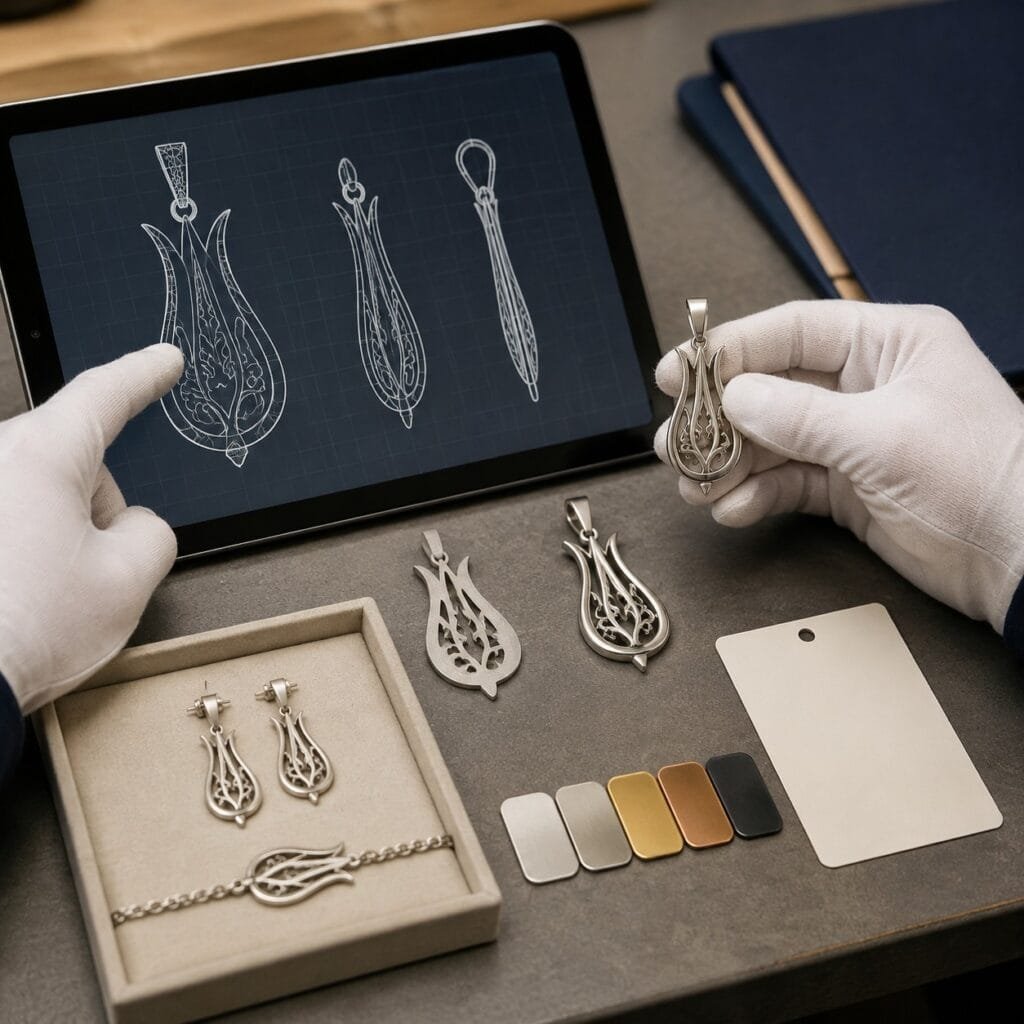
A useful development brief covers more than appearance. Chicolink reviews your market, sales channel, target customer, price position, quantity, launch date, product mix, and packaging plan together with the artwork. This information helps our designers and engineers develop a practical structure that fits your cost, schedule, and bulk-production needs. The result is a shared brief for quotation, sampling, and approval.
Information We Confirm Before Engineering Review
- Collection objective: Tell us whether the project is for a fashion brand, cultural gift program, importer, distributor, retail chain, ecommerce launch, seasonal collection, or replenishment line.
- Product architecture: List the planned pendants, necklaces, earrings, bracelets, rings, sets, colors, sizes, and estimated SKUs. This helps us decide whether one master proportion or several product-specific versions are needed.
- Commercial target: Provide quantity per style, target purchase cost or retail price, preferred material, packaging level, and launch date. Chicolink uses these inputs to assess tooling, process routes, PVD batches, and packaging.
- Market requirements: State the destination countries, wearing application, testing needs, labeling rules, barcodes, and any appointed inspection agency.
- Available design inputs: Upload authorized artwork, sketches, CAD, reference images, physical sample photos, color references, logos, and packaging guides. We use these files to understand your direction, not to reproduce protected third-party work.
With sufficient information, Chicolink targets an initial response within 6 hours for a regular inquiry. For a complex project, we target an initial assessment within 24 hours covering missing information, likely processes, major risks, and next steps. A formal quotation follows engineering and cost review.
Define The Ottoman Tulip Motif Before Production
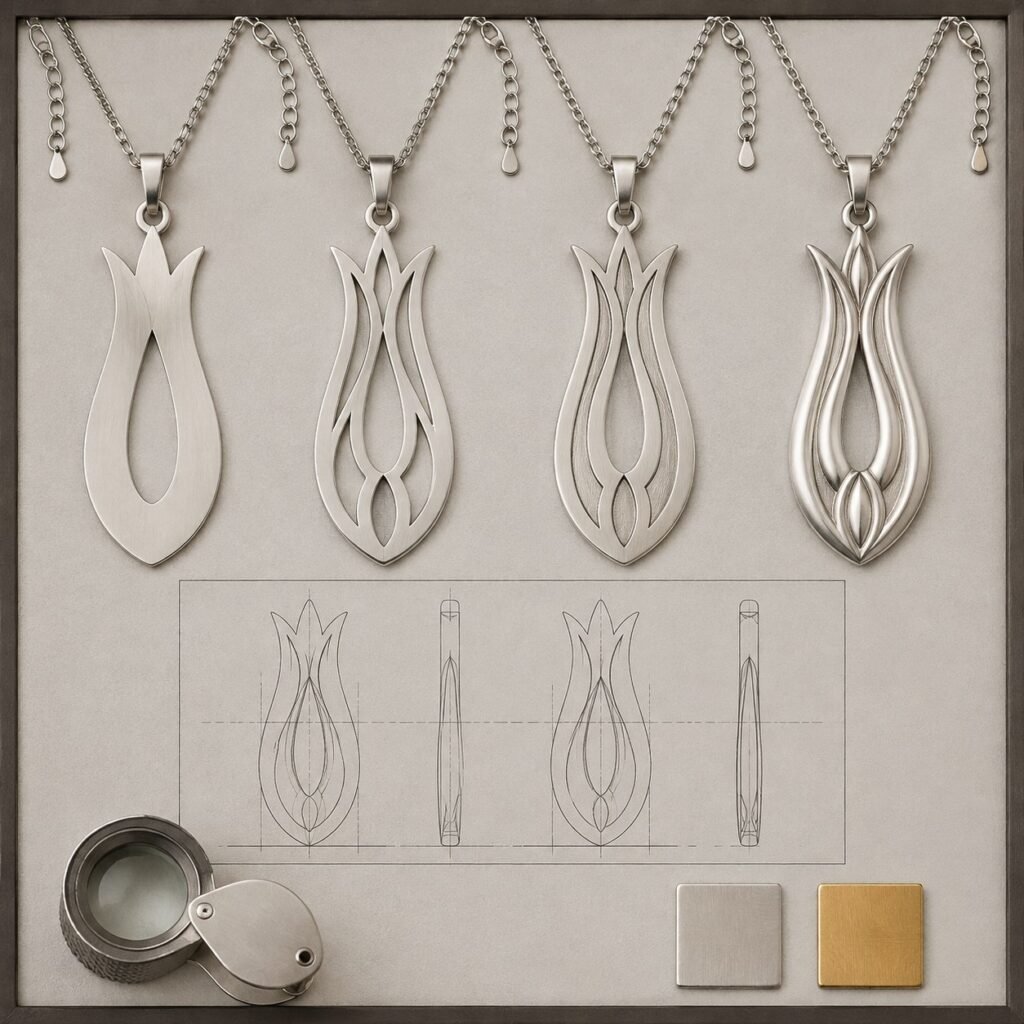
“Ottoman tulip” may describe different silhouettes, floral arrangements, line treatments, and decorative references. Chicolink does not authenticate historical designs. We convert your approved visual direction into a controlled jewelry specification so the motif remains consistent across samples, product categories, colors, packaging, and repeat orders. We define the artwork version, orientation, detail hierarchy, and authorization before sampling begins.
One Approved Motif, One Controlled Visual Language
- Source and authorization: You identify the motif source and confirm the right to use supplied artwork, museum elements, logos, typography, photographs, and brand assets. Protected third-party designs must be licensed, replaced, or redeveloped before production.
- Master outline: We confirm the petal count, centerline, symmetry, outer contour, stem or leaf treatment, positive and negative space, and whether the motif is geometric, flowing, minimal, relief-based, or color filled.
- Orientation rules: Pendant fronts and backs, left and right earrings, mirrored pairs, chain direction, logo direction, and packaging placement are documented. This prevents a correct motif from being assembled or displayed in the wrong direction.
- Detail hierarchy: Primary contours, secondary lines, engraving, recessed cells, openwork, stones, and color areas are separated. Features that are clear in a large illustration may need to be simplified for a small pendant or ring without losing the recognizable design language.
- Controlled versions: If the collection uses several sizes, Chicolink records each approved artwork and CAD revision rather than scaling one file blindly. Fine lines, gaps, corners, stone seats, and filling cells are reviewed again for every size and product structure.
The approved motif becomes part of the drawing, sample record, BOM, surface specification, and inspection criteria. Chicolink does not release unapproved artwork revisions for purchasing, production, coating, inspection, or packaging.
Build A Commercial Ottoman Tulip Jewelry Collection
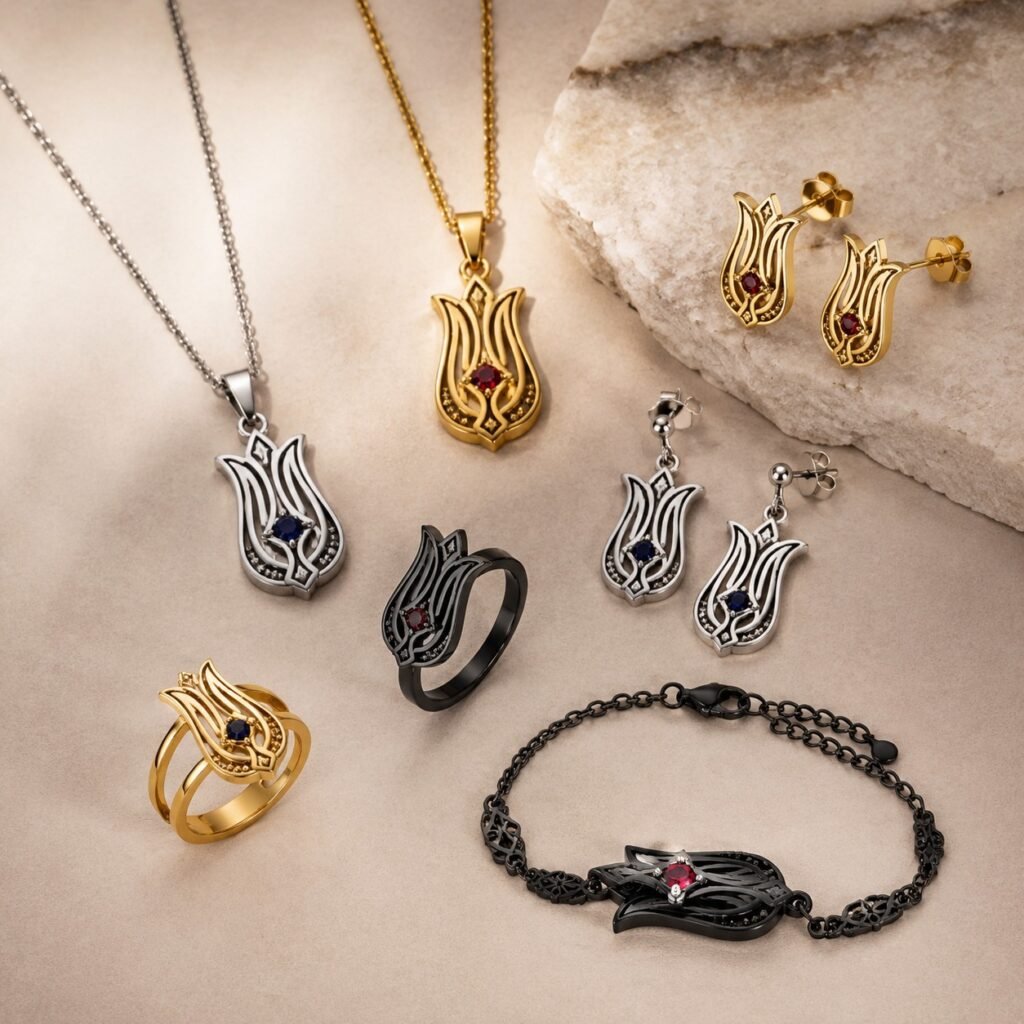
Chicolink develops one approved tulip motif into a coordinated product line. The collection plan defines each item's role, dimensions, weight, process, finish, price position, packaging, and quantity. Shared visual standards build recognition, while product-specific engineering keeps necklaces, earrings, rings, bracelets, and gift sets practical for their intended use. The same plan supports launch tiers and repeat orders, with a clear role for every SKU.
Signature Tulip Pendants
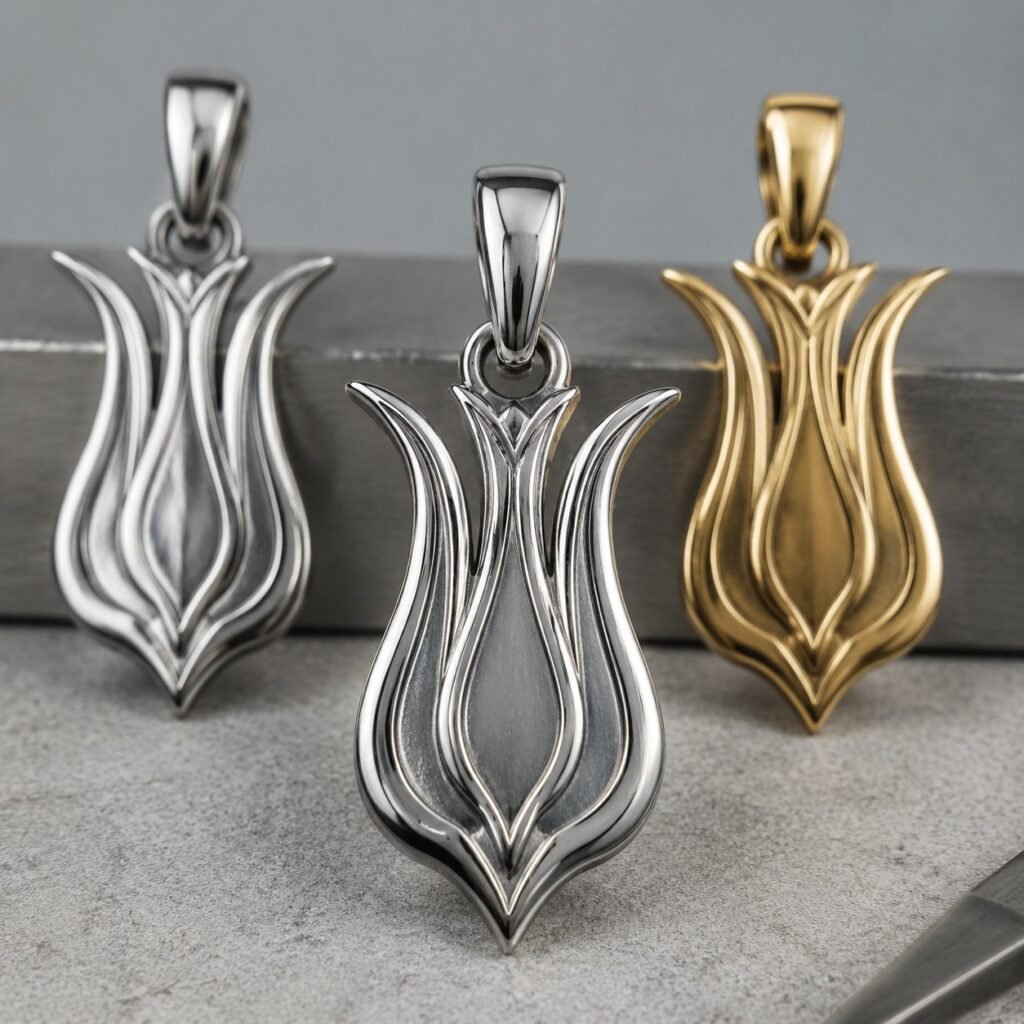
Use the fullest version of the approved motif as the collection anchor. Chicolink reviews pendant thickness, openwork, engraving or relief depth, bail geometry, chain clearance, center of gravity, front-and-back treatment, and the risk of flipping during wear. The signature pendant can establish the master PVD color, surface finish, filling color, logo position, and packaging direction for related products. It also provides the main photography reference for wholesale line reviews.
Commercial Tulip Necklaces
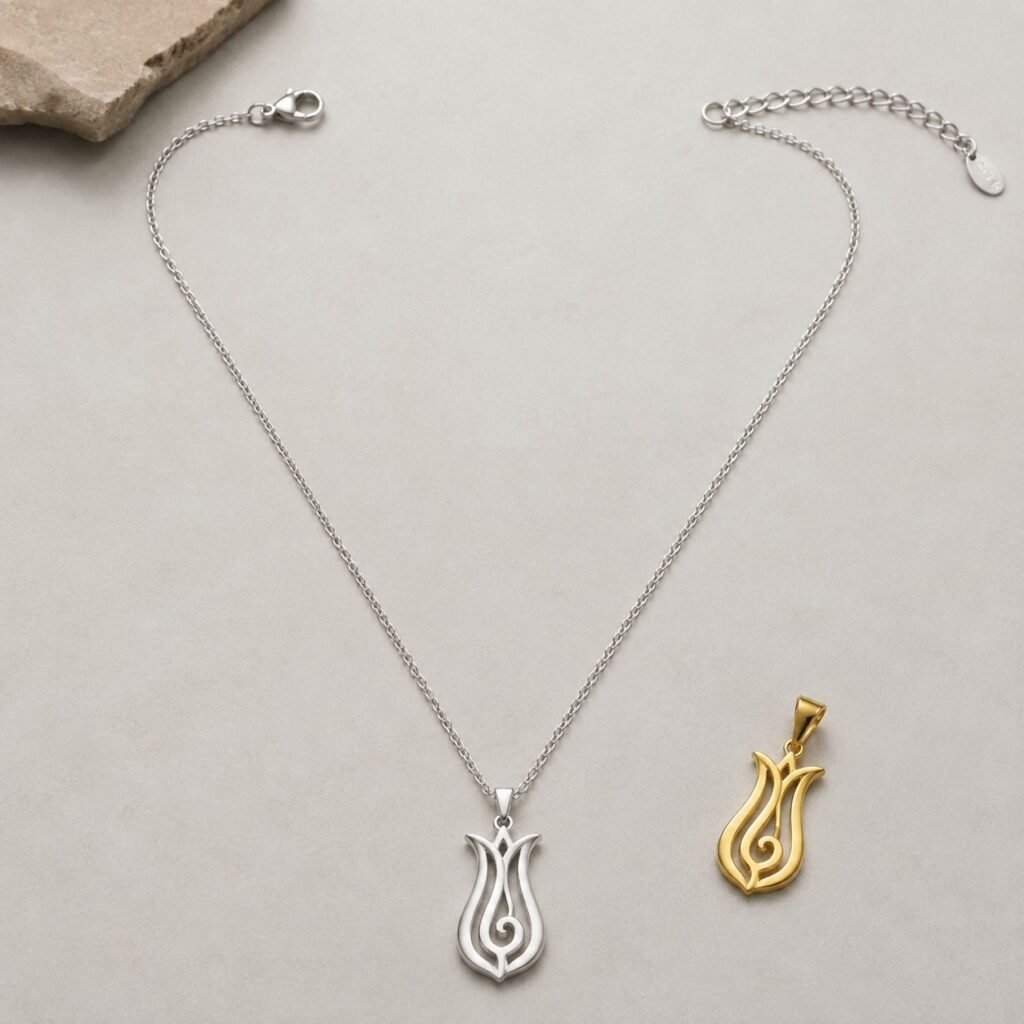
Convert the motif into an accessible necklace for wholesale, retail, or ecommerce channels. We confirm chain style, length, extension chain, clasp, end tag, pendant movement, total weight, and anti-tangle packaging. A necklace may use a simplified tulip outline to control cost and improve repeatability while retaining the collection's approved proportions, color language, and brand details. It can become a core replenishment item across several approved colors.
Mirrored Tulip Earrings
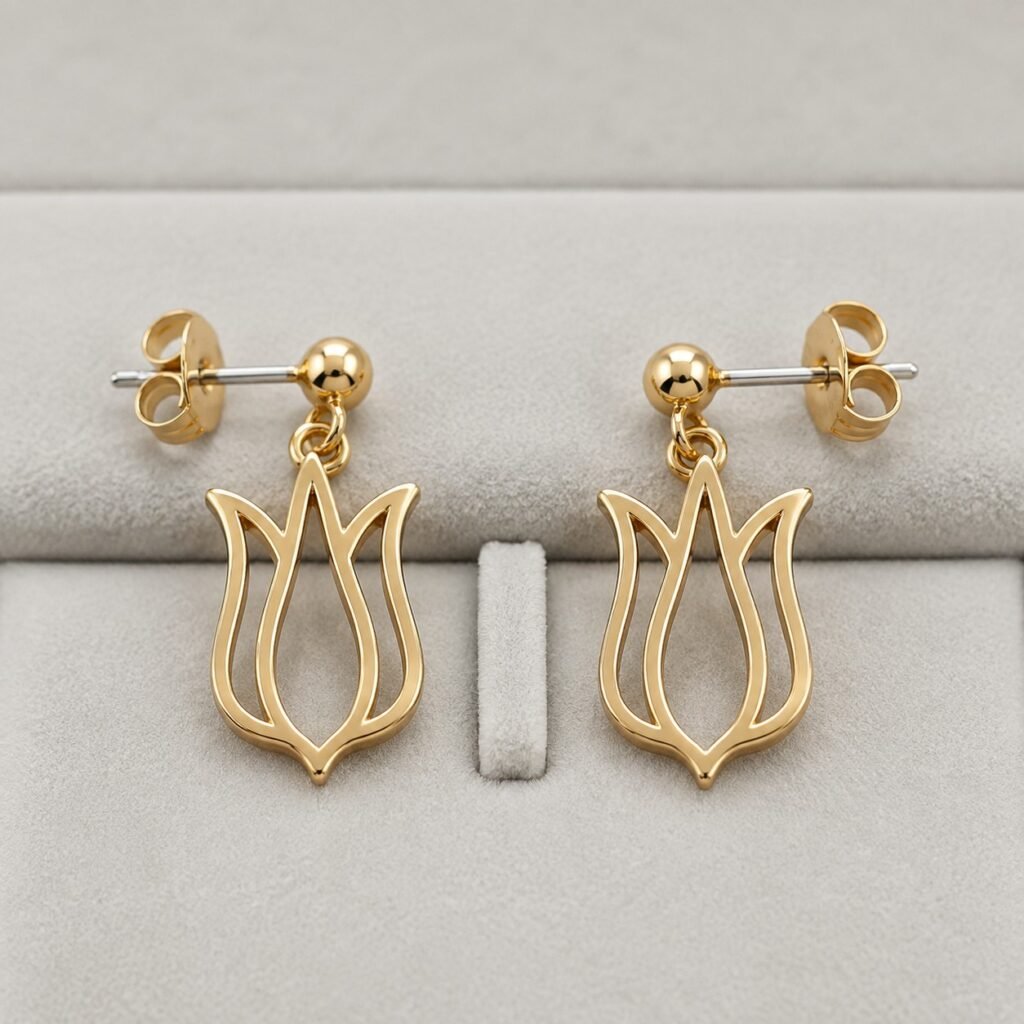
Tulip earrings require more than reducing the pendant size. Chicolink checks left-right orientation, pair matching, ear-post position, drop balance, total weight, edge smoothness, closure function, and packing protection. Fine openwork or color-filled cells may need adjustment at the smaller scale. The inspection specification records pairing, symmetry, color, surface quality, and assembly direction. Pair-level checks also support consistent retail presentation and returns control.
Tulip Rings And Bands
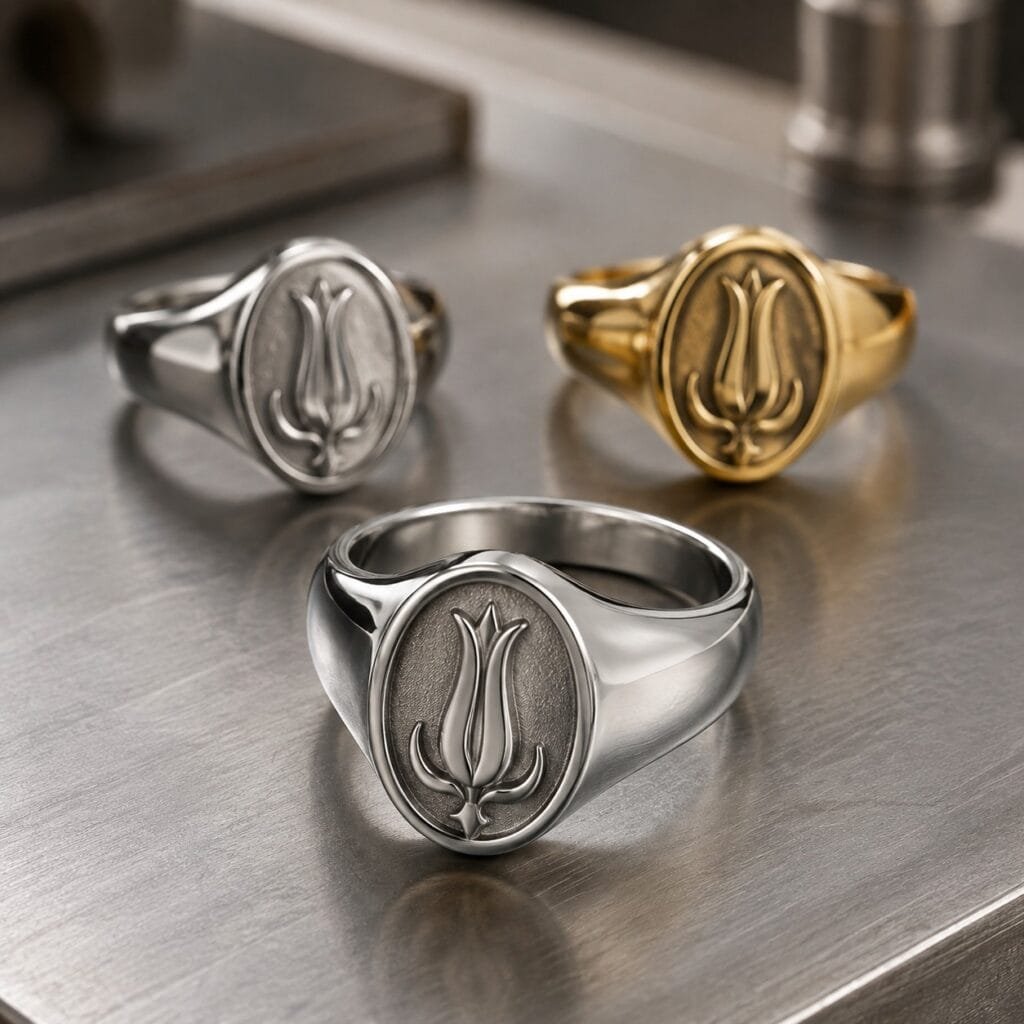
For rings, the tulip motif must work with curvature, ring size, finger comfort, polishing access, and structural strength. Chicolink evaluates whether the design is better suited to engraving, a raised centerpiece, openwork, a signet-style face, or a repeating pattern. The drawing records inner diameter, ring size system, motif orientation, critical dimensions, edge treatment, and approved finish. A dedicated size set may be needed when curvature changes the motif.
Tulip Bracelets And Charms
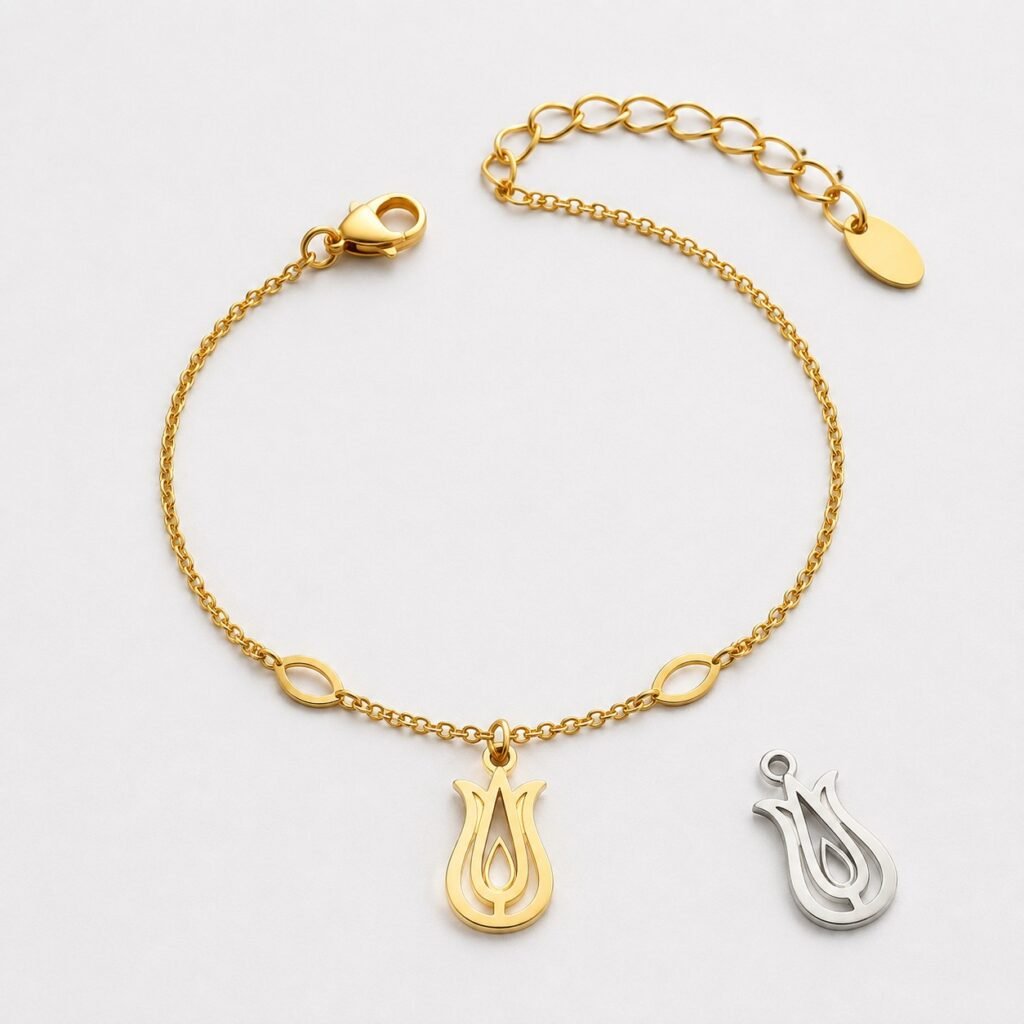
Bracelet development considers movement, link connection, charm rotation, clasp reliability, skin-contact surfaces, and resistance to tangling. The motif may be used as a central plate, repeated link, hanging charm, or engraved tag. Chicolink aligns the bracelet with the collection's necklace and earring standards while confirming length, extension range, connection strength, coating coverage, and packaging restraint. Connection components are specified separately to prevent unapproved substitutions.
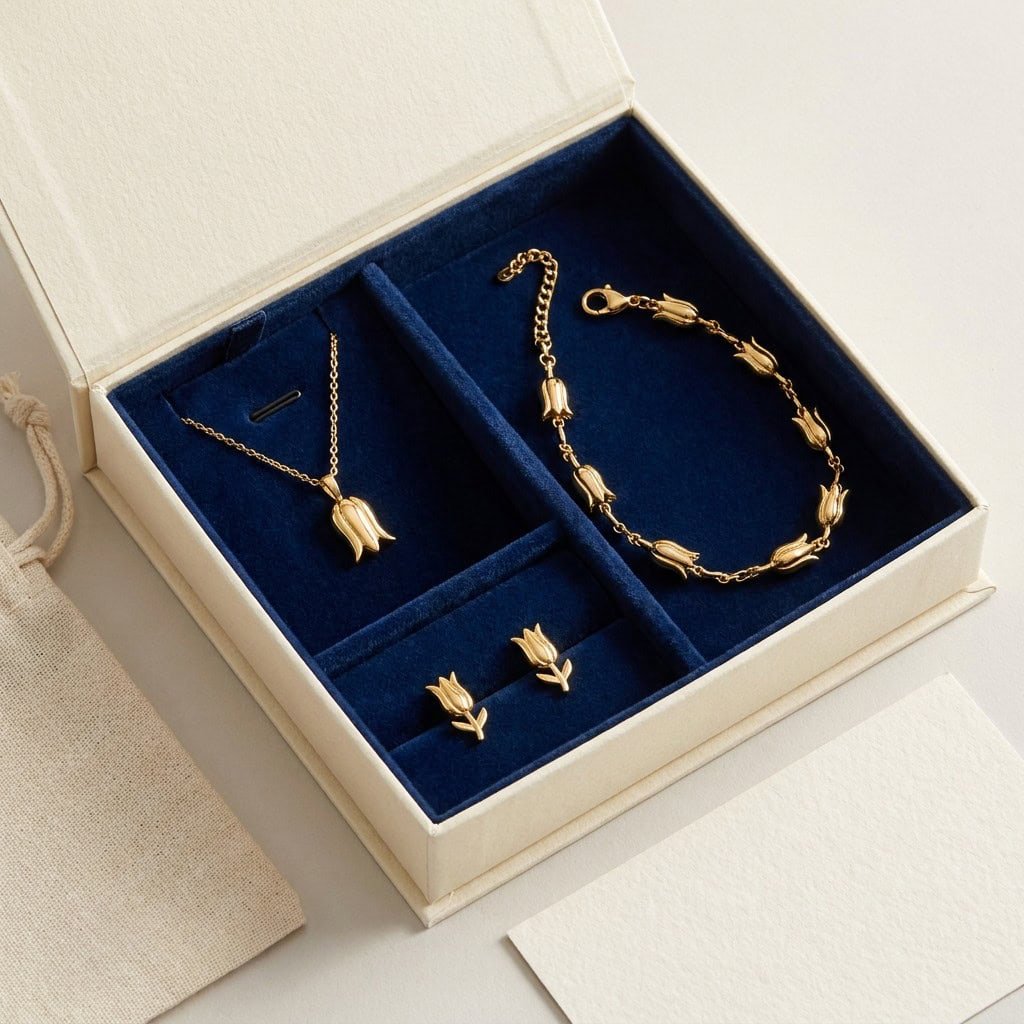
Tulip Gift Sets
Combine selected pieces into a coordinated gift or cultural retail set with a jewelry card, story card, pouch, gift box, barcode, SKU label, or distribution-ready packaging. Chicolink checks product orientation, protection from scratching, missing-part prevention, set composition, and labeling accuracy. Packaging claims and cultural descriptions remain subject to your approval and authorized brand content. Set-level QC verifies every component before the package enters its shipping carton.
Choose The Right Process For Each Tulip Detail
No single process suits every Ottoman tulip design. Chicolink selects the route after reviewing motif scale, relief, openings, color areas, volume, surface finish, quantity, tooling budget, and inspection needs. Use the table to compare process options before tooling or sampling. Final feasibility, dimensions, tolerances, process order, cost, and lead time are confirmed through drawing review and sample validation. This keeps visual ambition aligned with stable production.
| Desired Tulip Effect | Possible Chicolink Process | Best-Fit Application | Engineering Focus | Commercial Consideration |
|---|---|---|---|---|
| Fine lines, text, dates, or shallow decoration | Laser engraving | Flat pendants, tags, signet faces, backs, and private-label details | Line clarity, depth appearance, orientation, contrast, and readability after finishing | Low tooling dependence, but each product size and finish still requires confirmation |
| Recessed floral lines or cells | Etching | Graphic pendants, plaques, ring faces, and areas intended for color filling | Etch depth, edge definition, cleaning access, filling boundary, and compatibility with later finishing | Artwork preparation and process control affect cost and repeatability |
| Open tulip silhouette | Laser cutting or wire cutting | Flat pendants, earrings, charms, and bracelet plates | Minimum gaps, sharp corners, burr removal, distortion, hanging direction, and edge comfort | Suitable for flat structures; nesting, sheet thickness, finishing, and quantity influence cost |
| Repeated flat or formed shape | Stamping or pressing | Higher-volume pendants, charms, plates, and repeated components | Tooling, forming radius, edge condition, deformation, hole position, and dimensional repeatability | Tooling investment can support repeat volume when the design and quantity justify it |
| Raised or sculptural petals | Casting | Relief pendants, dimensional ring faces, sculptural charms, and decorative earrings | Metal flow, shrinkage, wall thickness, water-gate removal, polishing reach, and surface definition | Mold path, weight, yield, finishing labor, and order volume affect the quotation |
| Precise geometry or deeper relief | CNC machining | Premium components, prototypes, dies, selected relief parts, and controlled surfaces | Tool access, internal corners, machining marks, thickness, holding position, and polishing allowance | Machining time and material removal must match the target cost and volume |
| Colored petal cells | Cold enamel, epoxy resin, or confirmed color filling | Decorative pendants, earrings, charms, and gift collections | Material identification, color reference, cell depth, bubbles, overflow, shrinkage, curing, adhesion, and PVD compatibility | Color count, filling labor, reject risk, testing, and order quantity influence cost and timing |
| Gold, rose gold, black, gun metal, or other approved metal color | In-house PVD/IP or confirmed plating route | Coordinated series, premium finishes, and repeat color programs | Base material, polishing, coating structure, target thickness, color sample, coverage, hanging points, and test requirements | Coating batch, color quantity, durability target, testing, and packaging protection affect MOQ and price |
Factory Execution Context
Our 5,500+ square meter Dongguan factory has 400+ employees, 6 jewelry designers, 3 jewelry engineers, and 58 listed major machines, including CNC, casting, laser cutting, laser welding, stamping, polishing, and 6 PVD vacuum coating machines. Process allocation is confirmed for each project.
Lock Materials, Color And Surface Standards
We keep each Ottoman tulip collection coordinated across products and repeat orders — by defining material, surface, coating, and filling references from descriptions such as “antique gold,” “bright gold,” “soft matte,” or “deep red.” Production follows approved samples, specified viewing surfaces, coating requirements, filling references, and project-specific acceptance criteria. These records enable consistent color replenishment.
The same standard can be applied to different product sizes without relying on color names alone.
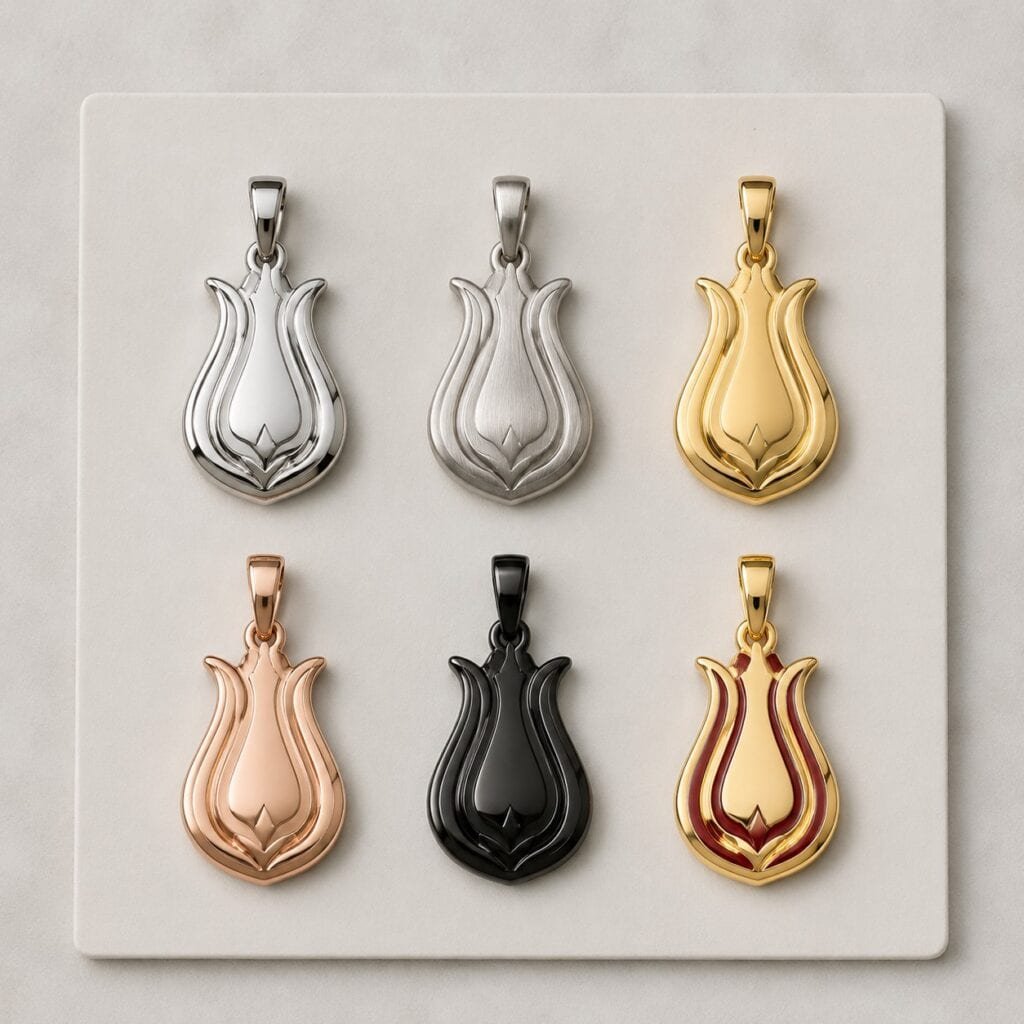
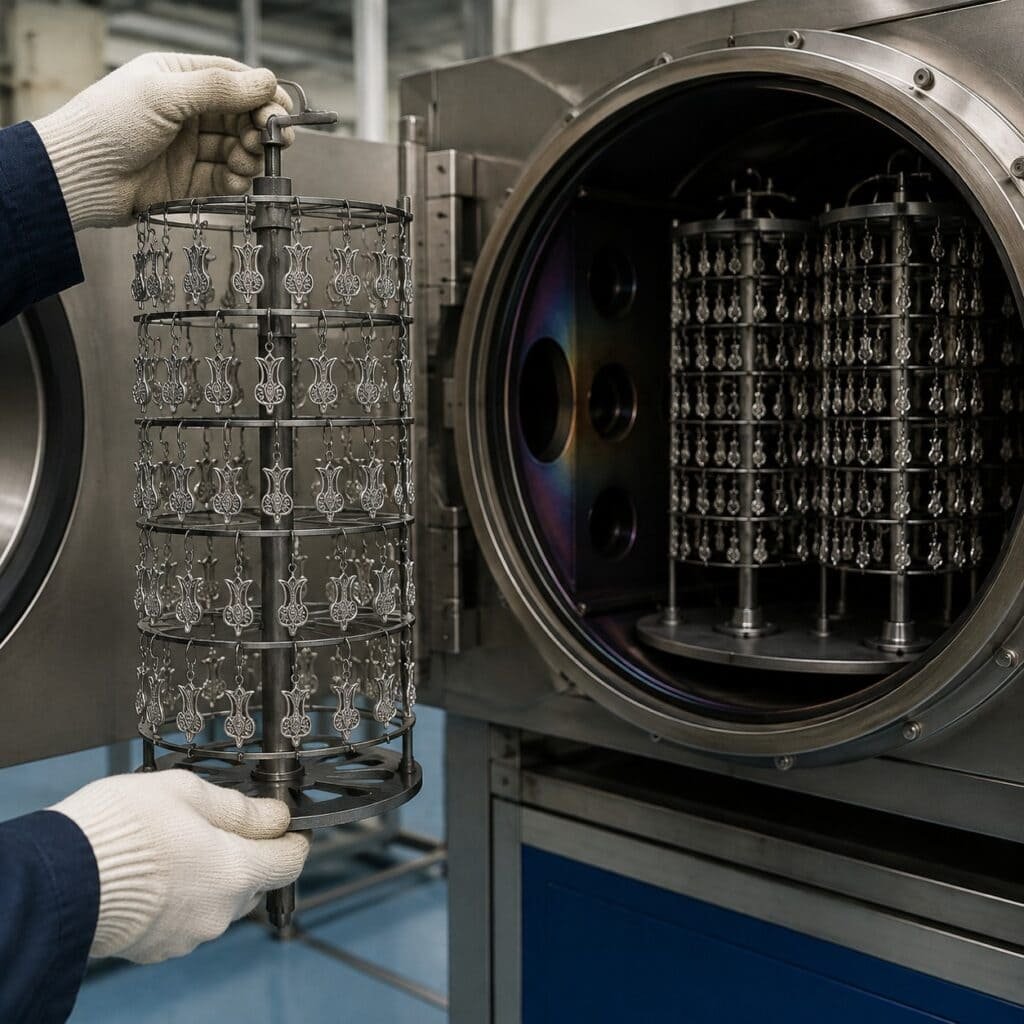
Build A Finish Standard That Bulk Production Can Follow
- Stainless steel grade: Chicolink evaluates 304 and 316L according to product structure, wearing environment, target market, machining requirements, price position, and your specifications. 316L is not automatically the best choice; the selected grade is recorded in the BOM and can be tested when required.
- Surface zones: The drawing can define primary A surfaces, secondary B surfaces, and less-visible C surfaces. Mirror polish, high polish, brushed, sandblasted, matte, satin, or mixed finishes are specified by area, direction, texture, and approved reference.
- In-house coating: Chicolink operates an in-house plating workshop with 6 PVD vacuum coating machines. Confirmed project colors may include gold, rose gold, black, gun metal, steel color, silver color, and other reviewed options. PVD/IP reference structures include E1 at 0.4 μm TiN plus 0.05 μm gold and E2 at 0.7 μm TiN plus 0.1 μm gold. The actual structure and thickness are selected and quoted by project.
- Color-filled details: Cold enamel, epoxy resin, paint, or another confirmed filling route is recorded separately from metal coating. Color code, material, cell location, filling height, gloss, curing, bubbles, overflow, shrinkage, adhesion, and compatibility with cleaning and PVD processes must be validated.
- Approval and inspection: The master sample, PVD color sample, filling reference, artwork version, surface specification, and packaging protection guide first-article and bulk inspection. Chicolink does not market any finish as permanently fade-proof.
Move From Prototype To Approved Master Sample
Sampling turns approved tulip artwork into a measurable product standard. Chicolink links the physical sample to its drawing, BOM, artwork, PVD color, filling reference, logo, packaging, test plan, and revision status. This gives both sides one clear approval reference before bulk production and reduces unpriced changes or approval disputes. The approved sample then controls first-article and bulk comparison.
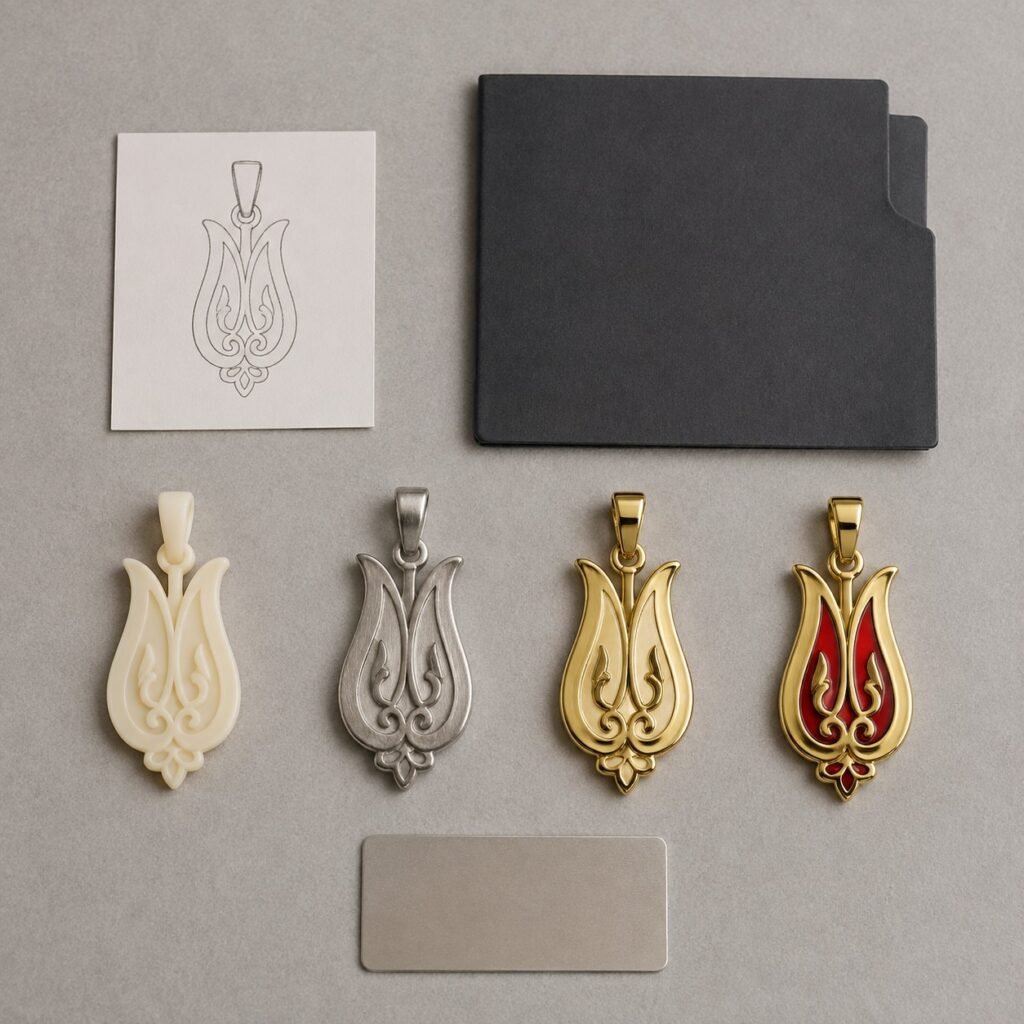
A Transparent Sampling And Approval Path
1. Requirement review: Chicolink confirms product type, dimensions, material, structure, motif version, process, finish, quantity, packaging, destination market, target delivery, and required tests.
2. Engineering and quotation: We assess manufacturability, process route, tooling, sample quantity, coating, filling, packaging, testing, and delivery. Sample fees usually apply. We identify mold, tooling, development, testing, and courier charges where applicable.
3. Drawing approval: You review the 2D/3D drawing, motif orientation, critical dimensions, surface zones, logo, assembly, and packaging before physical development.
4. Sample production: Existing-style samples normally require 3–7 working days. OEM/ODM custom samples normally require 25–30 working days. New tooling, complex structures, special coating, filling, stones, or packaging may require a different schedule.
5. Internal sample inspection: Chicolink checks the sample against the current drawing and specifications before sharing confirmation photographs or arranging shipment.
6. Structured feedback: Identify dimensions, motif clarity, color, surface, logo, weight, comfort, chain, clasp, filling, packaging, or other affected items. Marked photographs reduce ambiguity.
7. Revision control: Changes to artwork, CAD, BOM, color, logo, packaging, material, structure, tooling, or process receive an updated version record. Changes that affect cost, risk, or timing are reassessed; Chicolink does not promise a universal number of free revisions.
8. Master sample approval: The final approved sample and related documents become the bulk reference. Sample or mold fee credits depend on order value and written agreement; they are not automatic.
Control The Details Most Likely To Fail
Tulip jewelry quality depends on a small group of design-specific control points. Chicolink identifies them during drawing and sample review, then checks them at first article, in process, final, and packaging stages. Approved drawings and samples take priority over generic tolerances or subjective descriptions.
The control points focus on the details that most affect appearance, wearability, assembly, and customer returns.
Motif Detail Loss
Fine petals, narrow gaps, shallow lines, and small relief features may lose definition during casting, edge finishing, polishing, cleaning, or coating. Chicolink reviews feature scale and process allowance before sampling, then compares the approved motif, sample, and bulk pieces under consistent inspection conditions.
Sharp Edges And Burrs
Openwork tips, laser-cut edges, stamped holes, engraving transitions, and the inner surfaces of rings can create uncomfortable or unsafe edges. Chicolink includes edge condition, corner treatment, burr removal, skin-contact surfaces, and product-specific handling checks in the production and final-inspection requirements.
Filling Boundary Defects
Colored tulip cells may show bubbles, overflow, missing fill, shrinkage, uneven height, contamination, or poor adhesion. The approved sample records material, color, location, surface effect, and boundary expectation. Process compatibility and any required adhesion, wear, sweat, or cleaning test are confirmed by project.
PVD Coverage And Shade
Recessed petals, holes, edges, welds, contact points, and hanging positions may show coating shadows, color variation, or incomplete coverage. Chicolink's in-house plating workshop controls the approved coating specification, color-sample comparison, batch record, thickness checks, visible defects, and packaging protection required for the order.
Orientation And Pairing
Mirrored earrings, directional pendants, logos, chain connections, and story-card placement can be assembled incorrectly even when individual parts are acceptable. Drawings and work instructions identify the front, back, left, right, top, bottom, pair relationship, display direction, and approved packaging orientation.
Balance And Connection
A pendant may flip, a charm may rotate excessively, or a small bail may restrict chain movement. Chicolink evaluates center of gravity, bail clearance, hole position, jump rings, chain size, clasp function, welds, and connection strength during sampling and verifies the confirmed construction during bulk inspection.
Keep Bulk Orders And Reorders Consistent
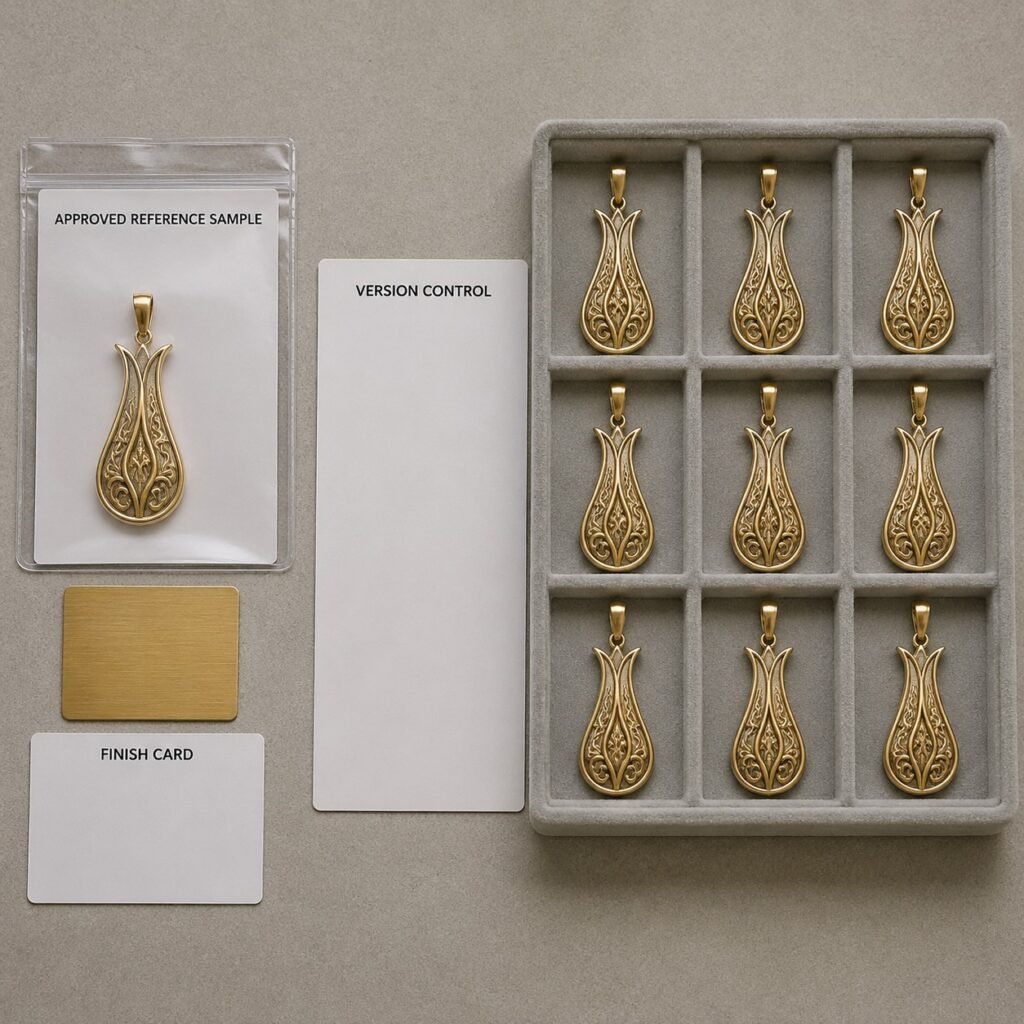
Large brands, importers, and distributors need a repeatable standard for the first bulk order and later replenishment. Chicolink links each approved Turkish Ottoman tulip design to its order, SKU, drawing, sample, material, process, PVD batch, inspection, packaging, and shipment records. This baseline supports deviation checks, corrective action, and controlled repeat orders. It also gives the next production run a documented starting point.
One Approved Baseline Across The Production Cycle
- Controlled release: Only the approved artwork, drawing, BOM, finish reference, master sample, logo, packaging, and inspection plan are released. Chicolink removes obsolete versions from purchasing, production, coating, inspection, and packaging.
- IQC and first article: Incoming steel, components, stones, filling materials, and packaging are checked against project requirements. The first piece verifies dimensions, motif direction, surface, PVD shade, filling, logo, assembly, and packaging before the batch continues.
- IPQC: Chicolink inspects relevant semi-finished stages such as cutting, stamping, casting, drilling, welding, polishing, coating, filling, setting, assembly, and packing. Finding motif or structural defects before later processes reduces batch-level rework.
- FQC and packing checks: Finished products are checked for appearance, color, dimensions, function, surface defects, components, logo, cleanliness, labels, SKU accuracy, set completeness, and packaging protection.
- Inspection level: Chicolink can perform 100% inspection or an agreed AQL inspection. Unless specified in writing, the internal default is normal inspection, general level II, with Critical Ac 0/Re 1, Major AQL 1.0, and Minor AQL 2.5. Your written inspection plan takes priority.
- Traceability: Records can connect the order and SKU to material lot, production work order, tooling, key processes, in-house plating equipment and batch, IQC/IPQC/FQC results, nonconforming-product disposition, packaging batch, carton number, and shipment information.
Chicolink operates a 5,500+ square meter factory with 400+ employees and a stated monthly capacity of more than 200,000 pieces. Capacity allocation, inspection level, delivery schedule, and reorder color control are confirmed for the actual SKU mix and order plan.
Match Testing To Your Target Jewelry Market
Testing depends on the destination market, product type, skin-contact area, materials, coating, color, customer specification, and sales channel. Chicolink coordinates internal checks and confirmed laboratory or inspection services. Each report applies only to its stated samples, materials, colors, coating structure, standard version, date, and test conditions. Early planning helps prevent late testing or documentation changes and keeps the launch file complete.
| Test Or Control | Project Trigger | Chicolink Project Approach | Reference Condition Or Cost |
|---|---|---|---|
| Material confirmation | Steel grade or mixed components affect market, quality, or contract requirements | Record each relevant material in the BOM and arrange material analysis when required | Method, sample quantity, laboratory, cost, and acceptance criteria confirmed by order |
| Nickel release | EU products, direct skin-contact items, or quality agreements | Coordinate EN 1811, EN 12472, or another confirmed standard through SGS, HKPC, or an appointed laboratory | Reference cost: SGS about USD 500 per color; HKPC about USD 120 per color |
| Lead and cadmium | EU, US, retail-chain, youth, or customer-specific restricted-substance programs | Confirm base metal, components, stones, coating, color, SKU, and applicable market requirement before testing | Laboratory, standard, samples, report scope, cost, and timing confirmed before submission |
| REACH-related support | European-market orders when applicable to the product and substances | Review the requested substance scope and verify the legal name, sample, material, color, coating, standard, issuer, date, and validity | Support is product- and market-specific, not a blanket compliance statement |
| Artificial sweat | PVD colors, skin-contact products, or project durability comparisons | Confirm formula, sample condition, contact method, observation, color change, and acceptance criteria | Internal default reference: 40±2°C for 24 hours at pH 4.7±0.2; about USD 100 |
| Salt spray | Corrosion-performance evaluation for bare steel, PVD, plated, or higher-requirement projects | Confirm standard, solution, pH, temperature, sample position, duration, post-test review, and acceptance criteria | Internal reference: bare steel 24 hours, PVD/plated 48 hours, higher requirement 72 hours; about USD 2/hour |
| Abrasion or wear | Coated or decorated products where your project specifies a wear method | Confirm test equipment, load, contact material, cycles, test area, and pass/fail criteria | Reference cost about USD 120; final arrangement confirmed by project |
| Pre-shipment inspection | Orders requiring independent verification | Coordinate SGS, HKPC, or an appointed inspection party for agreed product, packaging, quantity, and document checks | Agency, scope, inspection level, timing, travel, reinspection, and cost confirmed in advance |
Policy Notes
Chicolink may support REACH, California Proposition 65, EN 1811, EN 12472, lead-free, cadmium-free, nickel-related testing, ISO 9001 documentation, BSCI audit information, and other confirmed requirements. We verify every certificate or report for scope and validity before order use. CE and RoHS are considered only when legally applicable; ordinary non-electronic jewelry is not automatically described as meeting those schemes.
Confirm The Commercial Framework Before Sampling
Commercial clarity prevents problems with quantity, budget, color batches, packaging, testing, or launch timing. Chicolink reviews each Ottoman tulip collection by style, color, size, coating batch, package version, and production route. The figures below are common references, not unconditional offers. Final terms appear in the quotation, approved specifications, purchase order, quality agreement, and contract. Use them to prepare a complete project inquiry.
| Commercial Item | Chicolink Reference | What Must Be Confirmed |
|---|---|---|
| OEM/ODM MOQ | Commonly 500 pieces per style | Confirm style, size mix, color, PVD batch, material, stones, tooling, packaging, production difficulty, and mixed-size or color rules |
| Existing or regular styles | Common MOQ 120 pieces per style | Confirm SKU, stock, color, packaging, and shipment timing; this reference does not automatically apply to a new tulip design |
| Custom bulk lead time | Normally 25–45 working days after approvals and order conditions are met | Confirm SKU count, quantity, material, tooling, PVD, filling, stones, packaging, testing, inspection, payment, and schedule |
| Quotation response | Initial response targeted within 6 hours for regular inquiries; initial assessment within 24 hours for complex projects | Send complete files, dimensions, quantity, material, process, color, packaging, market, testing, trade term, and destination |
| Cost structure | Normally quoted per piece for stainless steel jewelry | Weight, steel grade, process route, tooling, surface finish, PVD structure, stones, filling, logo, packaging, tests, spare parts, inspection, and quantity |
| Quantity tolerance | A common reference is approximately ±5% for custom orders | Treatment of overage or shortage, tail quantity, invoicing, additional freight, and ownership must be agreed in writing |
| Packaging | OPP bag, anti-scratch separation, jewelry card, pouch, gift box, logo box, care card, barcode, SKU label, FBA support, and set packaging may be evaluated | Confirm package MOQ, dimensions, materials, protection, orientation, artwork, barcode files, carton packing, cost, and lead time |
| Payment | T/T or bank transfer, L/C, and PayPal may be supported | Reference terms are 50% deposit and 50% before shipment; final ratio, method, and credit terms depend on customer, order value, and contract |
| Trade terms | EXW, FOB, CIF, DAP, and DDP may be supported | Destination country and postcode, tax handling, insurance, customs responsibility, shipment mode, carton data, and requested arrival date |
| Logistics | DHL, FedEx, UPS, air freight, sea freight, offline forwarder, or online logistics platform | Carton quantity, dimensions, gross and net weight, declared information, destination, trade term, insurance, and expected delivery time |
Commercial Reference
For an initial review, send the approved motif or reference direction, product types, quantity per style, sizes, material preference, PVD or filling colors, target market, package level, required tests, target delivery, destination, and available CAD, artwork, or sample photographs.
Turkish Ottoman Tulip Jewelry FAQ
Use this FAQ to confirm the main decisions before developing a custom tulip collection with Chicolink. Final feasibility, pricing, schedules, tests, and acceptance criteria depend on the approved artwork, product structure, material, finish, quantity, packaging, destination market, and written requirements. The answers are project guidance; confirmed terms appear in your quotation and approval documents.
Is Chicolink a jewelry manufacturer in Turkey?
No. Chicolink Jewelry is a stainless steel jewelry manufacturer located in Dongguan, China. We develop and manufacture Turkish and Ottoman-inspired tulip jewelry for global B2B brands, importers, and distributors. You define and approve the cultural direction, artwork, story, and authorization. Chicolink provides engineering review, sampling, production, in-house PVD/IP coating, inspection, packaging, and export support.
Can you develop jewelry from my tulip artwork?
Yes, subject to design authorization and engineering review. Send the artwork, sketch, CAD file, reference image, or sample photographs together with dimensions, product type, quantity, material, color, packaging, market, and target date. We assess motif scale, structure, production route, finish, tooling, cost factors, sample plan, and bulk risks before issuing the formal quotation.
Do you certify an Ottoman design as authentic?
No. Chicolink does not provide historical or cultural authentication. You approve the cultural interpretation, source information, story, and legal right to use supplied artwork. We translate the approved motif into controlled drawings, samples, specifications, production steps, and inspection points without presenting the design as historically certified.
Which process preserves fine tulip details best?
The correct process depends on feature size, relief, openings, material thickness, surface finish, quantity, and budget. Laser engraving suits shallow lines; etching can create recessed details; laser cutting or stamping suits flat silhouettes; casting or CNC can create relief; confirmed filling processes add color. Chicolink selects the route through drawing review and sample validation rather than applying one process to every design.
Should I choose 304 or 316L stainless steel?
Chicolink evaluates 304 and 316L according to the target market, wearing environment, structure, machining difficulty, finish, testing plan, price position, and customer specification. 316L offers different corrosion characteristics but is not automatically the best choice for every complex design. The selected grade and all relevant component materials are recorded in the BOM and can be tested when agreed.
How long does a custom sample take?
An OEM/ODM custom sample normally requires 25–30 working days. An existing-style sample normally requires 3–7 working days. New molds, complex relief, multiple colors, special PVD, stones, filling, packaging samples, tests, or design revisions may change the schedule. Chicolink confirms the sample plan after reviewing complete files and requirements.
Are sample and mold fees refundable?
Sample fees normally apply, and a project may also require mold, tooling, development, testing, packaging, or courier charges. Whether sample or mold fees can be credited against a later bulk order depends on the order value and a written agreement. Chicolink does not apply an automatic refund or credit policy to every project.
What is the MOQ for a custom collection?
The common Chicolink OEM/ODM MOQ is 500 pieces per style. Final MOQ depends on style, size, color, steel grade, tooling, PVD batch, stones, filling, packaging, and production difficulty. The quotation also states whether quantities are counted by style, color, size, coating batch, or package version and whether mixed options are permitted.
How do you keep PVD colors consistent?
Chicolink operates an in-house plating workshop with 6 PVD vacuum coating machines. The project records the base material, polish, coating route, approved color sample, target structure or thickness, visible surfaces, tolerance, test requirements, and packaging protection. First articles and bulk batches are compared against the approved reference, with coating batch and inspection records retained for traceability and reorder review.
Can you support EU and US testing?
Chicolink can support confirmed nickel release, lead, cadmium, REACH-related, salt-spray, artificial-sweat, and other project-specific testing through internal controls or approved third parties such as SGS, HKPC, or a buyer-appointed laboratory. Requirements, standard version, samples, color, coating, cost, timing, and report scope must be confirmed for the actual product and target market.